
Baluchistan States Union
Short-lived federation of four princely states in southwest Pakistan (1952–1955) that brought Kalat, Kharan, Las Bela and Makran into a unified administrative arrangement before the One Unit merger.
The Baluchistan States Union was an administrative federation in what is today southwestern Pakistan that existed from 3 October 1952 until 14 October 1955. It brought together four former princely states under a single, limited federal framework while leaving many traditional authorities in place. The Union covered roughly the western portion of the modern province of Balochistan and had its capital at the town of Kalat. It coexisted alongside a separate Chief Commissioner's Province to the north and east.
Image gallery
3 Images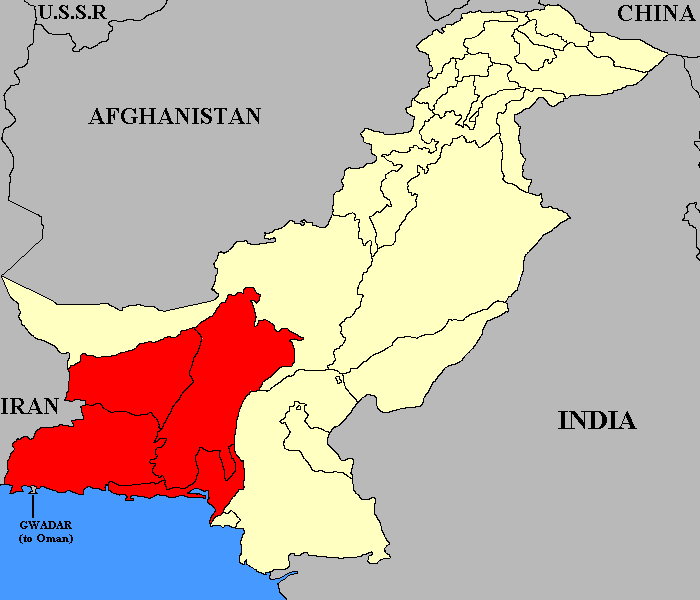


Constituent states and territory
The Union comprised four states ruled by local dynasts: the Khanate of Kalat (the largest), and the smaller states of Kharan, Las Bela and Makran. These entities retained their rulers and considerable internal autonomy, but accepted a limited shared administration for certain common responsibilities. Notably, the port town of Gwadar lay outside the Union; at the time it was under Omani control and was not part of the federation. The Union’s territory lay largely to the southwest of the older Chief Commissioner's Province and represented the western half of the region now known as southwest Pakistan.
Organization and powers
The Baluchistan States Union was governed through a Council of Rulers in which the four monarchs met to decide shared matters. Day-to-day administration within each state continued under existing local institutions and the rulers retained symbolic and real powers over internal affairs. The Union arrangement covered coordination on issues such as inter-state communication, certain judicial and fiscal questions, and representation to the central government. It was therefore a hybrid form — neither a fully integrated province nor a loose confederation — created to manage the transition from the colonial princely system into the Pakistani polity.
Origins, development and dissolution
The Union was created after the partition of British India, during a period when Pakistan was reorganizing the many princely states that fell within its borders. It was intended to provide a common framework for the four rulers while preserving their status and local administration. The arrangement lasted only until the central government pursued a wider administrative reorganization: the One Unit policy of 1955 aimed to merge all western provinces and states into a single entity called West Pakistan. On 14 October 1955 the Baluchistan States Union was dissolved and its constituent territories were absorbed into that larger unitary province.
Legacy and significance
Though brief, the Baluchistan States Union illustrates the complexities of integrating princely states after decolonization. It preserved local authority for a transitional period but also paved the way for later provincial consolidation. The absence of Gwadar from the Union is often noted as an example of the region’s fragmented sovereignty in the 1950s; Gwadar itself remained under Omani rule until it became part of Pakistan later in the decade. The dissolution of the Union and subsequent administrative changes contributed to political developments in the region and influenced how the modern province of Balochistan took shape in later reorganization efforts.
Notable distinctions
- The Baluchistan States Union preserved monarchical rule within a single collaborative council rather than replacing local governments with direct provincial administration.
- It coexisted with the separate Chief Commissioner's Province of Baluchistan, which contained areas to the north and east and included the regional headquarters at Quetta.
- The Union’s short life (1952–1955) ended under the One Unit policy, a major centralizing step in Pakistan’s early constitutional history.
For readers seeking further details about the constituent states, their rulers, and the administrative arrangements of the early Pakistani period, consult specialized histories of Balochistan and primary documents from the 1950s era which discuss accession, federal relations, and the One Unit reorganization. Online and archival resources may provide maps, treaties and government records relating to the Union and its integration into the Pakistani state.
Related articles
Author
AlegsaOnline.com Baluchistan States Union Leandro Alegsa
URL: https://en.alegsaonline.com/art/8620