
Belarusian Democratic Republic (Belarusian People's Republic)
A short-lived Belarusian state proclaimed in 1918 amid World War I and the Russian Revolution; later overrun by Soviet forces. Its government-in-exile preserved a national claim and symbols.
Overview
The Belarusian Democratic Republic (also called the Belarusian People's Republic, BNR) was a self-declared independent Belarusian state proclaimed in 1918 during the upheavals of World War I and the Russian Revolution. It represented one of the first modern attempts to create an independent Belarusian polity and to assert a distinct national language, symbols and institutions. The BNR gained limited recognition from some states but did not receive broad international acceptance and was soon displaced by Soviet power.
Image gallery
10 Images




Origins and historical context
The BNR emerged in a context of collapsing imperial authority, German occupation of parts of the former Russian Empire, and political mobilization by Belarusian activists seeking cultural and political self-determination. Its proclamation followed a period in which competing forces—occupying Central Powers, Bolshevik authorities and local national movements—vied for control of territory and administration. The circumstances that helped produce the BNR were shaped by wartime occupation and the general political dislocation of 1917–1918.
Although the new Belarusian council invited international contacts and received recognition from a small number of governments, it did not secure widespread diplomatic acceptance. It was distinct from the emerging communist regimes of the period; contemporary and later references often contrasted the BNR with the various Soviet or pro-Bolshevik entities such as the Communist People's Republics (see related item).
Government, symbols and aims
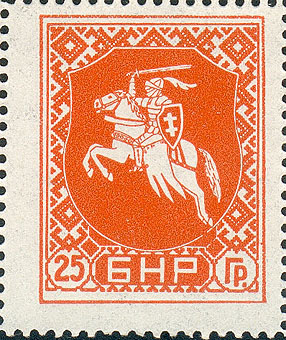
The BNR organized a national council intended to act as a provisional government, sought to develop administration in Belarusian language and promoted national culture. Key symbols associated with the republic were the white-red-white tricolor flag and the historical Pahonia (the mounted knight) coat of arms—both later reappeared in 20th- and 21st-century Belarusian political life. The republic aimed to establish sovereignty, promote Belarusian education and print, and represent Belarusian interests in international discussions.
Fall, exile and continued claims
The advance of Bolshevik forces and the establishment of Soviet-controlled Belarusian institutions led to the collapse of effective BNR authority on Belarusian territory. The Belorussian Soviet Socialist Republic was formed in the wake of these events (1919) and later became one of the constituent republics of the Soviet Union. Leaders and members of the BNR escape or relocated abroad and formed a government-in-exile that continued to claim continuity with the 1918 republic. That exiled body—often referred to as the Rada of the BNR—maintained a symbolic role and preserved the claim to Belarusian independence (government-in-exile).
Legacy and significance
Though short-lived, the Belarusian Democratic Republic left an enduring legacy in Belarusian national memory: its date of proclamation is commemorated by many in the Belarusian diaspora and opposition movements, its symbols returned to public use after the collapse of the Soviet Union, and its experience is cited in debates over modern Belarusian statehood. Historians consider the BNR a formative episode in the development of Belarusian political identity, despite its limited territorial control and international recognition. For broader context on the international actors involved during that era, see contemporary references to the Central Powers (related states).
Related articles
Author
AlegsaOnline.com Belarusian Democratic Republic (Belarusian People's Republic) Leandro Alegsa
URL: https://en.alegsaonline.com/art/10195