
Saint Denis — early bishop, martyr, and patron saint of France
Saint Denis, traditionally the first bishop of Paris and patron saint of France, is remembered for his martyrdom, the cephalophore legend, and the Basilica of Saint-Denis as a royal necropolis.
Overview
Saint Denis is venerated as the patron saint of France and as the first bishop associated with the Christian community of Paris. Tradition links him to the missionary activity that brought Christianity to the Paris region during the late third century. His life and death have been shaped by a mixture of historical notice and later legend, which together created a powerful cult and a lasting place in French religious and cultural memory. Patron saint and France are terms often paired in accounts of his significance.
Image gallery
7 Images



Life and martyrdom
Early sources and medieval hagiography present Denis as a missionary-bishop who arrived in the Paris area in the middle of the third century, with traditional dates placing his arrival between 250 and 270. He is said to have been arrested during a period of persecution and executed for refusing to renounce his faith. Later accounts fix his martyrdom in the early 270s, often giving the year 272. He is commonly referred to as the first bishop associated with the city of Paris.
Legend and iconography
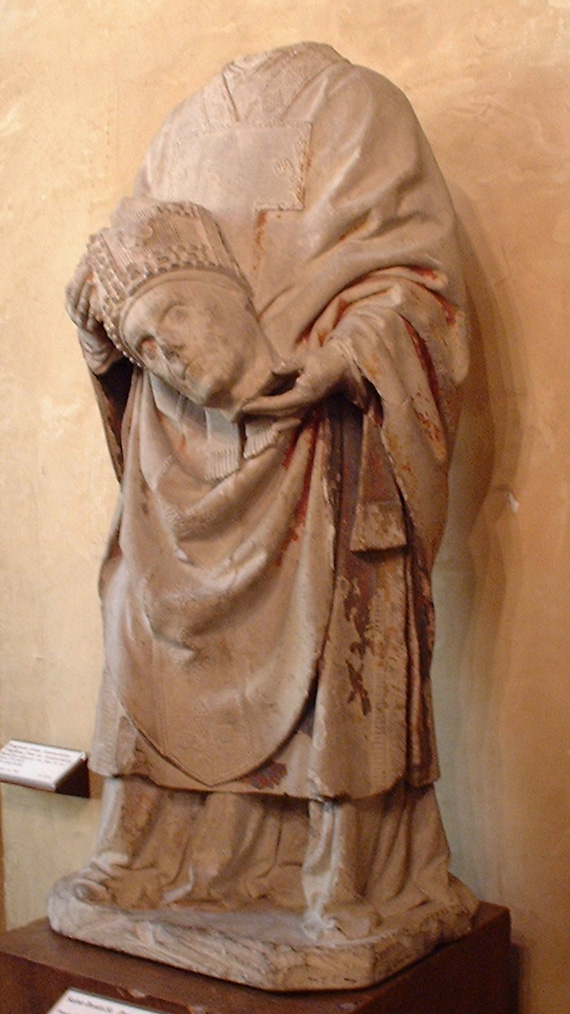
The best-known miracle associated with Saint Denis is the cephalophore episode: after being beheaded, he is said to have picked up his head and walked a considerable distance while preaching repentance. That route is traditionally remembered along the Rue des Martyrs, and accounts often note that he walked about 6 km (roughly 3.7 mi) before collapsing. This striking image—Denis carrying his own head—became a common motif in medieval art and a distinctive emblem in depictions of the saint.
Basilica of Saint-Denis and the cult
Where the saint’s body was regarded as having fallen, a shrine and later an abbey developed. The Basilica of Saint-Denis, north of Paris, became an important pilgrimage site and, over centuries, the burial place for many French monarchs. The abbey and its church played a central role in the liturgical and political life of medieval France and were instrumental in shaping the national cult around Denis.
Legacy and significance
- Patronage: venerated as a protector of France and of Parisian Christians.
- Feast and commemoration: celebrated in church calendars and local traditions.
- Architecture and art: the Basilica of Saint-Denis is notable for its early Gothic innovations and royal tombs.
- Cultural memory: the cephalophore legend influenced literature, visual arts, and place-names such as Rue des Martyrs.
Notable facts and distinctions
Historical evidence for many details of Denis’s life is limited, and scholars treat specific dates and episodes cautiously. Nevertheless, the mixture of historical core and legendary accretion produced one of medieval France’s most enduring saints. Stories about his missionary role, martyrdom, and miraculous walking with his head remained important for medieval piety and continue to shape how Saint Denis is remembered today.
Further reading and institutional resources can be found through church histories and heritage sites linked here: patronage, national context, episcopal role, Parisian history, third-century date, late antiquity, martyrdom year, distance tradition, mileage conversion.
Related articles
Author
AlegsaOnline.com Saint Denis — early bishop, martyr, and patron saint of France Leandro Alegsa
URL: https://en.alegsaonline.com/art/85525