
Saint Vincent amazon (Amazona guildingii)
A colorful parrot species endemic to Saint Vincent in the Caribbean, the Saint Vincent amazon is a canopy-dwelling parrot of conservation concern noted for its vivid head coloration and limited range.
Overview
The Saint Vincent amazon (Amazona guildingii) is a parrot species endemic to the island of Saint Vincent in the Caribbean. It is one of the region's most distinctive parrots and is restricted to native forest and wooded valleys on the island. The species belongs to the genus Amazona, a group of medium- to large-bodied parrots found in the Americas and the Caribbean.
Image gallery
4 Images

Appearance and identification
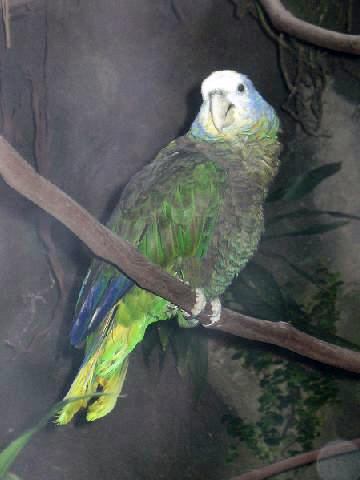
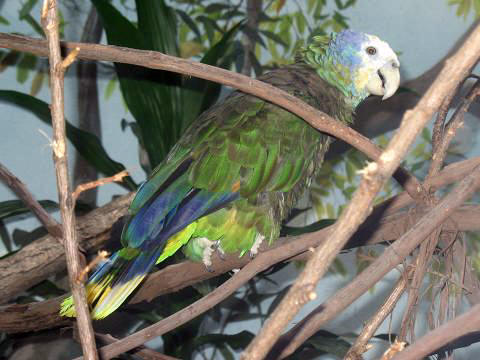
This parrot is notable for its colorful head and largely green body. The crown and face show yellowish-white, blue and green tones, while the upperparts have a greenish-bronze cast. The wings carry violet to blue-green shading that becomes more apparent in flight. Overall, it has the robust bill and compact profile typical of amazon parrots, with plumage patterns that make it distinguishable from other local species.
Habitat, diet and behavior
The Saint Vincent amazon lives primarily in montane and lowland forests, favoring mature trees where it forages and nests in cavities. Its diet is composed mainly of fruits, seeds, buds and flowers; individuals often move in small flocks or family groups. As a forest canopy species, it plays a role in seed dispersal and local ecosystem dynamics on the island. For general context about the island and its ecosystems see Saint Vincent.
Threats and conservation
Because its distribution is limited to a single island, the Saint Vincent amazon is vulnerable to a small range of pressures. Threat factors include habitat loss through agricultural conversion and development, severe weather events, illegal capture and introduced predators. Conservation efforts have centered on habitat protection, legal safeguards, local awareness, and targeted management actions; captive breeding and reintroduction programs have been discussed or implemented in some cases. For conservation status and resources, consult specialist conservation pages.
Notable facts and distinctions
- The species is an island endemic, meaning it is naturally found only on Saint Vincent.
- Its colorful head pattern and violet-tinged wings distinguish it from many other Amazona species.
- Conservation of the species is closely tied to protecting mature forest habitat and engaging local communities.
Further reading and community-led initiatives can be explored via local conservation organizations and birding resources: more information and ways to help.
Questions and answers
Q: What is the Saint Vincent amazon?
A: The Saint Vincent amazon is a type of parrot that lives only in the island of Saint Vincent in the Caribbean.
Q: What other name can the Saint Vincent amazon be called?
A: The Saint Vincent amazon can also be called the Saint Vincent parrot.
Q: How does the Saint Vincent amazon look like?
A: The Saint Vincent amazon is a large, multi-colored parrot with a yellowish white, blue and green head, greenish-bronze upperparts plumage, and violet blue-green wings.
Q: Where is Saint Vincent located?
A: Saint Vincent is an island located in the Caribbean.
Q: How many parrot species live in Saint Vincent?
A: The only parrot species that lives in Saint Vincent is the Saint Vincent amazon.
Q: Is the Saint Vincent amazon a common bird?
A: No, the Saint Vincent amazon is not a common bird, as it only inhabits one island in the Caribbean.
Q: What is the Saint Vincent amazon's scientific name?
A: The Saint Vincent amazon's scientific name is Amazona guildingii.
Related articles
Author
AlegsaOnline.com Saint Vincent amazon (Amazona guildingii) Leandro Alegsa
URL: https://en.alegsaonline.com/art/86237
Sources
- iucnredlist.org : "Amazona guildingii"
- birdlife.org : "St vincent amazon Amazona guildingii"
- biodiversitylibrary.org : Biodiversity Heritage Library
- avianeyes.org : The Amazona guildingii: Conservation Status and Future Survival
- avianweb.com : "Saint Vincent Amazons or St. Vincent Parrots (Amazona guildingii)"
- unep-wcmc-apps.org : "Amazona guildingii"