
Royal Irish Constabulary
The Royal Irish Constabulary (RIC) was the centralized police force that policed most of Ireland under British rule from the 19th century until 1922, noted for its rural organization, paramilitary character and contested legacy.
Overview
The Royal Irish Constabulary (Irish: Constáblacht Ríoga na hÉireann) was the principal policing body responsible for maintaining public order across most of Ireland when it was governed as part of the United Kingdom. Formed in the early 19th century as successive administrations sought a more uniform and centrally controlled police service for the island, the force developed into a distinctive, semi-military organisation that combined routine civil policing with duties that resembled gendarmerie work.
Image gallery
10 Images




Organisation and duties
The RIC was organised into divisions, counties and local barracks, with an Inspector-General at its head and a hierarchical rank structure beneath him. It worked alongside municipal forces such as the Dublin Metropolitan Police, which policed the capital. RIC constables carried arms, lived in isolated barracks in rural areas, and were trained to respond both to ordinary crimes and to political disturbances. Recruitment tended to produce a largely Irish rank-and-file and an officer corps that often included Protestant and British-born members, reflecting the administrative needs of a state police force.
History and development
The constabulary evolved during the 19th century as part of broader reforms in law enforcement in Britain and Ireland. The force was granted the title "Royal" in recognition of its services to the crown after disturbances in the 1860s, and thereafter became commonly known by the initials RIC. Over decades it played a central role during periods of agrarian unrest, the Land War, and later in response to nationalist agitation and the political upheavals that accompanied the First World War.
Notable episodes and controversies
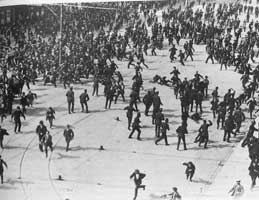
In the late 1910s and early 1920s the RIC became a focal point of the Irish War of Independence. The arrival of temporary recruits and special units — popularly known as the "Black and Tans" and the Auxiliary Division — intensified confrontations and left a legacy of disputed actions, reprisals and civilian suffering that are still subject to historical debate. The policing methods, alleged partisan behaviour, and sometimes heavy-handed tactics of certain units contributed to deep and lasting resentment among many Irish nationalists.
Disbandment and legacy
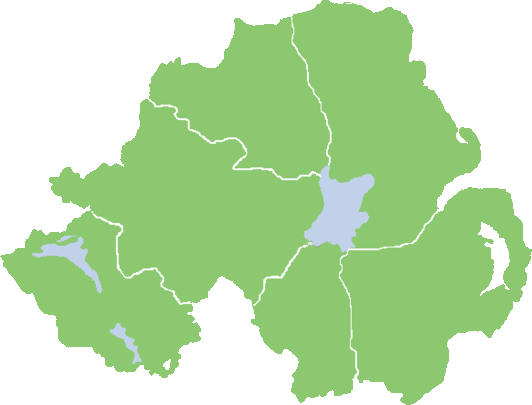
Following the Anglo-Irish settlement and the creation of the Irish Free State in 1922, the RIC was formally disbanded. In the new Free State the Garda Síochána (then often called the Civic Guard) was established to take on policing duties with a civilian ethos, while in Northern Ireland the Royal Ulster Constabulary (RUC) succeeded the RIC's role within the partitioned statelet. The RIC's records, barracks architecture and photographic archives remain important sources for historians studying policing, rural life and political conflict in 19th- and early 20th-century Ireland.
Characteristics and historical importance
- Functioned as a centrally directed, paramilitary police force responsible for both ordinary crime and public order.
- Operated a dense network of rural barracks that embedded constables in local communities.
- Played a significant role in major political events, including agrarian agitation, nationalist campaigns and the War of Independence.
- Its dissolution and replacement shaped modern policing institutions in both the Republic of Ireland and Northern Ireland, and its disputed actions remain a subject of study and public memory.
More detailed studies and primary material on the force, its uniforms, barrack system and operations can be found in specialised works and archival collections; readers may consult general references and institutional histories for deeper analysis. See also related topics: Sir Robert Peel and early police reform, Queen Victoria and honours granted to imperial services, the Dublin Metropolitan Police, and the later Royal Ulster Constabulary.
Related articles
Author
AlegsaOnline.com Royal Irish Constabulary Leandro Alegsa
URL: https://en.alegsaonline.com/art/84467
Sources
- royalirishconstabulary.com : "Royal Irish Constabulary RIC - www.royalirishconstabulary.com"