
Pan (moon)
Pan is a small inner moon of Saturn that orbits within the Encke gap of the A ring. Discovered in Voyager images, it is notable for its distinctive equatorial ridge and role clearing ring material.
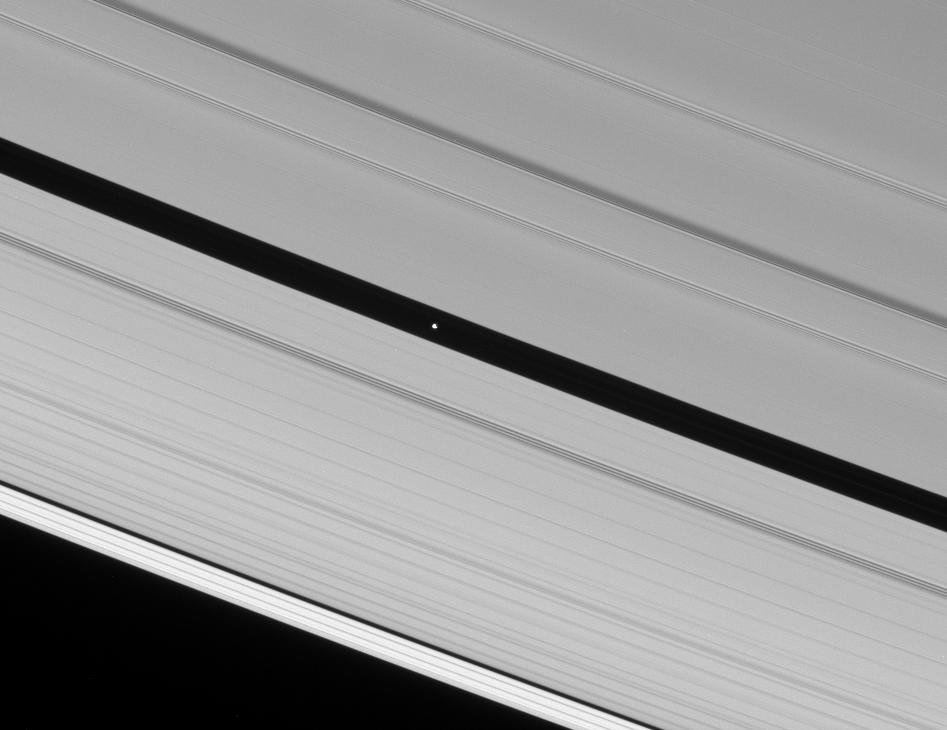
Pan is a tiny natural satellite of Saturn that travels within the main planet's rings. It lies in the Encke gap of Saturn's A ring and orbits very close to the planet: roughly 133,600 km above Saturn's cloud tops according to observational data (orbital distance). Because of its location and interactions with surrounding ring particles, Pan is often described as a ring‑embedded or "gap‑clearing" moon.
Image gallery
9 Images







Physical characteristics
Images returned by spacecraft show Pan as an irregular, flattened body with a prominent equatorial ridge that gives it a flying‑saucer or walnut‑like appearance. Its overall dimensions are small compared with most moons; observations indicate a body only a few tens of kilometres across. Mass estimates place Pan at about 4.95 ± 0.75 × 10^15 kg. The equatorial bulge is widely interpreted as accumulated ring material that adhered to the moon as it moved along its orbit.
Orbit and role in the rings
Pan orbits inside the Encke gap and acts as a local sculptor of the ring environment. Its gravity clears a path in the dense A ring, maintaining the gap and producing narrow wakes and waves in nearby ring particles. These dynamical effects make Pan an important example of how small moons influence ring structure and evolution.
Discovery and naming
Pan was identified by Mark Showalter in 1990 while examining images taken earlier by the Voyager 2 spacecraft (Voyager 2 photographs). The International Astronomical Union officially named the moon Pan on 16 September 1991, after the rustic Greek god of shepherds and nature (Pan). It is also catalogued as Saturn XVIII in the sequence of Saturnian satellites.
Scientific significance and observations
Pan is scientifically valuable because it provides a close-up case of accretion and clearing processes within a planetary ring. High-resolution images from later missions revealed its shape and ridge, supporting models in which ring particles slowly collect on a small moon's equator. Continued monitoring of Pan helps researchers understand ring‑satellite interactions and the short‑term dynamics of Saturn's rings (A Ring studies).
Notable facts
- Pan orbits within a gap it helps to maintain, illustrating the shepherding role of small moons.
- Its unusual equatorial ridge is likely built from ring material accreted over time.
- Discovered by reanalysis of Voyager imagery, Pan highlights the value of archival data for new discoveries.
Together these properties make Pan a compact but striking member of Saturn's complex satellite and ring system, providing insight into small‑scale gravitational sculpting and the lifecycle of ring particles.
Related articles
Author
AlegsaOnline.com Pan (moon) Leandro Alegsa
URL: https://en.alegsaonline.com/art/74296
Sources
- ui.adsabs.harvard.edu : 2008AJ....135..261J
- doi.org : 10.1088/0004-6256/135/1/261
- ciclops.org : "Sizes, shapes, and derived properties of the saturnian satellites after the Cassini nominal mission"
- ui.adsabs.harvard.edu : 2010Icar..208..395T
- doi.org : 10.1016/j.icarus.2010.01.025
- cfa-www.harvard.edu : IAUC 5052: Saturn
- cfa-www.harvard.edu : IAUC 5347: Satellites of Saturn and Neptune
- planetarynames.wr.usgs.gov : "Planet and Satellite Names and Discoverers"