
Rhea: Saturn's Second-Largest Moon
Rhea is Saturn's second-largest natural satellite, composed mainly of water ice with some rock. It has an ancient, heavily cratered surface and was examined closely by the Cassini mission.
Overview
Rhea is the second-largest moon orbiting Saturn and one of the larger icy moons in the Solar System. Its surface is dominated by water ice mixed with rock, producing a bright, heavily cratered landscape. Rhea follows a near-circular, tidally locked orbit so the same face generally points toward Saturn.
Image gallery
10 Images






Physical characteristics
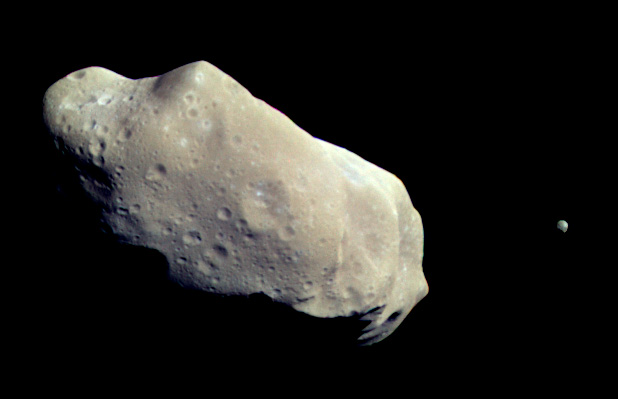
The moon's low overall density indicates a composition rich in water ice with a smaller fraction of silicate rock. Its terrain preserves an old history of impacts: broad basins, numerous craters and long, linear streaks of bright material. The surface texture and albedo suggest a cold, rigid crust with limited geologic resurfacing in recent geologic time.
Key properties
- Composition: predominantly water ice with rock.
- Surface: heavily cratered, with bright streaky deposits.
- Rotation: synchronous (same hemisphere faces Saturn).
- Atmosphere: effectively none, though a very thin exosphere of sputtered molecules has been reported.
Exploration and study
Most detailed knowledge of Rhea comes from flybys by the Cassini spacecraft, which returned images and in situ measurements in the 2000s. Data from those encounters clarified surface geology, measured the moon's gravity field and searched for possible rings or a substantial atmosphere. For summaries of mission results see Cassini observations and analyses of composition at composition studies.
History and notable facts
Rhea was observed in the 17th century and long known as a bright satellite of Saturn. One intriguing episode in modern study arose when magnetospheric data hinted at anomalies that some scientists interpreted as signatures of narrow rings; later imaging failed to confirm large rings, so the question remains cautious and debated. Rhea's ancient, heavily cratered surface makes it an important object for studying the early impact history of the Saturnian system and the behavior of icy bodies in the outer Solar System.
Importance and distinctions
Unlike larger, more geologically active moons, Rhea appears geologically quiet and preserves ancient features. Its bright ice-rich surface contrasts with darker, more volatile-bearing satellites and provides a comparative reference for understanding ice-rock mixtures, cratering processes and how Saturn's environment shapes small icy worlds.
Related articles
Author
AlegsaOnline.com Rhea: Saturn's Second-Largest Moon Leandro Alegsa
URL: https://en.alegsaonline.com/art/82467
Sources
- commons.wikimedia.org : Rhea
- minorplanetcenter.org : Natural Satellites Ephemeris Service
- oarval.org : "Classic Satellites of the Solar System"