
Red Square (Moscow)
Historic city square in central Moscow separating the Kremlin from Kitay-gorod; site of major monuments, state ceremonies and a UNESCO World Heritage listing.
Overview
Red Square is the central open space in Moscow and one of the best‑known public squares in Russia. Its location is commonly given at 55°45′15″N 37°37′12″E. The square's Russian name, Красная площадь, is often translated as "Red Square" in English. It sits at the interface between the historic Kremlin citadel and the commercial quarter of Kitay‑gorod within the city of Moscow, in the country of Russia. Because many of the capital's main avenues and cultural routes originate or converge here, Red Square is commonly treated as the symbolic centre of Moscow and, by extension, of the Russian state.
Image gallery
10 Images




Layout and principal buildings
The square forms a long rectangular area that separates the Kremlin — the former royal fortress and current seat of government — from the historic trading district. The Kremlin itself is closely linked to the square; readers can follow more about the fortress at the Kremlin. The combined site of Red Square and the Kremlin is recognised as a protected cultural ensemble: see Red Square and the Kremlin and the related entries for UNESCO and its listing as a World Heritage Site.
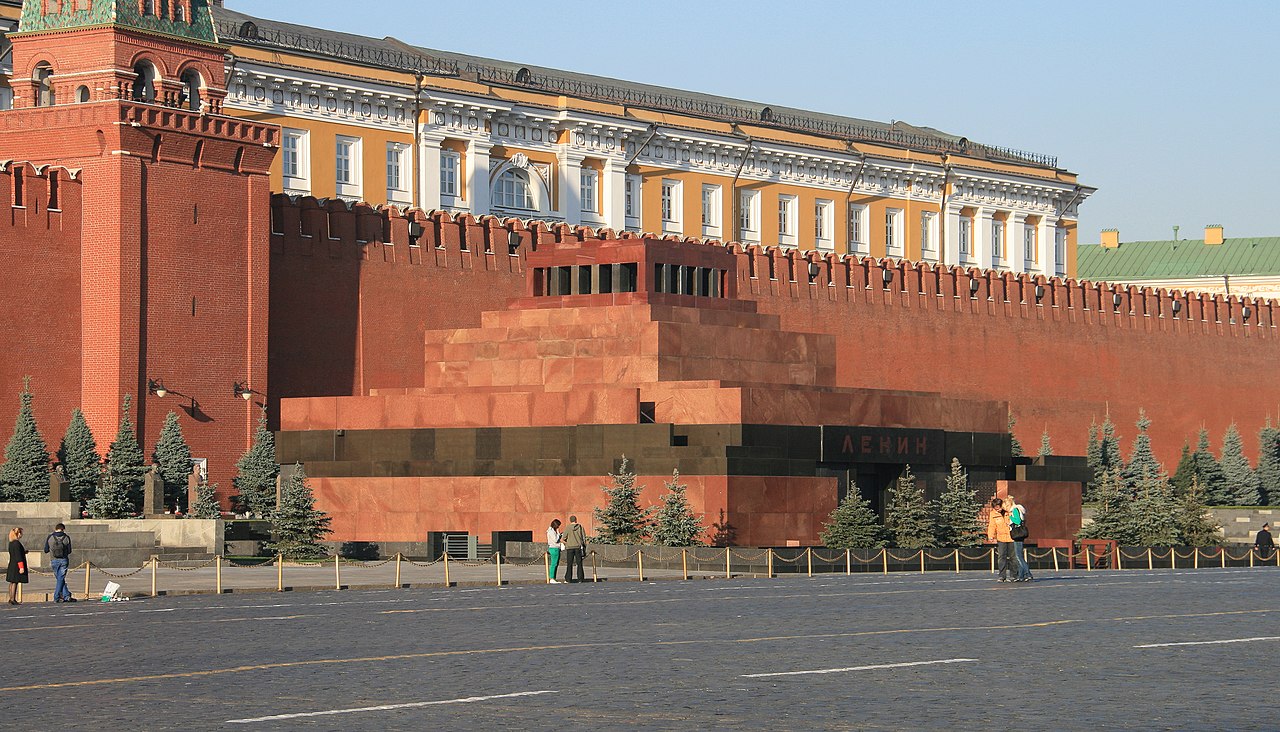
Prominent structures that frame the square include the onion‑domed Saint Basil's Cathedral to the south, the long iron‑arched façade of the GUM department store to the east, and the State Historical Museum. Near the Kremlin wall stands Lenin's Mausoleum, the granite tomb where the embalmed body of Vladimir Lenin has been displayed since the 1920s; the mausoleum has also been associated with the burial and later removal of other Soviet leaders (for example, Joseph Stalin was interred in the mausoleum for a period and his remains were later removed in 1961) — see a biographical note on Joseph Stalin for context.
History and development
Red Square developed over many centuries from a riverside trading area and fortified approach to the Kremlin into a ceremonial and administrative centre. In medieval and early modern times it served as a marketplace and a route for processions. From the 18th century onward it became a stage for official state occasions and public gatherings. During the Soviet period the square acquired a high profile as the location for military parades, mass demonstrations, and state commemorations. Since the late 20th century the square has been the focus of conservation, public events and growing tourism.
Uses, visitors and cultural importance
Today Red Square functions as a multifunctional civic space: it hosts official parades and commemorations, seasonal markets and cultural festivals, while also attracting domestic and international visitors as a major tourist attraction. Its layers of architecture and memorial sites make it a central reference point for Russian history and identity, and it is frequently used in imagery and reporting about Moscow.
Notable facts and practical information
- Geographic marker: coordinates are widely published and help locate the square in maps and guides (coordinates).
- Cultural protection: the ensemble of Red Square and the Kremlin is recorded under international heritage programmes (UNESCO, World Heritage).
- Names and language: the Russian name Красная площадь reflects historical meanings of the word "red" relating to beauty as well as its modern association.
- Nearby institutions: for more on the Kremlin site itself see the Kremlin and for general information about Moscow visit Moscow resources.
Because of its long public role, Red Square continues to be studied for its architectural, political and social significance in Russia and internationally. Readers seeking primary sources and detailed archival material can follow reference links and institutional pages identified above.
Related articles
Author
AlegsaOnline.com Red Square (Moscow) Leandro Alegsa
URL: https://en.alegsaonline.com/art/81704