
Receptor antagonist
A receptor antagonist is a molecule that binds to a cellular receptor and prevents activation, used widely in physiology and medicine to modulate signalling and treat disease.
A receptor antagonist is a substance that binds to a biological receptor and reduces or prevents the receptor's normal response to an activating molecule. Antagonists are a class of ligands that interfere with receptor signalling without producing the usual activating effect; in some cases they merely block access, while in others they actively stabilize an inactive receptor state. For a basic definition of related terms see biological repressor and ligand.
Image gallery
2 Images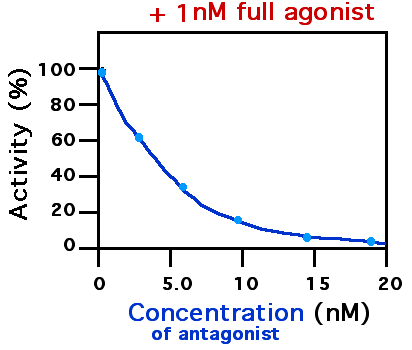

How antagonists work
Antagonists operate by occupying the binding site on a receptor or by modulating its shape so that an agonist cannot produce a response. Some antagonists are competitive: they compete directly with an agonist for the same site and can be displaced by higher agonist concentration. Others are noncompetitive or allosteric: they bind elsewhere and reduce the receptor's ability to respond even when the agonist is present. A related concept is an inverse agonist, which decreases a receptor's baseline activity, while a partial agonist produces a weaker activation than a full agonist.
Types and characteristics
- Competitive (reversible) — binds the active site and is surmountable by more agonist.
- Noncompetitive (irreversible or allosteric) — reduces maximum response regardless of agonist concentration.
- Selective vs. nonselective — some antagonists target a single receptor subtype, others affect multiple receptors.
- Pharmacokinetic considerations — affinity, residence time and metabolism influence clinical effect.
Uses and examples
Receptor antagonists are central to many medicines and experimental probes. Examples include beta blockers used for cardiovascular conditions (beta-adrenergic antagonists), antihistamines that block H1 receptors, opioid antagonists used in overdose management, and angiotensin receptor blockers in hypertension. In research, antagonists help identify which receptors mediate particular physiological responses and are tools in studying the body's regulatory systems such as homeostasis.
Clinical importance and distinctions
Clinically, the choice of an antagonist depends on selectivity, side-effect profile, route of administration and duration of action. Antagonism can be useful to counteract excessive signalling (for example, blocking a hormone receptor) or to protect tissues from harmful overstimulation. Distinctions between binding affinity and functional efficacy are important: high affinity does not always equate to strong clinical effect if the drug is rapidly cleared or poorly absorbed. For contrast, see discussions of agonists and how they differ from antagonists.
Background and research directions
The antagonist concept emerged as pharmacology developed methods to characterize receptor binding and dose–response relationships. Modern drug discovery continues to refine antagonist design to enhance subtype selectivity and reduce adverse effects, and to exploit allosteric modulation for subtler control of signalling. Antagonists remain indispensable both as therapeutics and as scientific tools for probing biological systems.
Related articles
Author
AlegsaOnline.com Receptor antagonist Leandro Alegsa
URL: https://en.alegsaonline.com/art/81550