
Random-access memory (RAM): functions, types, history, and uses
Overview of random-access memory (RAM): what it is, how it works, main types (DRAM, SRAM, NVRAM), historical development, typical uses, and distinguishing features such as volatility and performance.
Random-access memory (commonly abbreviated RAM) is the primary working storage used by digital computers to hold programs and data that the processor needs immediately. Unlike sequential or block storage, RAM permits reading and writing data at arbitrary addresses with roughly uniform access time, which makes it suitable for temporary workspace and fast data exchange between the central processing unit and active software. For a general definition see this overview and for its role inside a system chassis consult system architecture references.
Image gallery
8 Images




Characteristics and common forms
RAM is typically implemented as semiconductor memory chips mounted on modules (DIMMs, SO-DIMMs) and measured in bytes of capacity and in access speed. Key technical characteristics include latency (the delay to start a transfer), bandwidth (how much data can be moved per second), and volatility (whether stored information is retained without power). Modern RAM types differ in construction and application; for example, dynamic RAM (DRAM) stores bits as electric charge and must be periodically refreshed, while static RAM (SRAM) uses bistable latches and retains data while powered without refresh.
Examples and related concepts are often discussed together: program memory and data buffers show how operating systems and applications rely on RAM for execution and temporary storage. Error-correcting code (ECC) variants add parity or correction bits for reliability in servers, and small, non-volatile variants are used for configuration or firmware storage.
History and technological development
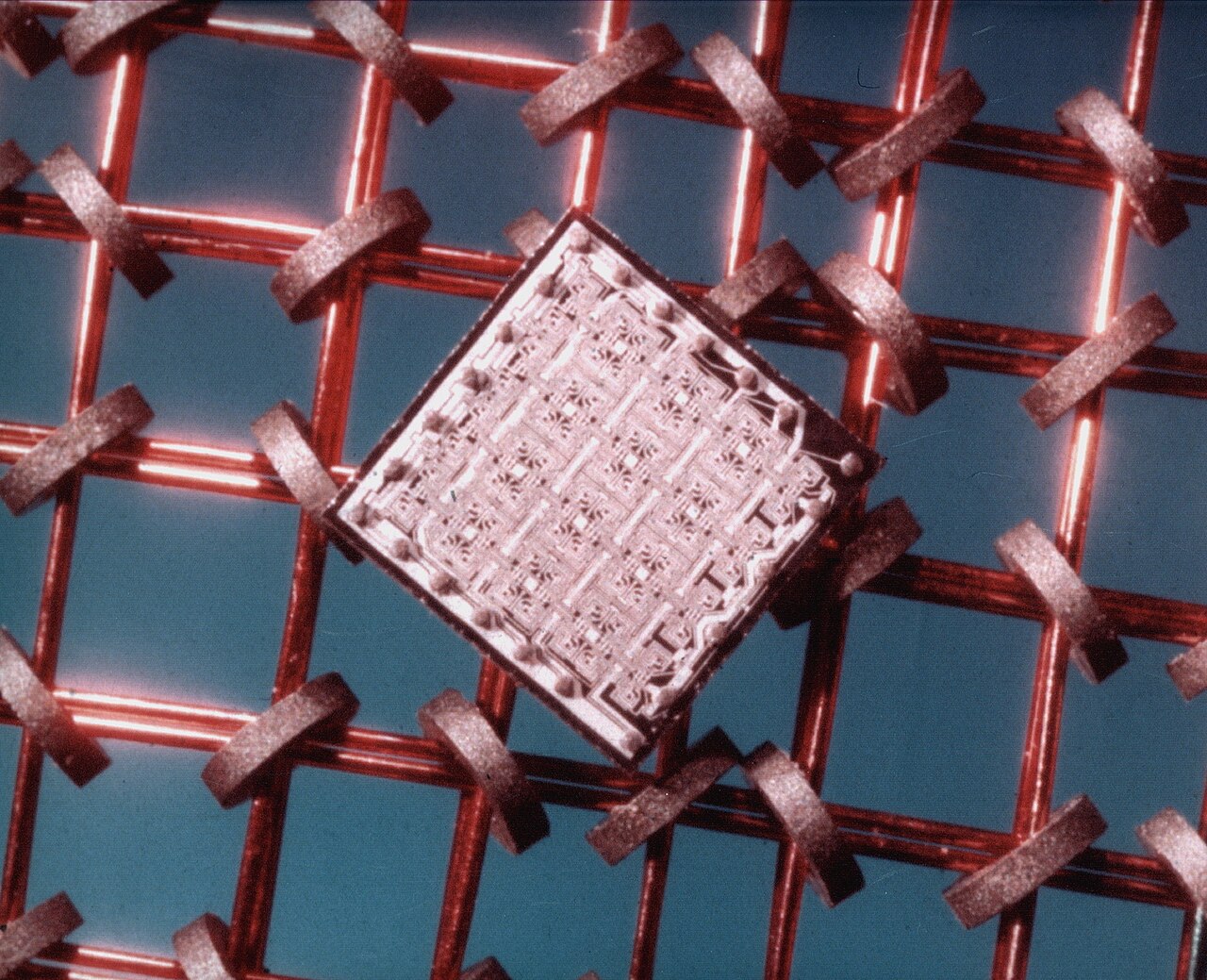
The earliest forms of random-access storage included mechanical and magnetic schemes; later, magnetic-core memory became widespread before semiconductor memories took over in the late 20th century. Modern RAM almost always uses transistors and capacitors implemented with MOSFET technology; for background on underlying devices see MOSFET fundamentals. Non-volatile random-access options (often abbreviated NVRAM) emerged to retain state without power and are discussed separately at NVRAM resources.
Uses, examples, and practical importance
RAM is central to system responsiveness: more or faster RAM reduces reliance on slower secondary storage and can improve multitasking. Typical uses include:
- Executable code and program stacks for running applications.
- File system caches and buffers that speed up input/output.
- Graphics framebuffers and memory for high-performance computing tasks.
Operating systems also use virtual memory techniques to extend apparent RAM using disk-based swap, which trades performance for capacity. Consumer devices use different module sizes and power profiles than servers or embedded systems.
Distinctions and notable facts
The most important practical distinction is volatility: conventional RAM loses its contents when power is removed, whereas non-volatile forms preserve data but are typically slower or more costly. Another useful distinction is between DRAM, which is dense and used for main memory, and SRAM, which is faster and used for caches. Historical transitions—from magnetic to semiconductor implementations—and continuing trade-offs among cost, speed, and persistence shape how RAM is designed and deployed across desktops, mobile devices, and data centers. For an overview of magnetic memory history see magnetic memory history.
Related articles
Author
AlegsaOnline.com Random-access memory (RAM): functions, types, history, and uses Leandro Alegsa
URL: https://en.alegsaonline.com/art/81112