
Ramus Pomifer (Apple Branch): an obsolete constellation
Ramus Pomifer, Latin for 'apple branch', was an obsolete constellation located between Hercules and Lyra. It depicted a branch held by Hercules and later became part of Cerberus et Ramus; it is no longer used.
Overview
Ramus Pomifer (Latin: "apple branch") was an historical constellation depicted in the area of sky between Hercules and Lyra. It personified a branch or bough associated with the mythic hero, and was drawn so that the branch appeared to be held in Hercules' left hand. The name and subject reflect allegorical decisions by mapmakers rather than distinct bright stars or a compact stellar pattern.
Image gallery
1 Image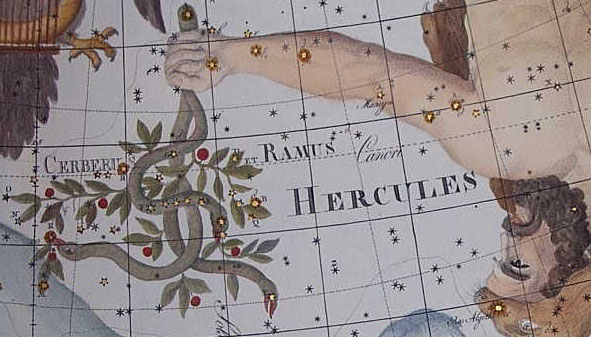
Depiction and meaning
Artists and atlas-makers represented the figure as a simple branch of fruit or wood, sometimes with leaves or an apple, added to the established figure of Hercules to fill a gap in the celestial artwork. Because the motif was decorative, its exact shape and the particular group of stars it encompassed varied from chart to chart. In many illustrations the object had no obvious bright anchor star and was therefore faint on the sky.
History and development
The designation appears on a number of early modern star charts and atlases as one of several supplementary figures placed around better-known constellations. Over time the branch motif was combined with another minor figure, Cerberus, producing the composite label Cerberus et Ramus in some sources. Such inventions were common among European celestial cartographers seeking to enrich or explain mythic scenes in star maps.
Characteristics and context
- Location: roughly between the traditional boundaries of Hercules and Lyra, overlapping faint stars rather than bright, distinctive ones.
- Appearance: a bough or apple-bearing branch; artistic rather than observational in origin.
- Relation to other figures: frequently drawn as part of Hercules' arm or hand and later shown alongside Cerberus in composite charts.
- Stars: the assignment of particular stars to the figure varied and generally used stars now counted as belonging to Hercules.
Legacy and modern status
Ramus Pomifer is considered an obsolete constellation. When astronomers and organizations standardized constellations in the 19th and early 20th centuries, such additive and decorative figures were omitted in favor of a fixed set of 88 official constellations. Today the area once labeled Ramus Pomifer is treated as part of the recognized constellation of Hercules, and the name survives mainly in historical studies of star charts and celestial art. For those researching older atlases or the visual history of the sky, Ramus Pomifer is an example of how cultural and artistic choices once shaped the way people organized and narrated the heavens.
Further reading can be found in historical catalogs and star-chart commentaries that document obsolete constellations and their evolution; modern treatments typically place these figures in a historical or illustrative context rather than in current astronomical practice.
Related articles
Author
AlegsaOnline.com Ramus Pomifer (Apple Branch): an obsolete constellation Leandro Alegsa
URL: https://en.alegsaonline.com/art/81068
Sources
- lhldigital.lindahall.org : "Ioannis Bayeri Rhainani I.C. Uranometria"
- ianridpath.com : "Star Tales – Cerberus"