
Lyra (constellation)
Lyra is a small northern constellation notable for the bright star Vega, the Ring Nebula (M57), the double star Epsilon Lyrae and the prototype variable RR Lyrae.
Overview
Lyra is a compact constellation in the northern celestial hemisphere. It is best known for its brightest star, Vega, which forms one corner of the prominent Summer Triangle asterism. Although relatively small in area, Lyra contains several objects of interest to amateur and professional observers, including bright stars, multiple star systems and distinct deep-sky nebulae.
Image gallery
7 Images





Notable stars and deep-sky objects
Key stellar and nebular components include:
- Vega — an A-type main-sequence star and one of the brightest stars in the night sky; it is often used as a photometric reference and lies nearby in astronomical distance terms.
- Epsilon Lyrae — the famous "Double Double," a multiple star system easily split with small telescopes into two close pairs.
- RR Lyrae — the prototype of a class of pulsating variable stars (RR Lyrae variables) used as distance indicators in astronomy.
- M57 (the Ring Nebula) — a well-known planetary nebula visible in small telescopes; its ring-like appearance makes it a popular target.
- M56 — a globular cluster located near the border of Lyra.
History and cultural significance
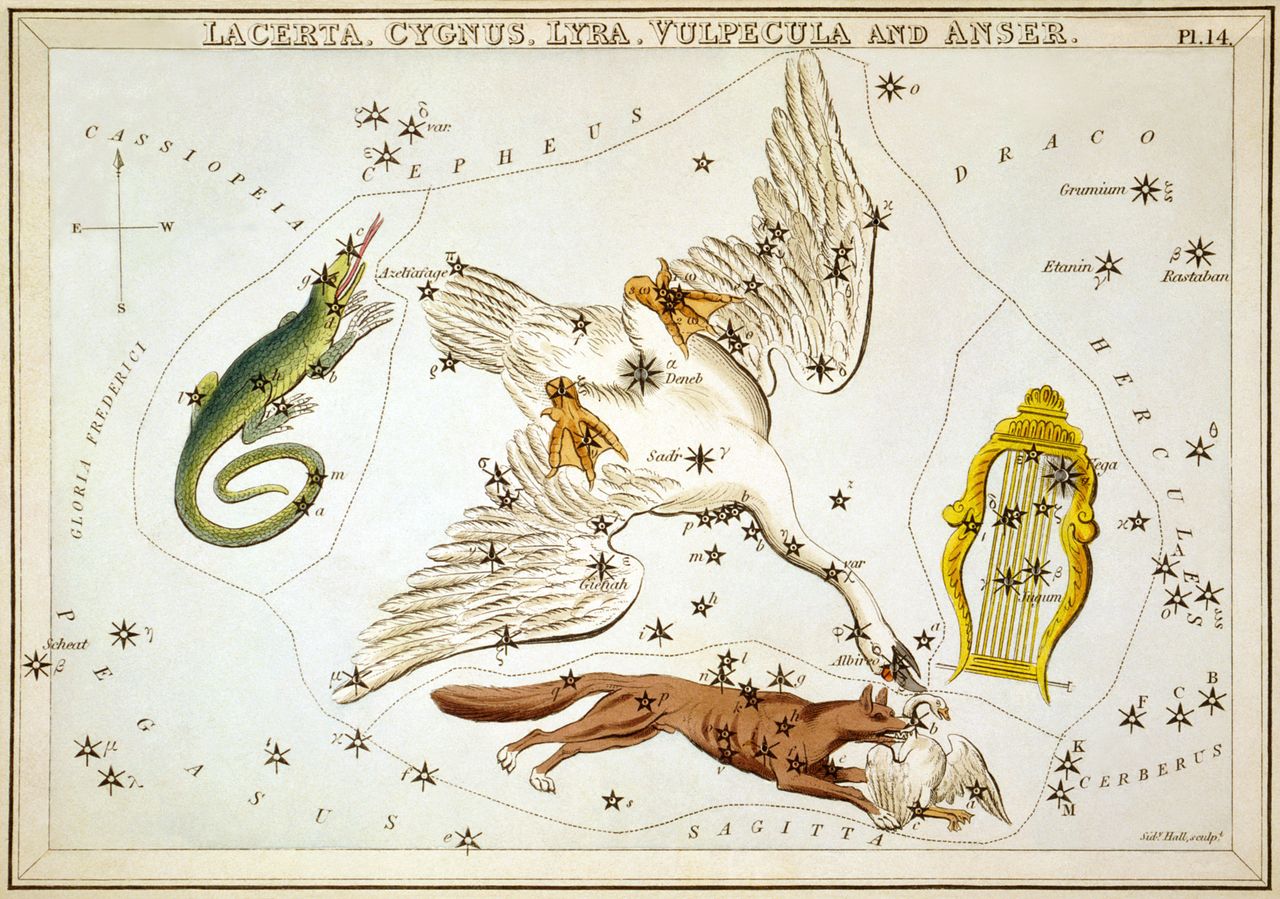
The figure of Lyra represents the lyre, a small harp associated in classical myth with musicians such as Orpheus and the god Hermes. The constellation was cataloged by ancient astronomers and appears in the list of 48 classical constellations recorded by Ptolemy. Over centuries it has been depicted as a lyre or harp across a variety of star charts and cultures.
Observation and location
Lyra lies in the northern sky between the constellations Cygnus and Hercules and is most easily seen from mid-northern latitudes during summer months. Its compact shape and bright central star make it a convenient reference for locating nearby objects. Observers often use Vega as a starting point to find the Ring Nebula and nearby multiple stars.
Notable facts and resources
Despite its small size, Lyra plays an outsized role in observational astronomy because of Vega and the presence of prototype objects such as RR Lyrae and M57. For more introductory material and sky charts see Lyra constellation.
Related articles
Author
AlegsaOnline.com Lyra (constellation) Leandro Alegsa
URL: https://en.alegsaonline.com/art/60146