
Hercules (constellation)
Hercules is a prominent northern constellation linked to the mythic hero. It contains the keystone asterism, several notable stars, and famous deep-sky objects such as the globular clusters M13 and M92.
Overview
Hercules is a large northern constellation traditionally associated with the classical hero Hercules (Greek: Heracles). It occupies a broad area of the sky and is most visible in the northern hemisphere during spring and summer months. In star charts it is usually drawn as a kneeling figure or standing warrior holding a club. The constellation is recognized in modern astronomy as one of the 88 official constellations designated by the International Astronomical Union; it was also listed among the 48 constellations catalogued by the ancient astronomer Ptolemy and has been part of star lore for many centuries (mythological link).
Image gallery
5 Images


Appearance and pattern
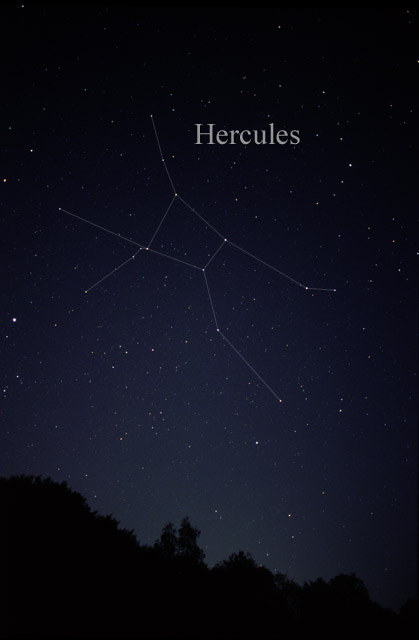
Hercules lacks a single very bright star, which can make its outline subtle to the casual observer. The most familiar feature is the "Keystone," a roughly rectangular asterism formed by four stars that helps locate the figure's torso. Several individual stars mark the hero's limbs and head: Alpha Herculis (often called Rasalgethi) and Beta Herculis (Kornephoros) are commonly noted, while other stars form a loose pattern that has been interpreted in different ways by various cultures. The constellation lies in the northern celestial hemisphere and is typically found near neighboring constellations such as Lyra and Corona Borealis (regional context).
Notable stars and deep-sky objects
- Alpha Herculis (Rasalgethi) — a prominent multiple star system often listed in observing guides (star detail).
- Beta Herculis (Kornephoros) — another bright star used to help trace the Keystone.
- Zeta Herculis — a well-known binary system studied for its orbital properties.
- M13 (Great Globular Cluster) — one of the best-known globular clusters in the northern sky and a popular target for amateur telescopes.
- M92 — a second bright globular cluster in Hercules, often observed alongside M13.
History and cultural background
The identification of the constellation with the hero of classical legend dates back to antiquity and is reflected in Greek and Roman sources. Over time the image evolved, but the association with bravery and heroic deeds remained consistent. The constellation as named and bounded in modern star atlases traces its roots to the classical lists and was formalized by modern astronomers; its official boundaries were established by international agreement in the 20th century (modern status).
Observing Hercules
Hercules is a rewarding region for amateur astronomers because of its deep-sky offerings rather than very bright stars. The Keystone asterism provides an easy starting point for star-hopping to M13 and M92. Under dark skies the globular clusters resolve into rich fields of stars through modest telescopes; some binary and variable stars in the constellation are also frequent targets for study. In addition, a number of stars in Hercules have been found to host planets and remain subjects of professional research (myth and modern study, star catalogs, observing resources).
Related articles
Author
AlegsaOnline.com Hercules (constellation) Leandro Alegsa
URL: https://en.alegsaonline.com/art/43727
Sources
- astronomy.swin.edu.au : "Constellation"