
Synchrotron (circular particle accelerator)
A synchrotron is a circular particle accelerator that synchronizes magnetic and electric fields to keep particles on a fixed orbit while increasing their energy; used in research and light sources.
Overview
A synchrotron is a type of circular particle accelerator in which charged particles travel many times around a closed path while gaining energy. Unlike simple cyclotrons, a synchrotron adjusts the guiding magnetic field and the accelerating electric field together so that the beam follows the same orbit as its momentum rises. The ability to accelerate particles to very high energies while maintaining a stable, confined beam makes the synchrotron a fundamental tool in physics and allied sciences.
Image gallery
6 Images



How it works
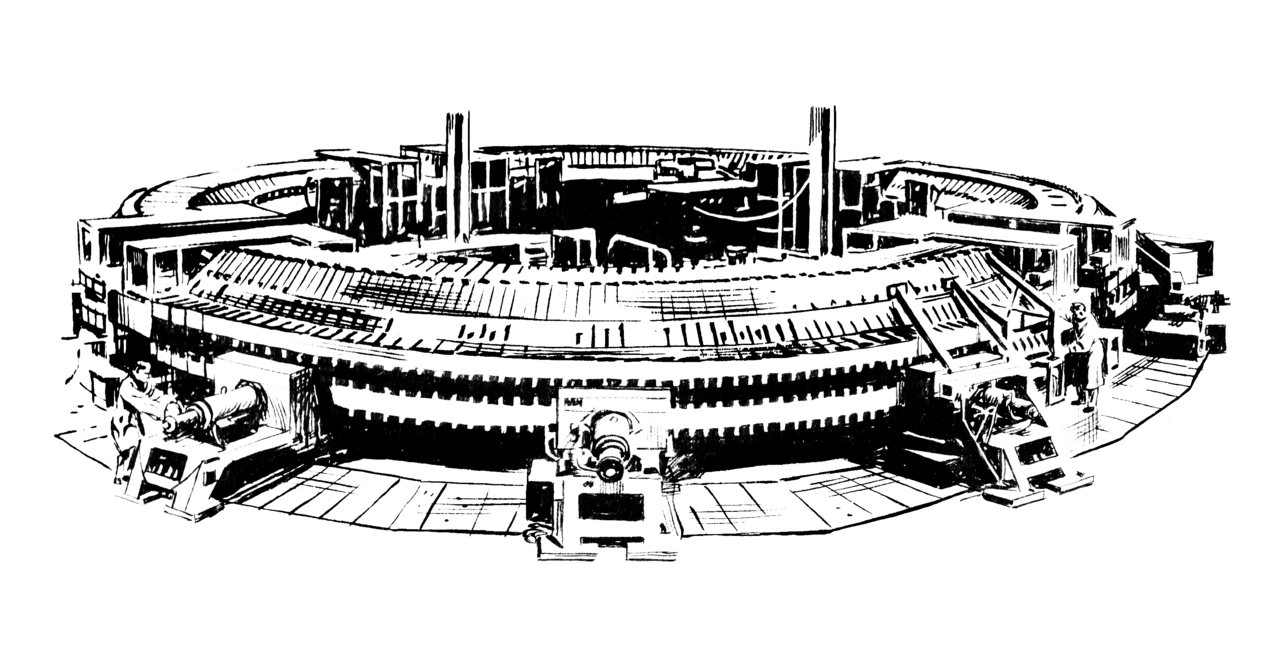
Particles are injected into the ring and pass repeatedly through radio-frequency cavities that provide short bursts of accelerating electric field. Magnets around the ring bend and focus the beam: dipole magnets provide the main bending force, quadrupoles focus the beam transversely, and higher-order magnets correct subtle deviations. As the particles gain energy, the magnetic field strength is increased in step so the trajectory radius stays essentially constant — a condition called synchronism.
Key components
- RF cavities: supply the accelerating electric fields timed to the particle bunches.
- Bending magnets (dipoles): force the beam into the circular orbit and determine its curvature.
- Focusing magnets (quadrupoles and sextupoles): keep the beam compact and correct optical errors.
- Injection and extraction systems: add particles to the ring or remove them for experiments or transfer to other machines.
History and development
The principle of synchronizing accelerating and guiding fields — sometimes called phase stability — was developed in the mid-20th century and led to the first practical synchrotrons. Several physicists contributed to the concept and early construction of machines: theoretical proposals and prototype electron and proton rings were built in the years following World War II. These early developments established the synchrotron as a route to energies not easily reached by linear or fixed-field cyclotron designs.
Applications and importance
There are two broad roles for synchrotrons. In particle physics, large synchrotrons accelerate protons, electrons or ions for collision experiments that probe fundamental particles and forces. In materials and life sciences, so-called synchrotron light sources use the intense X-rays emitted when electrons are bent by magnets; those X-rays enable high-resolution imaging, spectroscopy, and studies of chemical and biological structures. Synchrotron facilities support research in chemistry, geology, medicine and industrial development.
Notable distinctions and facts
Synchrotrons are distinct from storage rings and cyclotrons by their method of synchronizing fields and their adaptability for very high energies. A related phenomenon, synchrotron radiation, is both a challenge and an asset: it causes energy loss in high-energy accelerators but also provides extremely bright, tunable photon beams for experiments. For further background on accelerator types and technologies see accelerator overview, material on magnetic systems at magnet design, and resources about RF acceleration at RF cavities and timing.
Questions and answers
Q: What is a synchrotron?
A: A synchrotron is a type of particle accelerator where particles travel around many times in a circle.
Q: How do synchrotrons work?
A: Synchrotrons use a magnetic field to turn particles in a circle, as well as an electric field to speed them up.
Q: How is the size of the circle maintained while the particles go faster in a synchrotron?
A: The components in a synchrotron are carefully matched up with the travelling particle beam to ensure that the circle stays the same size while the particles go faster.
Q: Who invented the proton synchrotron?
A: Mark Oliphant invented the proton synchrotron.
Q: Who first published the idea of a synchrotron?
A: Vladimir Veksler was the first to publish the idea of a synchrotron.
Q: Who constructed the first electron synchrotron?
A: Edwin McMillan was the first to construct the first electron synchrotron.
Q: What is the main purpose of a synchrotron?
A: The main purpose of a synchrotron is to accelerate particles to high speeds in order to study their properties.
Related articles
Author
AlegsaOnline.com Synchrotron (circular particle accelerator) Leandro Alegsa
URL: https://en.alegsaonline.com/art/95667
Sources
- nature.com : Nature 407, 468 (28 September 2000)
- bnl.gov : The Cosmotron
- chess.cornell.edu : "Paul Hartman (1913-2005), a Synchrotron Radiation Pioneer"