
Quantum tunnelling: barrier penetration, mechanism, and applications
Quantum tunnelling is a quantum effect in which particles penetrate classically forbidden energy barriers, central to nuclear decay, semiconductor devices, microscopy and some chemical processes.
Overview
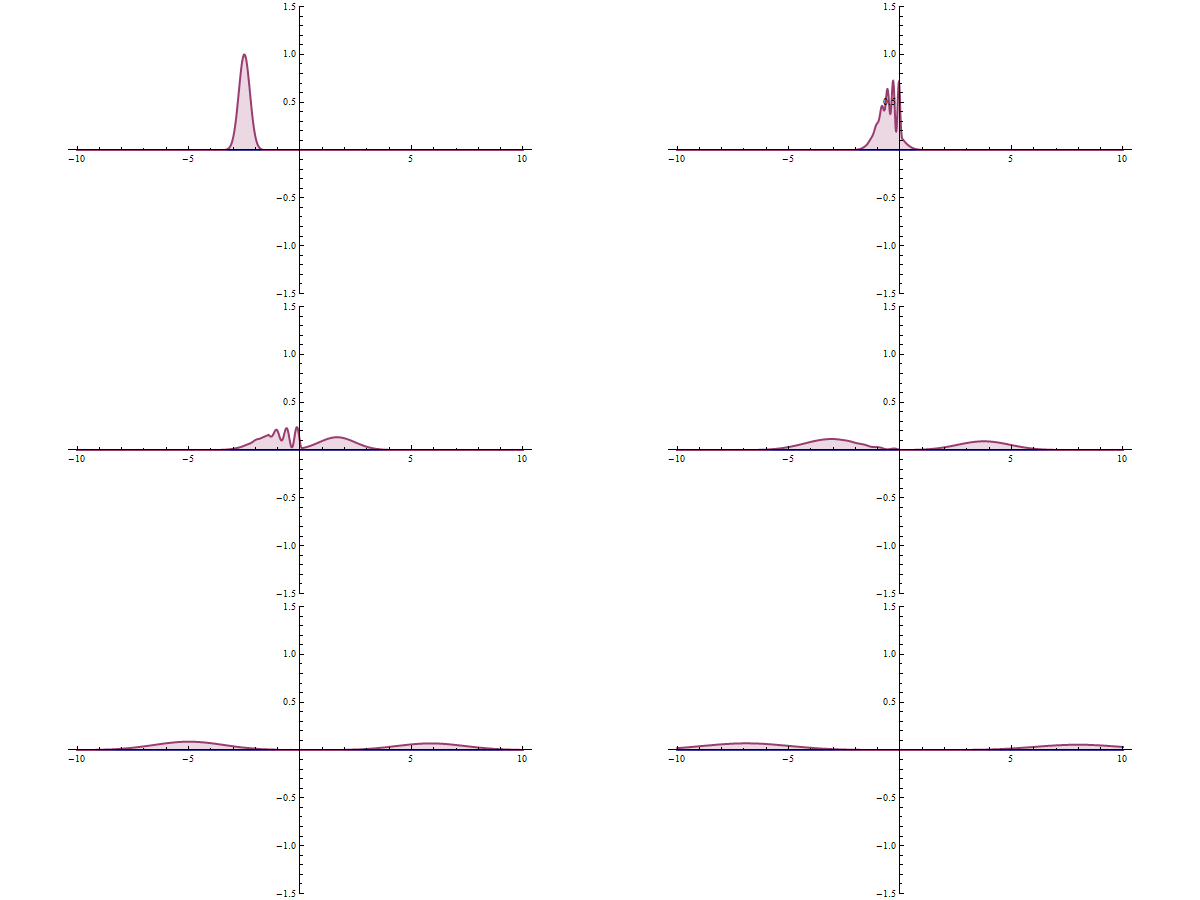
Quantum tunnelling is a fundamental phenomenon of theoretical physics and quantum mechanics in which a particle has a finite probability to be found on the other side of an energy barrier that classical physics forbids it to cross. The effect follows from the wave-like description of matter: the particle's wavefunction does not stop abruptly at a barrier but decays, leaving a non-zero amplitude inside and beyond the barrier. This gives a measurable chance that the particle will be detected on the far side even when its kinetic energy is lower than the barrier height.
Image gallery
6 Images



How it works
At the heart of tunnelling is wave–particle duality: entities ordinarily described as particles also exhibit wave properties. When a wavepacket encounters an energy barrier its amplitude inside the barrier falls exponentially, but does not vanish. If the barrier is sufficiently thin or the particle's wavelength sufficiently long, the transmitted amplitude beyond the barrier can be significant.
- Typical tunnelling participants include electrons, photons in optical analogues, and other subatomic particles.
- Factors affecting transmission probability include barrier width and height, particle mass and energy, and the shape of the potential.
- Because probabilities govern the outcome, probability amplitudes—rather than deterministic trajectories—determine whether tunnelling occurs.
Historical development
The need to explain processes such as alpha decay led early researchers to accept that particles could cross classically forbidden regions. Work by scientists such as George Gamow and independently by R. W. Gurney and E. U. Condon applied quantum ideas to nuclear decay and showed tunnelling could account for observed lifetimes. Later developments formalized barrier penetration in the Schrödinger equation and connected it to a wide range of phenomena in physics and chemistry.
Applications and examples
Tunnelling underlies several important technologies and natural processes. In electronics it enables tunnel diodes and contributes to leakage and operation of flash memory where charges move through thin insulating layers. The scanning tunneling microscope exploits electron tunnelling between a tip and a surface to image individual atoms. In nuclear physics, alpha particles escape nuclei by tunnelling, and in stars nuclear fusion of light nuclei is aided by tunnelling through Coulomb barriers. Chemical reactions and enzyme activity can sometimes be influenced by proton or electron tunnelling, and superconducting devices and some proposals for quantum computing use tunnelling in Josephson junctions.
- Examples: alpha decay, STM imaging, tunnel diodes, flash-memory charge transfer.
- Natural roles: stellar fusion rates, some isotope exchange reactions.
- Research areas: quantum devices, nanoscale transport, and chemical dynamics.
Key points and limitations
Quantum tunnelling does not mean macroscopic objects routinely pass through walls: the probability for a complex, massive object to tunnel is effectively zero in ordinary conditions, which is why everyday matter appears classical. For the same reason, tunnelling is most relevant for light, microscopic particles and for engineered systems with very thin barriers. Experimental observation and applications exploit situations where barrier thickness, energy scales, and coherence are tuned so tunnelling becomes significant. Careful interpretation is required: tunnelling is a probabilistic, wavefunction-based effect rather than a classical traversal through a hole in space.
Further reading and resources: introductory treatments of quantum mechanics explain mathematical models of tunnelling; reviews in condensed-matter and nuclear physics discuss device and natural applications. For practical demonstrations, the operation of a scanning tunneling microscope and the behavior of tunnel diodes show tunnelling's direct technological impact. Advanced discussions examine decoherence, time in tunnelling, and limits for macroscopic objects approaching quantum regimes. For additional context see materials on energy barriers, experimental measures of probability, and particle-specific details for quarks and other constituents; photonic analogues are discussed under photon-based experiments.
Useful introductory links and topics: theoretical physics overview, electron tunnelling, particle-wave duality, and more specialized texts on subatomic particles and wave mechanics provide accessible starting points for learners and practitioners.
Related articles
Author
AlegsaOnline.com Quantum tunnelling: barrier penetration, mechanism, and applications Leandro Alegsa
URL: https://en.alegsaonline.com/art/80392