
Active fault
An active fault is a fracture in the Earth's crust that has moved recently and is likely to produce future earthquakes; studied to assess seismic hazard and guide planning.
Overview
An active fault is a fracture or zone of fractures in the Earth's crust that has experienced movement in the geologically recent past and is considered likely to generate future seismic events. Geologists commonly classify a fault as active when there is evidence of movement within the most recent geological epoch (often taken as the last 10,000 years). Active faults are primary contributors to earthquakes and are a central focus of seismic hazard assessment and land-use planning. For general background on structural breaks in rock, see fault, and for the related phenomenon of sudden ground shaking, see earthquake.
Image gallery
3 Images
Characteristics and types
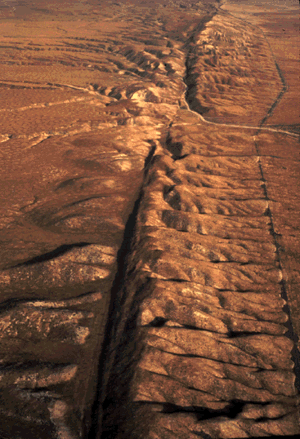
Active faults vary in length, orientation and behavior. Some produce visible surface ruptures during large events; others are 'blind' and slip at depth without breaking the surface. Fault motion styles include strike-slip (horizontal), dip-slip (vertical), and oblique combinations. Important measurable traits include slip rate (how fast two sides of the fault move relative to one another), recurrence interval (roughly how often large ruptures occur), and whether the fault is locked (accumulating strain) or creeping (slowly slipping without large earthquakes).
How scientists identify activity
- Paleoseismology and trenching across a fault to reveal and date past surface offsets.
- Instrumental seismic records that locate repeating earthquakes along a structure.
- Geodetic measurements (GPS, InSAR) that detect ongoing crustal deformation.
- Geomorphic and stratigraphic evidence such as offset river terraces, scarps, or displaced sediments.
Origin and tectonic context
Active faults arise from tectonic forces that deform the crust: plate boundaries commonly host networks of active faults, but active structures also occur within plates where stresses are concentrated. Over geological time a fault may become more or less active as stress patterns evolve. The distribution, orientation and interaction of faults control regional seismicity patterns.
Importance and practical uses
Mapping and characterizing active faults underpins seismic hazard maps, engineering design, building codes, infrastructure siting and emergency planning. Knowledge of a fault's slip rate and recurrence behavior helps estimate the probability of future large earthquakes, though precise timing cannot be predicted. Identifying active faults reduces risk by guiding safer land use and retrofitting vulnerable structures.
Distinctions and notable facts
Definitions of "active" can vary by jurisdiction and purpose; some agencies use shorter or longer time windows or different thresholds of displacement. Not all active faults produce frequent large earthquakes—some have very long recurrence intervals. Ongoing research refines methods to detect subtle signs of activity and to understand how faults interact during sequences of earthquakes.
Related articles
Author
AlegsaOnline.com Active fault Leandro Alegsa
URL: https://en.alegsaonline.com/art/797
Sources
- earthquake.usgs.gov : "Active fault"