
African Plate: structure, motion, and geological significance
Comprehensive overview of the African Plate: extent, internal subdivisions, boundaries, rifting (East African Rift, Red Sea), motion, geological history from Gondwana, hazards, and research methods.
Overview
The African Plate is one of Earth’s major tectonic plates. It carries most of the landmass commonly called the continent of Africa together with adjacent regions of oceanic crust. In tectonic descriptions the plate includes continental lithosphere, submerged oceanic domains and peripheral microplates. In many geological contexts authors distinguish the Nubian (western) block from the Somali (eastern) block to make clear whether the discussion treats the whole lithospheric plate or its actively rifting components.
Image gallery
4 Images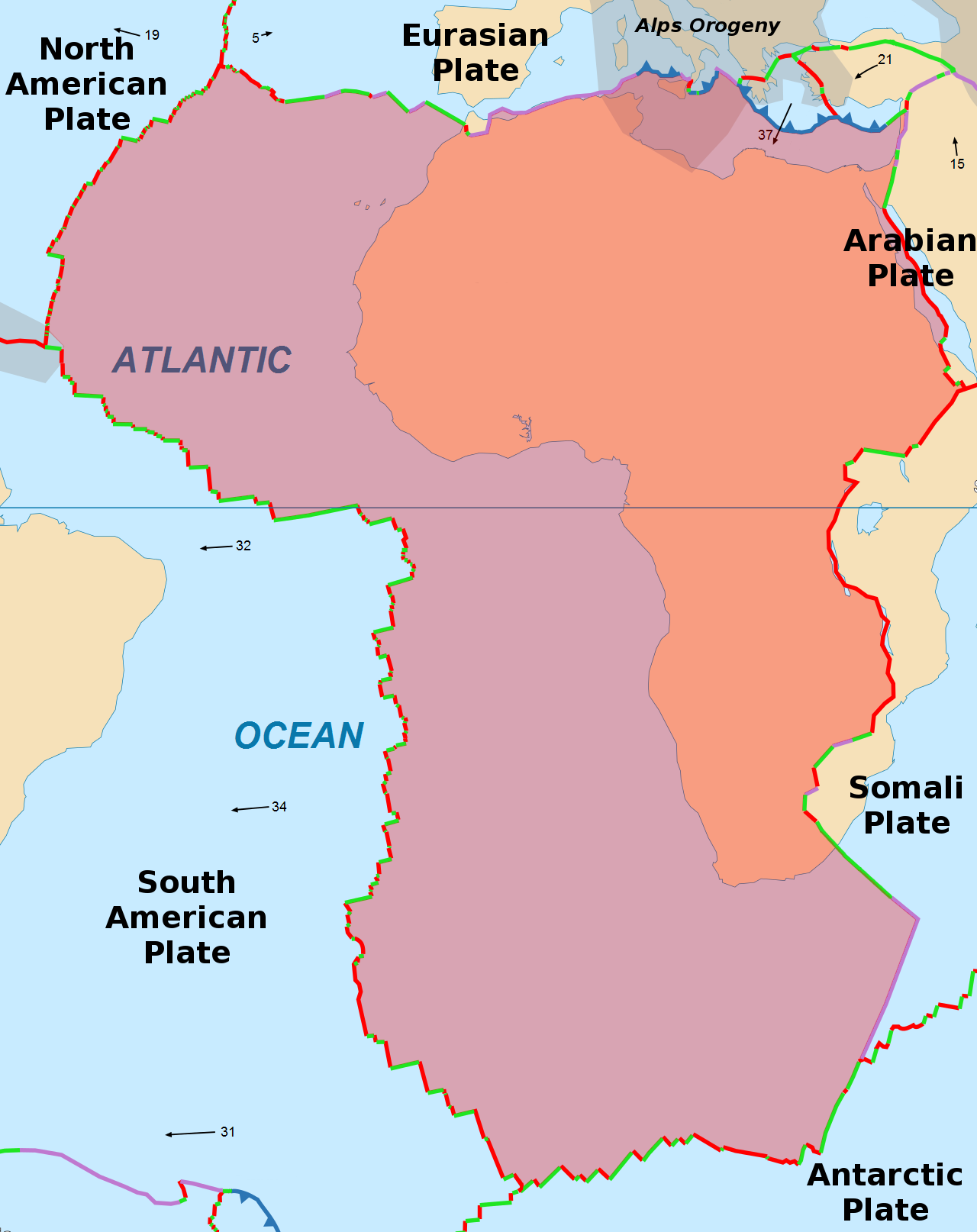

Extent, boundaries and neighboring plates
The African Plate extends from the Mid-Atlantic Ridge in the west across much of the African landmass to complex northern and eastern margins where it meets Eurasia and the Arabian Plate. Major boundaries include the Mid-Atlantic Ridge (a spreading center), the East African Rift System where rifting is active, and the Red Sea and Gulf of Aden rifts along the northeastern margin near the Red Sea. In the north the plate interacts with Mediterranean and Eurasian systems, producing zones of collision and subduction where oceanic lithosphere descends beneath continental or island-arc crust. These boundaries control patterns of seismicity, volcanism and crustal deformation.
Internal structure and major features
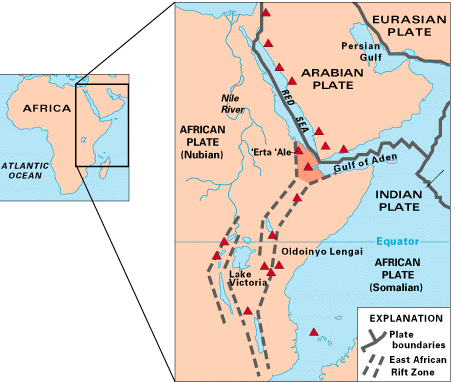
Internally the plate comprises ancient stable cratons, younger mobile belts, rifted basins and passive continental margins. Large cratonic cores in central and southern Africa host old Precambrian rocks; along their edges are rift systems and basins where the crust has been thinned. Offshore, oceanic crust created at mid-ocean ridges forms the plate’s seafloor. The East African Rift separates the Somali portion from the Nubian portion and includes segmented rift valleys, volcanic centers and sedimentary basins that record ongoing extension.
Rifting, mantle processes and competing hypotheses
The East African Rift evolved over tens of millions of years and is the site of continental breakup in an early stage. One explanation invokes a buoyant, thermally anomalous mantle upwelling beneath the Afar region: a mantle plume beneath Afar that may help initiate volcanism and uplift. Other interpretations emphasize pre-existing lithospheric weaknesses and far-field tectonic stresses produced by the motions of adjacent plates; proponents of plume models and of passive rift models both use geological, geophysical and geochemical data to evaluate these ideas (one hypothesis highlights plume influence).
Motion, geodesy and interactions
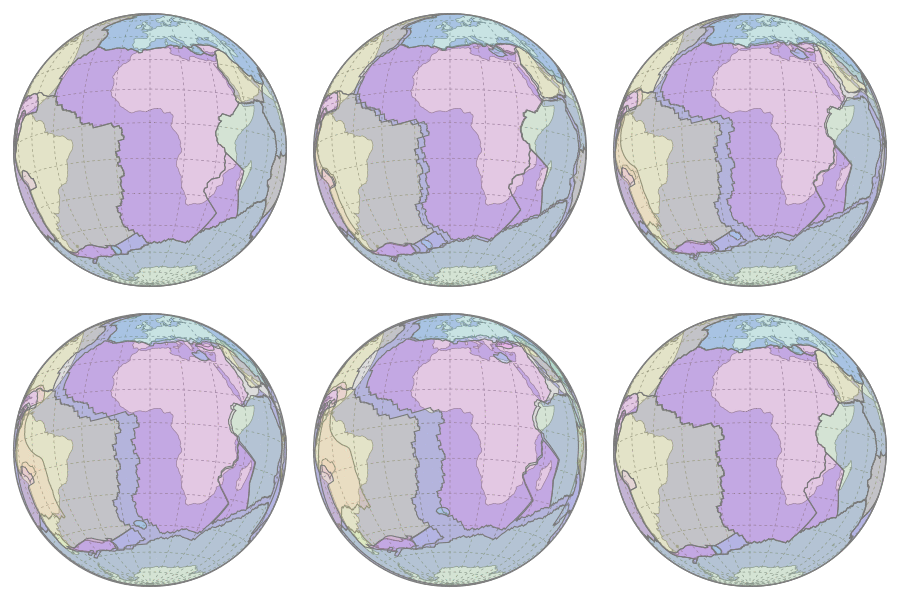
Geodetic measurements show the African Plate moves slowly relative to other plates, generally northeastward at a rate on the order of a few centimetres per year. This gradual motion brings it into closer contact with the Eurasian Plate and influences deformation along their shared margin. Where oceanic crust meets continental crust there can be subduction, collision and complex faulting; these interactions have helped shape the central and eastern Mediterranean region and adjacent belts. Near rifts and volcanic centers ongoing extension produces earthquakes and episodic eruptions.
Geological history
The plate’s deep-time history is tied to the breakup of the southern supercontinent Gondwana (sometimes referred to in older literature as the southern supercontinent Gondwana in broader context), during which continental fragments such as the Indian subcontinent separated and ocean basins opened. Successive episodes of rifting, seafloor spreading and continental collision through the Mesozoic and Cenozoic established the present arrangement of plates and margins.
Volcanism, seismic hazard and environmental effects
Active rift segments and associated volcanic chains generate hazards that include earthquakes, fissure eruptions and localized ground deformation. Rift volcanism produces a range of lava types and volcanic landforms; volcanic soils and geothermal systems also influence local economies and ecosystems. Subduction and collision farther north have contributed to mountain building and complex basin formation in the Mediterranean and surrounding regions.
Economic, ecological and research significance
Understanding the African Plate is important for resource exploration (minerals, hydrocarbons, geothermal), hazard preparedness, and reconstructing Earth’s tectonic past. Researchers use field geology, seismic imaging, satellite geodesy and laboratory geochemistry to study crustal structure, mantle processes and plate motions. Topics of active research include the relative roles of mantle plumes versus plate-driven extension, the timing of rift evolution, and links between deep mantle structure and surface tectonics.
Further reading
Introductory overviews of plate boundaries, regional tectonics and rift evolution are useful starting points. Key subjects to explore include the nature of continental crust and oceanic crust, the sequence of events that followed the breakup of Gondwana, and modern geodetic and seismic studies of African plate motions. For regional syntheses see treatments of the Mediterranean, the Red Sea and the East African Rift; these resources emphasize how crustal processes, mantle dynamics and plate interactions combine to shape the landscape.
Questions and answers
Q: What is the African Plate?
A: The African Plate is a major tectonic plate that includes much of the continent of Africa, as well as the oceanic crust which lies between the continent and various surrounding ocean ridges.
Q: How long ago did the Somali Plate begin rifting from the African Plate?
A: The Somali Plate began rifting from the African Plate along the East African Rift approximately 60 million years ago (mya).
Q: What are two hypotheses regarding why this rifting occurred?
A: Two hypotheses suggest that either a mantle plume beneath the Afar region caused this rifting, or it was just a zone of weakness as plates to its east moved northwards.
Q: How fast is the African Plate moving?
A: The African Plate's speed is about 2.15 cm (0.85 in) per year.
Q: In what direction has it been moving over past 100 million years?
A: Over past 100 million years, it has been moving in a general northeast direction.
Q: What happens when oceanic crust meets continental crust in parts of central and eastern Mediterranean?
A: When oceanic crust meets continental crust in parts of central and eastern Mediterranean, there is subduction.
Q: What other plates were once part of Gondwana with Indian subcontinent?
A:The African, Somali and Arabian Plates were all once part of Gondwana with Indian subcontinent.
Tags
Related articles
Author
AlegsaOnline.com African Plate: structure, motion, and geological significance Leandro Alegsa
URL: https://en.alegsaonline.com/art/1272
Sources
- nature.com : "Evidence for motion between Nubia and Somalia along the Southwest Indian ridge journal"
- doi.org : 10.1038/18014
- hypertextbook.com : "Speed of the continental plates"