
Portland Bill — headland on the Isle of Portland, Dorset
Portland Bill is the southern headland of the Isle of Portland in Dorset, England. Known for its lighthouse, strong tidal currents, distinctive geology and coastal walking, it is a notable navigation point and visitor attraction.
Overview
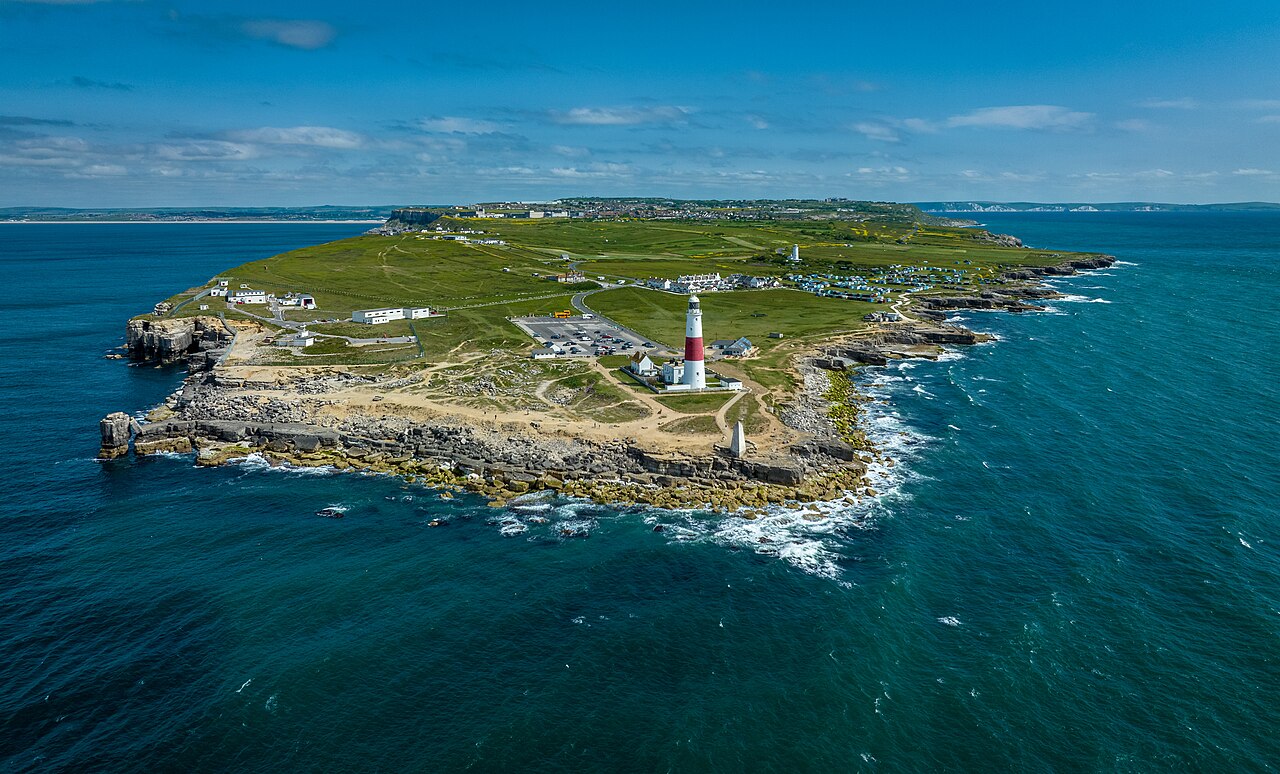
Portland Bill is a narrow promontory forming the southern extremity of the Isle of Portland, a tied island off the south coast of England. The feature marks the southernmost point of the county of Dorset and is a well known coastal landmark. The headland is often visited for its dramatic shoreline, views across Lyme Bay and the prominent lighthouse that guides vessels through nearby shipping channels.
Image gallery
10 Images



Landscape and geology
The Bill sits at the end of a rocky ridge of Jurassic-era limestones that give the Isle of Portland its name. The island is connected to the mainland by the long shingle spit of Chesil Beach, a classic tombolo feature. The local stone — Portland stone — has been quarried for centuries and has been used in many British and international buildings. The coastline around the Bill is characterised by wave-cut platforms, stacks and steep slopes, and it is exposed to strong winds and tidal flows.
Navigation and lighthouses
Because of submerged rocks and powerful tidal streams, Portland Bill has long been important for navigation. Mariners use the headland as a coastal reference and several lighthouse structures have been built here to reduce the risk of shipwreck. The most visible modern lighthouse is a painted tower that doubles as a visitor attraction and interpretation centre. A pair of older tower lighthouses nearby illustrates earlier solutions to coastal lighting.
History and human use
Human activity on and around Portland Bill has included quarrying, small-scale fishing, and maritime services. The nearby port and resort of Weymouth lies to the north-west and has historic links with sailing and coastal trade. Weymouth and Portland together hosted sailing events at the London 2012 Olympic Games, underlining the area's suitability for competitive offshore and inshore racing. Lifeboat and coastguard services operate in the locality because of the active shipping lanes and recreational boating.
Wildlife, recreation and access
The headland and adjacent cliffs support seabirds, migrant passerines and coastal plants adapted to thin soils and salt spray. Portland Bill is popular for birdwatching, fossil hunting along nearby shorelines, walking the coastal path and scenic photography. Visitors reach the Bill by road and on foot from the island villages; local paths offer views of the lighthouse and the busy approaches to Portland Harbour.
Notable facts and visitor information
- Navigation point: Portland Bill is used by mariners to mark the southern approach to the Isle of Portland and Portland Harbour. See navigation guidance: Portland Bill navigation.
- Lighthouse visitor site: The lighthouse offers interpretation for visitors; details may be found via local visitor services: visitor information.
- Geology and stone: Portland stone quarrying shaped the island's economy and architecture: Portland stone.
- Coastal environment: Tidal streams and local weather make the area dynamic and occasionally hazardous: coastal conditions.
- Local towns: Weymouth and nearby settlements provide accommodation and visitor facilities: Weymouth, local tourism.
- Access and services: Lifeboat and coastguard operations support safety at sea: maritime services.
- Further reading and maps: For routes, conservation advice and historical notes see: information and maps.
Portland Bill remains a compact but richly featured coastal destination: significant for geology and stonework, notable for maritime history and navigation, and valued today for outdoor recreation and wildlife observation.
Related articles
Author
AlegsaOnline.com Portland Bill — headland on the Isle of Portland, Dorset Leandro Alegsa
URL: https://en.alegsaonline.com/art/78277