
Pollux (star) — the bright orange giant of Gemini
Pollux is the brightest star in Gemini, an evolved K-type orange giant roughly 34 light-years away. It has expanded after exhausting core hydrogen and is known to host at least one exoplanet.
Overview
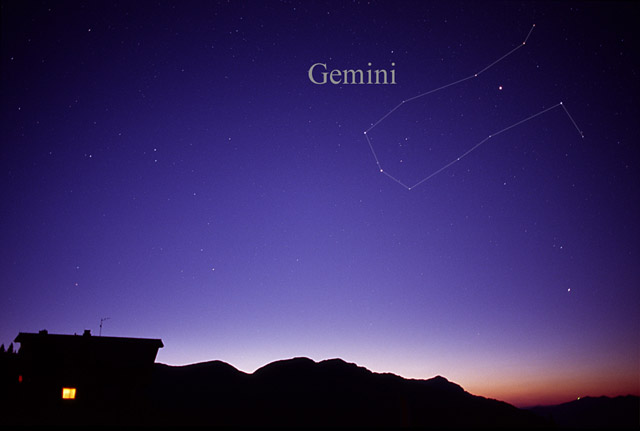
Pollux is the most luminous star in the constellation Gemini as seen from Earth. Its orange hue marks it as an evolved giant rather than a hot main-sequence star. Located at a relatively close interstellar distance, Pollux is prominent in northern-hemisphere skies and has been recognized since antiquity by multiple cultures.
Image gallery
5 Images



Physical characteristics
Classified as a K-type giant (K0 III in many catalogues), Pollux has left the main sequence after exhausting hydrogen at its core. As a result it has expanded and cooled compared with its earlier life as a hotter, A-type star. Its diameter is often stated to be on the order of several million kilometres; measurements place the star's diameter at roughly 11,000,000 kilometres, many times larger than the Sun's (diameter estimates). Its apparent brightness and color are typical of a mid-K giant.
Evolution and history
Pollux began life as a more massive, hotter star and spent much of that time on the main sequence fusing hydrogen. As core hydrogen ran out it expanded into a giant, developing a cooler outer envelope and brighter total luminosity. This evolutionary path is typical for stars of a few solar masses and explains Pollux's present spectral type and radius.
Planetary system and scientific importance
Observers have detected at least one companion around Pollux: a long-period, gas-giant exoplanet discovered through radial-velocity monitoring. The presence of a planet orbiting a giant star offers useful data on the survival and evolution of planetary systems as their host stars age. Pollux thus serves as an accessible laboratory for stellar and exoplanet studies.
Notable facts and quick reference
- Constellation: Gemini
- Spectral type: K-type giant
- Size: diameter ≈ 11,000,000 km (several times the Sun's)
- Companion: at least one confirmed exoplanet detected by radial-velocity
Because of its brightness and proximity, Pollux remains a frequent subject of photometric and spectroscopic observation. It illustrates key stages of stellar aging and the influence those stages can have on surrounding planetary bodies.
Questions and answers
Q: What type of star is Pollux?
A: Pollux is an orange giant star.
Q: Where is Pollux located within the constellation?
A: Pollux is the brightest star in the Gemini constellation.
Q: What is the diameter of Pollux?
A: The diameter of Pollux is over 11,000,000 kilometers (6,800,000 miles).
Q: Was Pollux always an orange giant star?
A: No, Pollux was once a type A star.
Q: What happened to Pollux to cause it to expand into a giant star?
A: Pollux used all the hydrogen in its core, causing it to expand and become a giant.
Q: In what direction is Pollux located from Earth?
A: The question doesn't provide enough context to answer.
Q: Can Pollux still undergo nuclear fusion?
A: The question doesn't provide enough context to answer.
Related articles
Author
AlegsaOnline.com Pollux (star) — the bright orange giant of Gemini Leandro Alegsa
URL: https://en.alegsaonline.com/art/77812