
Plant pathology (phytopathology)
Plant pathology examines the causes, development, diagnosis, management, and impact of plant diseases caused by pathogens and environmental factors, with emphasis on agriculture, ecology, and disease prevention.
Overview
Plant pathology, also called phytopathology, is the scientific study of plant diseases: their causes, development, diagnosis and control. It treats both infectious disorders produced by living agents and noninfectious damage caused by environmental or physiological factors. The field connects basic biology and ecology with applied practices used in agriculture, horticulture and natural-resource management. Fundamental concepts include host susceptibility, pathogen virulence and the role of the environment in determining whether disease occurs — often summarized as the disease triangle.
Image gallery
1 Image
Common causal agents and symptoms
Diseases may be caused by a wide range of organisms and agents. Major groups include fungi and fungal-like organisms (such as oomycetes), bacteria, viruses and viroids, phytoplasmas, protozoa, nematodes and parasitic plants. Each group produces characteristic signs or effects: fungal infections often yield mycelium, rusts or spots; bacterial diseases can cause wilts, soft rots or leaf spots; viral infections frequently produce mosaic patterns or stunting; and nematodes damage roots or cause galls. Abiotic stresses — for example nutrient imbalances, drought, frost or chemical injury — can mimic infectious symptoms and are part of a plant pathologist's diagnostic considerations.
Disease cycle and epidemiology
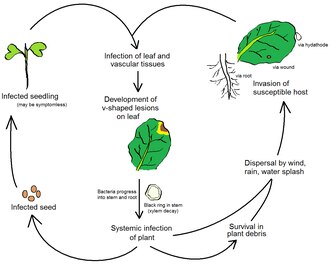
Understanding how a disease develops and spreads is central to control. A typical disease cycle includes pathogen survival, inoculum production, dispersal, infection, colonization and reproduction. Epidemiology studies patterns of disease in plant populations over time and space, identifying factors that drive outbreaks and severity. Effective surveillance and modelling of spread help manage risks in seed systems, nurseries and crop fields. Practical epidemiology often relies on field observation supported by laboratory tests and molecular assays.
Diagnosis, management and control
Diagnosis starts with symptom recognition and may include microscopy, culturing, serological tests and nucleic-acid methods such as PCR. Management strategies are diverse and commonly combined: cultural practices (crop rotation, sanitation, irrigation management), resistant crop varieties, chemical treatments (fungicides, bactericides), biological control agents and quarantine or certification measures to limit movement of infected material. Integrated disease management emphasizes reducing reliance on any single tactic and adapting responses to local conditions and pathogen biology.
History and significance
Plant pathology has a long history because plant diseases have shaped societies by reducing yields and triggering food shortages. Classic episodes such as the potato blight event that devastated 19th-century harvests highlight the discipline's importance. Scientific advances in the 19th and 20th centuries — including the recognition of microbes as disease agents and the development of modern diagnostic tools — transformed understanding and control. The discipline continues to evolve with genomics, remote sensing and modelling improving detection and prediction.
Applications, distinctions and notable facts
Applied plant pathology supports crop production, forestry, conservation and trade. It overlaps with plant breeding, entomology (vectors may spread pathogens) and soil science, but is distinct from studies of herbivores or insects that primarily damage plants by feeding. Key practice areas include seed health testing, disease resistance screening, postharvest disease management and biosecurity. For further reading on specific topics and terminologies, consult resources on plant disease, phytopathology, infection processes and plant viruses. Additional useful entries cover bacterial plant pathogens, pathogen biology and fungal diseases. To explore related organism groups, see pages on oomycetes, viroids and phytoplasmas. For diagnostic methods and disease surveillance consult laboratory techniques, nematode pathology and vector-borne disease. Practical guidance and policy references are available at agricultural extension.
Related articles
Author
AlegsaOnline.com Plant pathology (phytopathology) Leandro Alegsa
URL: https://en.alegsaonline.com/art/77287