
Plague doctor costume
Distinctive protective outfit used by physicians in early modern Europe treating plague victims, notable for its beaked mask, long protective coat, gloves, hat and staff; linked to miasma theory and later symbolism.
The plague doctor costume is the emblematic ensemble associated with physicians who treated victims during outbreaks of plague in early modern Europe. Designed according to the prevailing medical ideas of the time, the outfit combined clothing intended to shield the wearer from dangerous air and a set of accessories that allowed examinations and record‑keeping while minimizing direct contact.
Image gallery
6 Images


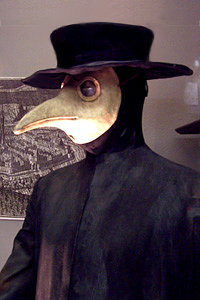
Key components
The ensemble varied by period and place, but commonly included:
- Beaked mask: A mask with a pronounced beak-like projection; glass openings protected the eyes and the cavity of the beak was filled with aromatic materials such as herbs and spices to counteract foul air. The beak idea appears in accounts of 17th-century practice and is often described with items like lavender inside the beak (aromatic substances).
- Long coat: A full-length coat, often waxed or leather, intended to repel bodily fluids and reduce direct contamination; versions extended to the ankles (description of the coat).
- Gloves, boots and hat: Gloves and high boots completed a sealed look; a wide-brimmed hat identified the wearer as a physician and offered some protection from droplets.
- Staff or cane: Used to point, lift clothing, examine patients and keep distance without hand contact.
Origins and purpose
The costume reflects the miasma theory of disease that dominated European medicine before germ theory: malodorous air was thought to carry infection, so filtering and fragrant substances were used in attempts to cleanse inhaled air. The familiar ‘‘bird‑beak’’ variant is generally associated with the 17th century and with itinerant or municipal plague physicians, though protective garments of various kinds were used at other times.
Functions and legacy
Practically, the outfit provided some barrier against fleas, bodily fluids and direct contact, even if it did not prevent all transmission. Culturally, the costume has become a powerful symbol: it appears in historical imagery, theatrical portrayals and modern festivals such as Venetian carnival, and it is frequently used in art and literature as a motif for pestilence and death.
Notable distinctions
Not every doctor or region used the beaked mask, and surviving depictions vary in detail. The design was both a product of available materials—leather, waxed cloth, glass—and of contemporary medical ideas. Modern reconstructions and museum examples show a range of styles rather than a single standardized uniform.
Questions and answers
Q: What was the purpose of the plague doctor's costume?
A: The purpose of the plague doctor's costume was to protect him from diseases spread through the air.
Q: What was the primary component of the plague doctor's costume?
A: The primary component of the plague doctor's costume was a coat that went down to the ankles.
Q: What did the plague doctor's mask look like?
A: The plague doctor's mask looked like a bird's beak.
Q: What was the purpose of the things that were often placed in the beak of the plague doctor's mask?
A: The things that were often placed in the beak of the plague doctor's mask were meant to smell sweet or strong, often lavender, in order to mask the smell of the diseases.
Q: What other pieces of clothing were typically worn along with the coat and mask in the plague doctor's costume?
A: Along with the coat and mask in the plague doctor's costume, gloves, boots, a hat, and something else to go over the jacket were typically worn.
Q: Were the boots in the plague doctor's costume meant to be protective?
A: It is not specified in the text if the boots in the plague doctor's costume were meant to be protective, but they were typically worn as part of the costume.
Q: Why was it important for the plague doctor to wear a hat?
A: It is not specified in the text why it was important for the plague doctor to wear a hat, but it was typically worn as part of the costume.
Related articles
Author
AlegsaOnline.com Plague doctor costume Leandro Alegsa
URL: https://en.alegsaonline.com/art/77204
Sources
- books.google.com : A History of Fire And Flame 1932
- whqlibdoc.who.int : online as PDF, 28Mb download
- qjmed.oxfordjournals.org : QJM: An International Journal of Medicine
- books.google.com : The Mirror of Literature, Amusement, and Instruction