
Pincer (hand tool)
Pincers are hand tools that concentrate force at a jaw or edge to pinch, cut or pull objects. Used in carpentry, metalwork and removal tasks, they differ from pliers by their end-cutting or point-focused jaws.
Overview
Pincers are a class of hand tools used to apply concentrated force to an object in order to pinch, pull, cut or extract it. They operate with the principle of mechanical advantage, allowing a user to multiply hand force. In simple mechanical terms the tool functions as a first-class lever, with the pivot placed between the handles and the working jaw.
Image gallery
5 Images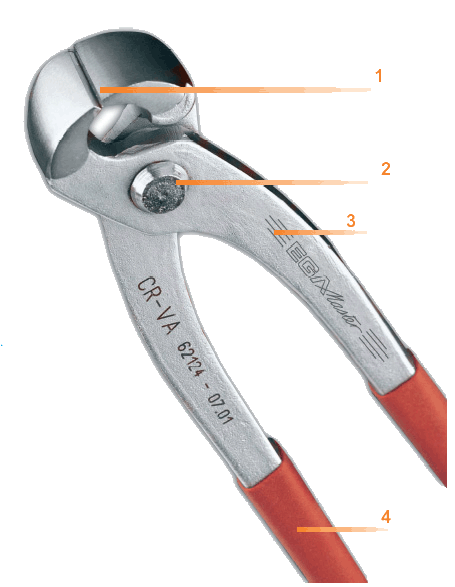


Design and key characteristics
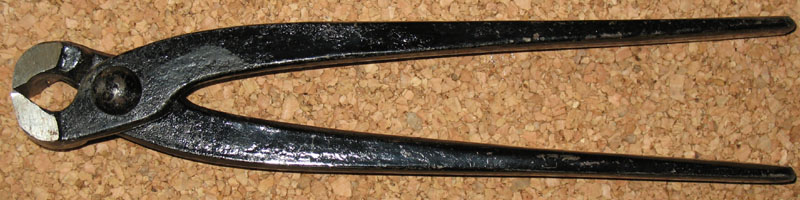
The defining feature of a pincer is its jaw geometry: the force is focused either to a point or along an edge that meets the handle at approximately a right angle. This geometry lets the jaws get close to a flat surface and concentrate pressure at a small contact area, which is why pincers are effective for prying and cutting near a substrate. The edge orientation is often described as at a right angle to the handles so the pulling or cutting face can approach materials flush.
Common uses and technique
Pincers are most commonly used to remove embedded items and to cut or bend small metal components. Typical tasks include extracting nails, tacks or staples, cutting small wire, and pulling pins. For example, a carpenter will often use pincers when removing nails driven into wood, because the tool can grip the nail head and lever it away while minimizing damage to the surface.
- Pulling nails and tacks
- Cutting or trimming wires and small pins
- Prying embedded fasteners from surfaces
- Shaping or bending small metal elements in repair work
History and notable facts
Pincers are an ancient form of hand tool and have existed in various shapes for centuries. Beyond workshop uses, historical accounts indicate that heated pincers were sometimes used as instruments of torture in earlier periods, including the Middle Ages, though their everyday association is with trades and craftwork rather than punitive practices. The basic form—forged steel jaws with two long handles—has changed little where the task requires a concentrated, end-focused grip.
Variants, distinctions and naming
Several related types exist: end-nippers or end-cutters concentrate cutting and pulling force at the tool's tip, while carpenter's pincers have a broader jaw with a rounded profile to roll a nail out as it is pulled. Pliers are a related family of tools but are designed primarily for squeezing, holding or bending rather than for end-cutting or extracting; the head shapes and force concentration differ accordingly.
Safety and maintenance
Use pincers with eye protection and a secure grip; the act of levering can fling fasteners or fragments. Do not use pincers as a substitute for hammers or pry bars beyond their intended capacity. Keep cutting edges clean and free of rust, oil the pivot occasionally, and inspect handles for cracking. Proper care preserves jaw alignment and the precision that makes pincers effective for delicate extraction work.
Related articles
Author
AlegsaOnline.com Pincer (hand tool) Leandro Alegsa
URL: https://en.alegsaonline.com/art/76950
Sources
- diracdelta.co.uk : "Lever"
- pbs.org : "Medieval Murder"
- commons.wikimedia.org : Pincer
- simple.wiktionary.org : pincer