
Plan 9 from Bell Labs
Plan 9 from Bell Labs is a research operating system released as free software. It treats system resources as files via the 9P protocol, supports per-process namespaces, and includes the rio GUI.
Overview
Plan 9 from Bell Labs is a research operating system released as free software and designed around a highly uniform, file-centric model of computing. Often described as a distributed operating system, Plan 9 was developed by the Computing Sciences Research Center at Bell Labs beginning in the late 1980s as a successor to UNIX. Its design emphasizes simple, composable interfaces that expose devices, services and networked resources through a consistent filesystem abstraction.
Image gallery
5 Images


Design and key features
At the core of Plan 9 is the principle that "everything is a file" taken further than in traditional UNIX: not only devices and local resources but also network services and user interfaces are represented and accessed as files. This uniformity is implemented by the 9P protocol, a lightweight network file protocol used for accessing local and remote resources. Later revisions of the protocol, often referenced as 9P2000, extend the original semantics while preserving the same file-oriented model.
Important technical characteristics include:
- Per-process namespaces: each process can have its own view of the filesystem, allowing private mounts and reconfiguration without affecting other processes.
- Union mounts and services: the ability to overlay multiple directories and to export services under filesystem paths (for example, directory trees under /srv).
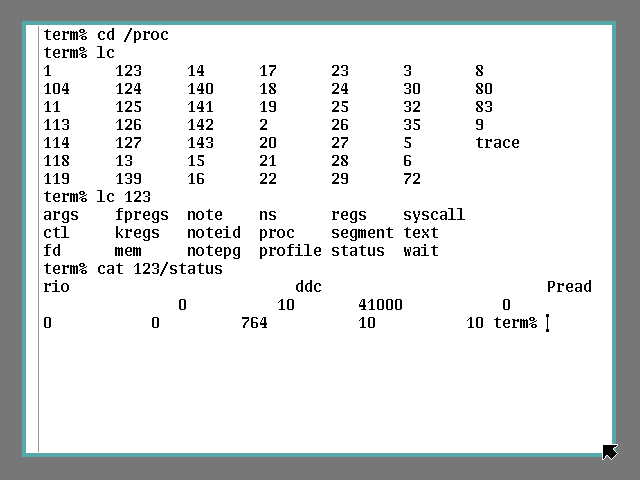
- Improved process and control filesystems: a more uniform proc-style interface that exposes process and kernel objects as files.
- Unicode (UTF-8) support: native and consistent character encoding across the system.
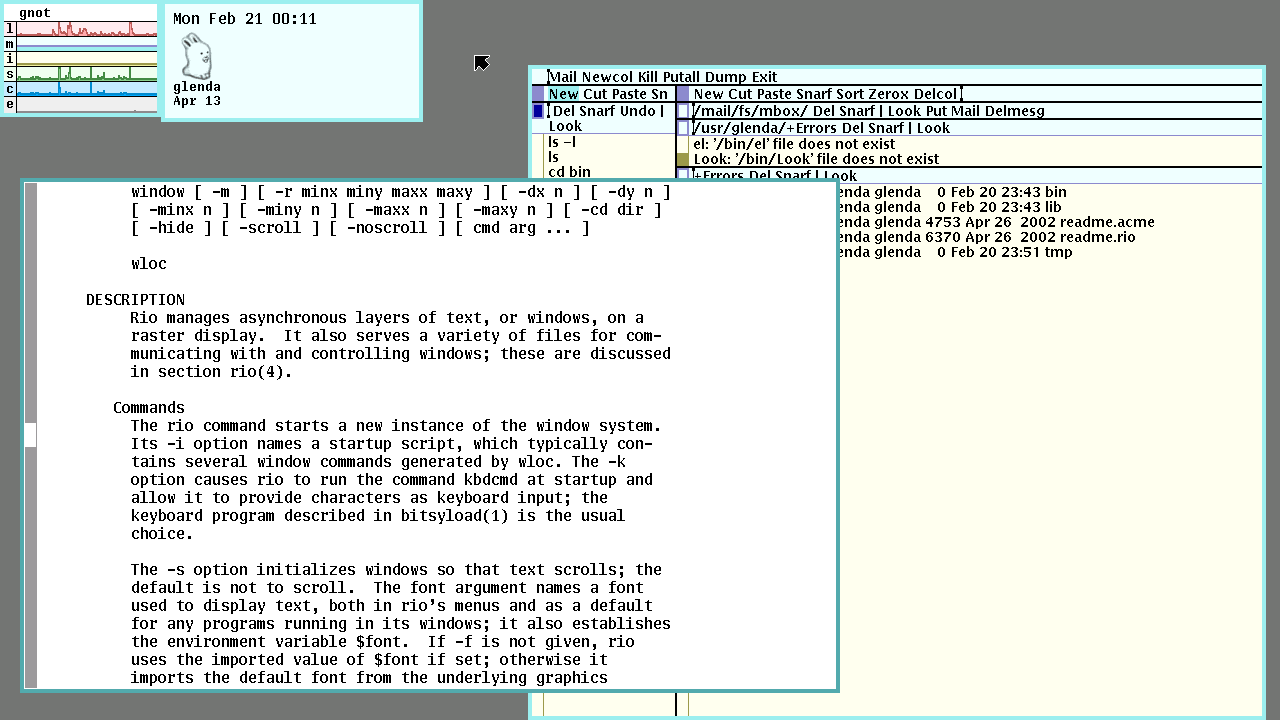
- Integrated graphical environment: the rio windowing system is built into the environment and designed to interoperate with the file-oriented interfaces.
History and name
Plan 9 was conceived as an experimental platform to explore new approaches to distributed and concurrent computing, building on lessons from UNIX but rethinking core assumptions about interfaces and resource sharing. The operating system's evocative name, Plan 9 from Bell Labs, references the cult science-fiction film Plan 9 from Outer Space, and some project iconography (such as the rabbit mascot Glenda) alludes to older film titles like Glen or Glenda. Although developed for research rather than mass-market adoption, Plan 9's ideas influenced later systems and academic work.
Uses, influence and modern status
Plan 9 has never been a mainstream desktop or server platform, but it has found a role among hobbyists, educators and researchers who value its elegant abstractions and minimal, coherent interfaces. Its influence appears in subsequent projects that adopt file-centric or namespace-driven designs, and the 9P protocol has been reused in other systems and tools. Because the system was released as free software, a small community maintains ports, derivatives and related tools that keep its ideas accessible for experimentation.
Notable distinctions
Compared with traditional UNIX-like systems, Plan 9's most visible distinctions are its pervasive use of the filesystem to represent non-file resources, the per-process namespace model that enables flexible composition of services, and the built-in expectation of network transparency via 9P. While UNIX emphasized compatibility and a common kernel interface, Plan 9 prioritized orthogonality and simplicity of interfaces, offering a different set of trade-offs that remain of interest to system designers and students of operating systems.
For further technical summaries, implementations, and community resources consult the project's documentation and contemporary retrospectives that analyze Plan 9's architecture and legacy in operating systems research.
Related articles
Author
AlegsaOnline.com Plan 9 from Bell Labs Leandro Alegsa
URL: https://en.alegsaonline.com/art/77230