
Right angle (90°) — definition, notation, tests and uses
A right angle measures exactly 90 degrees; lines, segments or planes that meet this way are perpendicular or orthogonal. Covers notation, measurement, construction, examples and mathematical tests.
A right angle is an angle of exactly 90 degrees. It is one of the basic building blocks of Euclidean geometry and everyday construction: when two straight lines meet to form a right angle they are called perpendicular or orthogonal. The concept also applies to planes and line segments, and it underlies many standard shapes such as squares and rectangles.
Image gallery
2 Images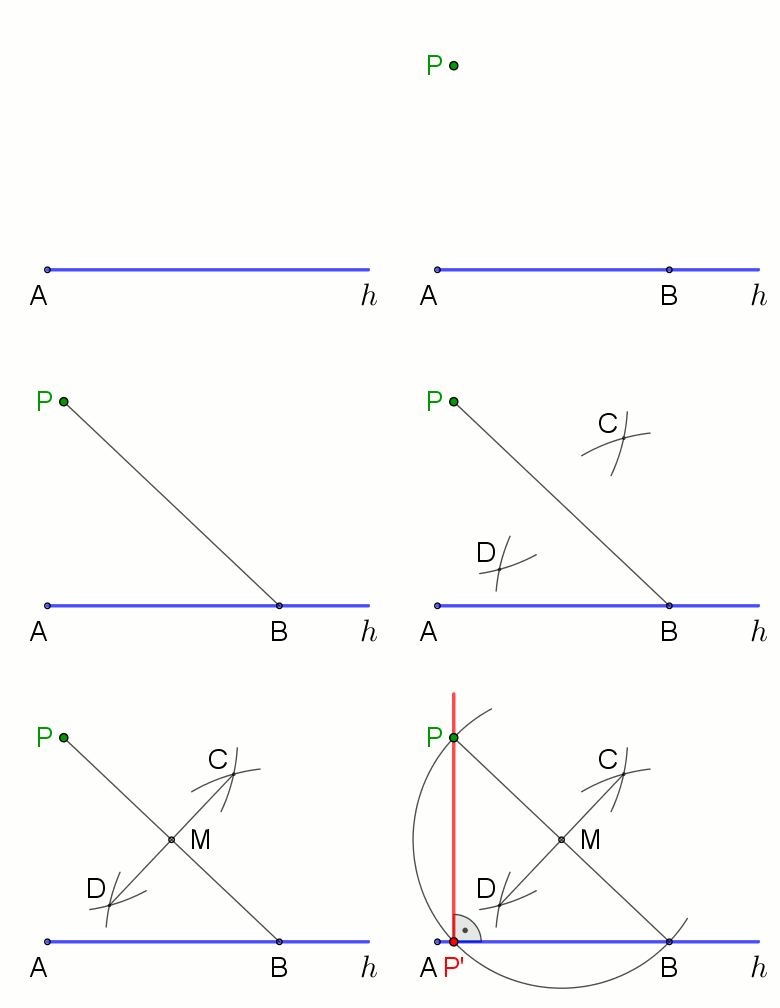

Definition and notation
A right angle is defined by its measure: 90°. In diagrams it is commonly marked with a small square placed at the vertex to indicate the right angle. In more formal texts the relation of perpendicularity between two lines ℓ₁ and ℓ₂ is written with the symbol ⟂ (for example, ℓ₁ ⟂ ℓ₂). For a short reference on the geometric definition see definition, and for the numeric measure see measurement.
Key properties and tests
- If two lines are perpendicular they create four right angles at their intersection; each is 90°.
- In coordinate geometry, two nonvertical lines with slopes m₁ and m₂ are perpendicular precisely when m₁·m₂ = −1 (they are negative reciprocals).
- In vector terms two vectors are orthogonal when their dot product is zero; this is the algebraic test for a right angle between directions.
- Practical tests include using a protractor to measure 90° or a try square / carpenter's square to check a corner for perpendicularity.
History, construction and common rules
Right angles have been recognized and employed since antiquity by builders and surveyors. Simple construction techniques include the 3–4–5 rule (a Pythagorean triple): a triangle with side lengths proportional to 3, 4 and 5 is a right triangle, so laying out lengths in that ratio gives a practical right angle for construction. Standard tools for producing or checking right angles include set squares, framing squares and modern digital levels.
Uses, examples and distinctions
Right angles occur in architecture (walls meeting floors and other walls), furniture, machine parts, engineering drawings and digital graphics. For instance, the top bar of the letter "T" meets its stem at right angles; many building walls are designed to be perpendicular to floors to simplify construction and load calculations—see walls, buildings and floor discussions for context. The term square angle is occasionally used as a synonym for right angle. When flat surfaces meet at 90°, they form a pair of perpendicular planes; for more on plane geometry, consult planes.
Why it matters
Right angles are fundamental to defining orthogonality in mathematics and to ensuring stability and predictability in manufactured and built objects. They produce regularity in shapes (rectangles, squares), simplify calculations (right triangles and trigonometry), and serve as a basic standard in surveying and design. Recognizing and constructing right angles reliably remains a practical skill in many trades as well as a conceptual cornerstone in mathematics and physics.
Related articles
Author
AlegsaOnline.com Right angle (90°) — definition, notation, tests and uses Leandro Alegsa
URL: https://en.alegsaonline.com/art/82889