
Physical change — alterations in form or state of matter
A physical change alters a substance's form, shape, or state without creating a new substance; examples include melting, freezing, dissolving, crystallization and mechanical deformation.
A physical change is any process that alters the form, appearance, or physical state of a substance without changing its chemical identity. In a physical change the molecules or atoms that make up the material remain the same species; only their arrangement, phase, or energy distribution is modified. Common macroscopic examples include cutting, bending, melting, freezing and dissolving. Because the composition is unchanged, many physical changes are reversible, although some are effectively irreversible for practical purposes (for example, shattering glass).
Image gallery
1 Image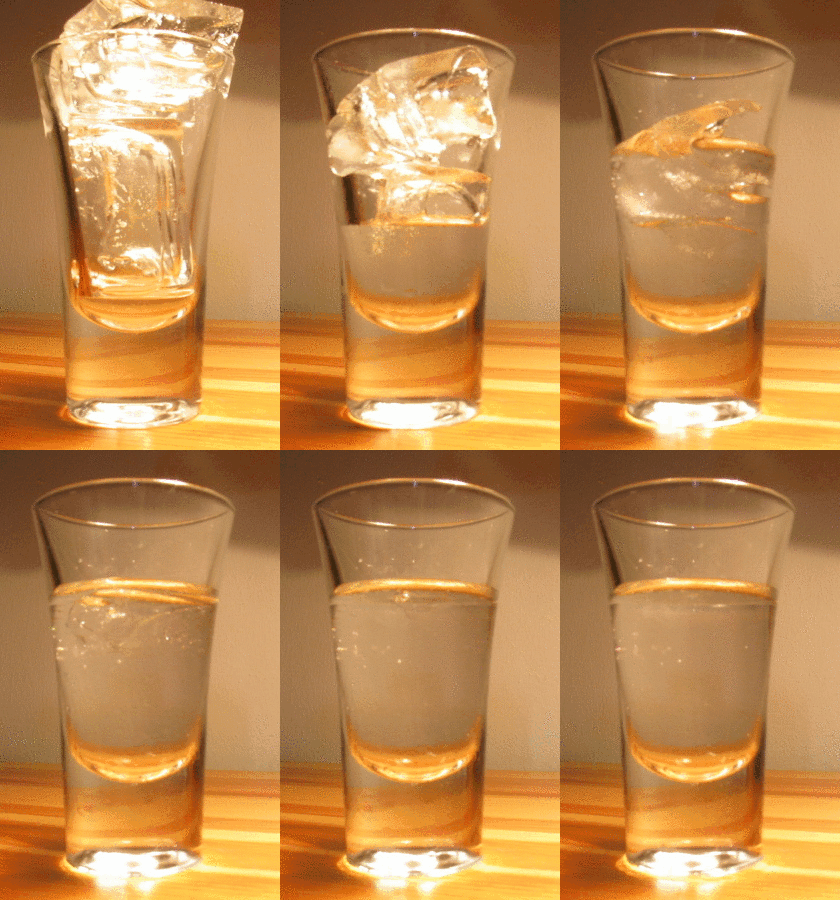
Key characteristics
Characteristic features of physical changes include conservation of chemical composition and mass, and alteration of physical properties such as shape, volume or density. Energy is often exchanged during the process—heat must be added to melt ice and removed to condense steam—but no new chemical bonds are formed or broken in the sense of producing different chemical species. Some processes, like crystallization, do involve a reorganization of atoms into an ordered structure even though the substance remains chemically identical.
Common examples
- Phase transitions: melting, freezing, boiling/evaporation, condensation, sublimation and deposition.
- Mechanical changes: cutting, stretching, crushing or bending of solids.
- Mixing and dissolving: dissolving salt in water or sugar in tea (the dissolved molecules remain chemically the same).
- Electrical conduction in a metal: passing electricity through a copper wire is a physical process involving mobile electrons rather than a chemical transformation.
Microscopic explanation
On a microscopic level, physical changes mainly alter intermolecular forces and spatial arrangements. Phase changes change how molecules pack and move—solids have restricted motion and ordered positions, liquids permit flow while maintaining cohesion, and gases have widely separated, rapidly moving molecules. Even when atoms shift positions to form a crystal lattice, their electronic structures and chemical identities remain the same.
Distinguishing from chemical change
Chemical changes produce new substances with different compositions and typically involve the making or breaking of chemical bonds. They are often accompanied by observable signs such as color change, gas evolution, or heat release, but these signs are not exclusive to chemical reactions. Because some physical processes can also release odor or gas (e.g., boiling a flavored liquid), classification relies on whether the chemical identity of the substance has changed rather than on a single indicator like reversibility.
Applications and importance
Understanding physical changes is central to many technologies and everyday practices: distillation and crystallization separate mixtures without chemical transformation; refrigeration and heat engines utilize phase changes to move energy; metalworking employs mechanical and thermal physical changes to shape materials; and recycling often depends on physical separation. Recognizing when a change is physical helps in designing processes that conserve mass and in selecting appropriate methods for separation and recovery.
In summary, physical changes rearrange matter's form or state while preserving its chemical identity. They are ubiquitous in nature and industry and are defined by conservation of composition, alterations in energy and structure, and often but not always by practical reversibility.
Related articles
Author
AlegsaOnline.com Physical change — alterations in form or state of matter Leandro Alegsa
URL: https://en.alegsaonline.com/art/76642