
Phosphorus(V) chloride (phosphorus pentachloride)
Phosphorus(V) chloride (PCl5) is a chlorinating reagent and inorganic phosphorus compound. It shows molecular and ionic structures, hydrolyzes vigorously, and is used in organic and industrial synthesis.
Overview
Phosphorus(V) chloride, commonly called phosphorus pentachloride, is an inorganic phosphorus compound with the formula PCl5. In this compound phosphorus adopts an oxidation state of +5. It is widely used as a chlorinating and dehydrating reagent in laboratory and industrial chemistry.
Image gallery
7 Images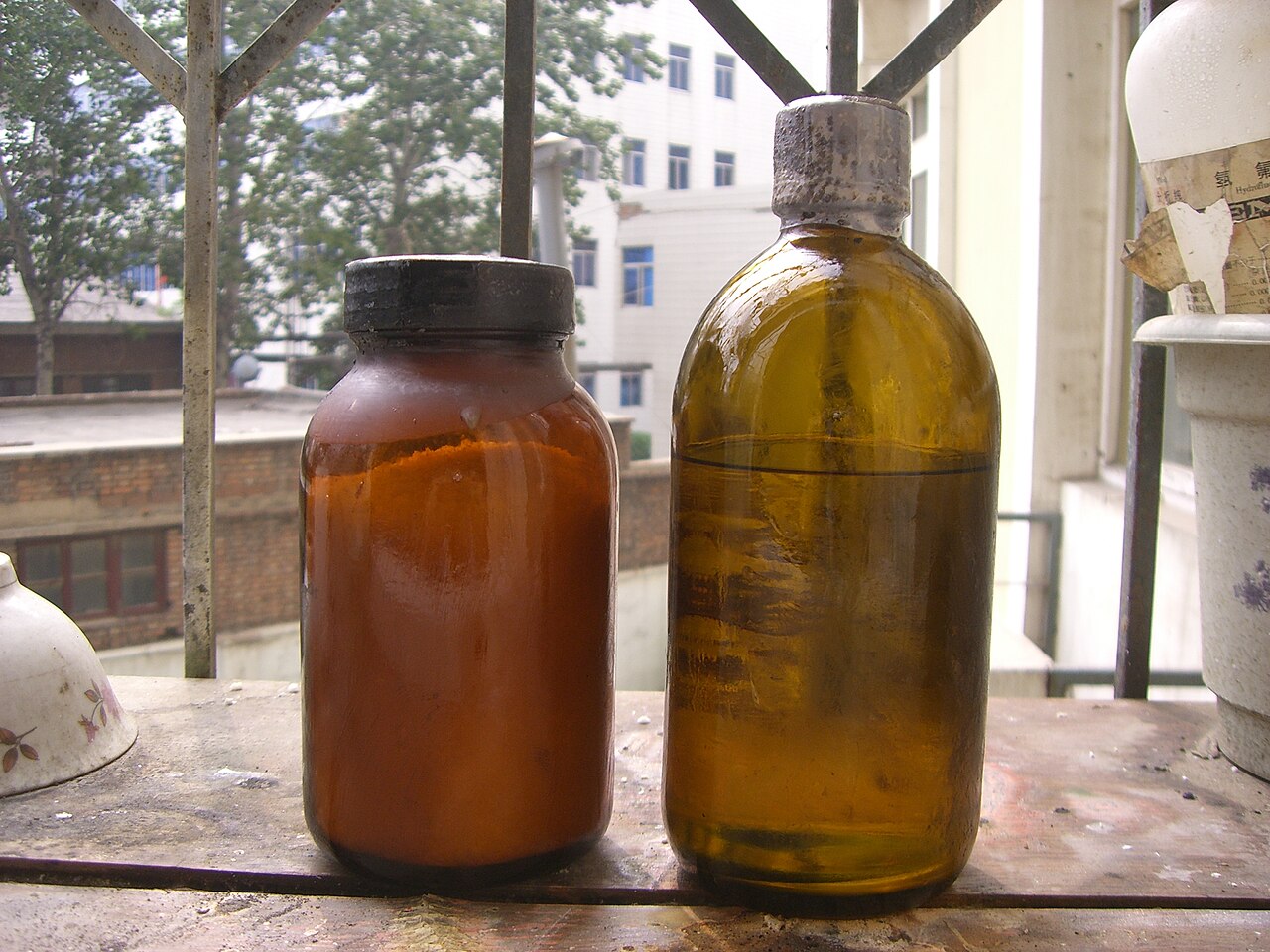


Structure and bonding
In the gas phase and in many nonpolar solutions PCl5 exists as a covalent, trigonal bipyramidal molecule (AX5, VSEPR geometry). In the solid state it is better described as an ionic pair, composed of the tetrahedral cation [PCl4+] and the octahedral anion [PCl6-]. This dual character reflects the ability of phosphorus to expand its coordination number beyond four.
Preparation and equilibrium
PCl5 is prepared by chlorinating phosphorus trichloride. The reaction PCl3 + Cl2 ⇌ PCl5 is reversible and temperature- and pressure-dependent; heating or reducing chlorine shifts the equilibrium toward PCl3 and Cl2. Industrial syntheses and laboratory preparations control conditions to favor formation of PCl5.
Chemical behavior and typical reactions
PCl5 is a strong chlorinating agent and reacts readily with nucleophiles. It hydrolyzes vigorously with water to give phosphorus oxychloride (POCl3) and hydrogen chloride, and further hydrolysis yields phosphoric acid. It can convert alcohols and carboxylic acids to the corresponding chlorides and forms hexachlorophosphate salts in the presence of excess chloride.
- Hydrolysis: PCl5 + H2O → POCl3 + 2 HCl (overall steps)
- Chlorination: alcohols → alkyl chlorides; acids → acyl chlorides
- Complex formation: reacts with Cl- to form [PCl6-]
Applications
PCl5 is used as an intermediate in the manufacture of organophosphorus compounds and phosphorus oxychloride, and as a reagent for introducing chlorine into organic molecules. In research laboratories it serves as a convenient chlorinating or dehydrating reagent where more selective alternatives are not required.
Safety and handling
Phosphorus pentachloride is corrosive and reacts exothermically with moisture to release toxic hydrogen chloride gas and possibly chlorine. It must be handled in a dry, well-ventilated area or inert-atmosphere glovebox, with appropriate personal protective equipment and secondary containment. Spills are neutralized carefully and wastes treated according to regulations.
Questions and answers
Q: What is phosphorus(V) chloride?
A: Phosphorus(V) chloride is a chemical compound also known as phosphorus pentachloride.
Q: What is the chemical formula of phosphorus(V) chloride?
A: The chemical formula of phosphorus(V) chloride is PCl5.
Q: What types of ions does phosphorus(V) chloride contain?
A: Phosphorus(V) chloride contains phosphorus and chloride ions.
Q: What is the oxidation state of phosphorus in phosphorus(V) chloride?
A: The oxidation state of phosphorus in phosphorus(V) chloride is +5.
Q: What is the other name of phosphorus pentachloride?
A: Phosphorus pentachloride is another name for phosphorus(V) chloride.
Q: Can we say that phosphorus pentachloride is a chemical compound?
A: Yes, we can say that phosphorus pentachloride is a chemical compound.
Q: What chemical compound contains phosphorus and chloride ions?
A: Phosphorus(V) chloride is the chemical compound that contains phosphorus and chloride ions.
Related articles
Author
AlegsaOnline.com Phosphorus(V) chloride (phosphorus pentachloride) Leandro Alegsa
URL: https://en.alegsaonline.com/art/76584