
Philosophiæ Naturalis Principia Mathematica
Isaac Newton's 1687 Principia sets out the laws of motion and universal gravitation in three books, founding classical mechanics and reshaping natural philosophy with mathematical argument.
Overview
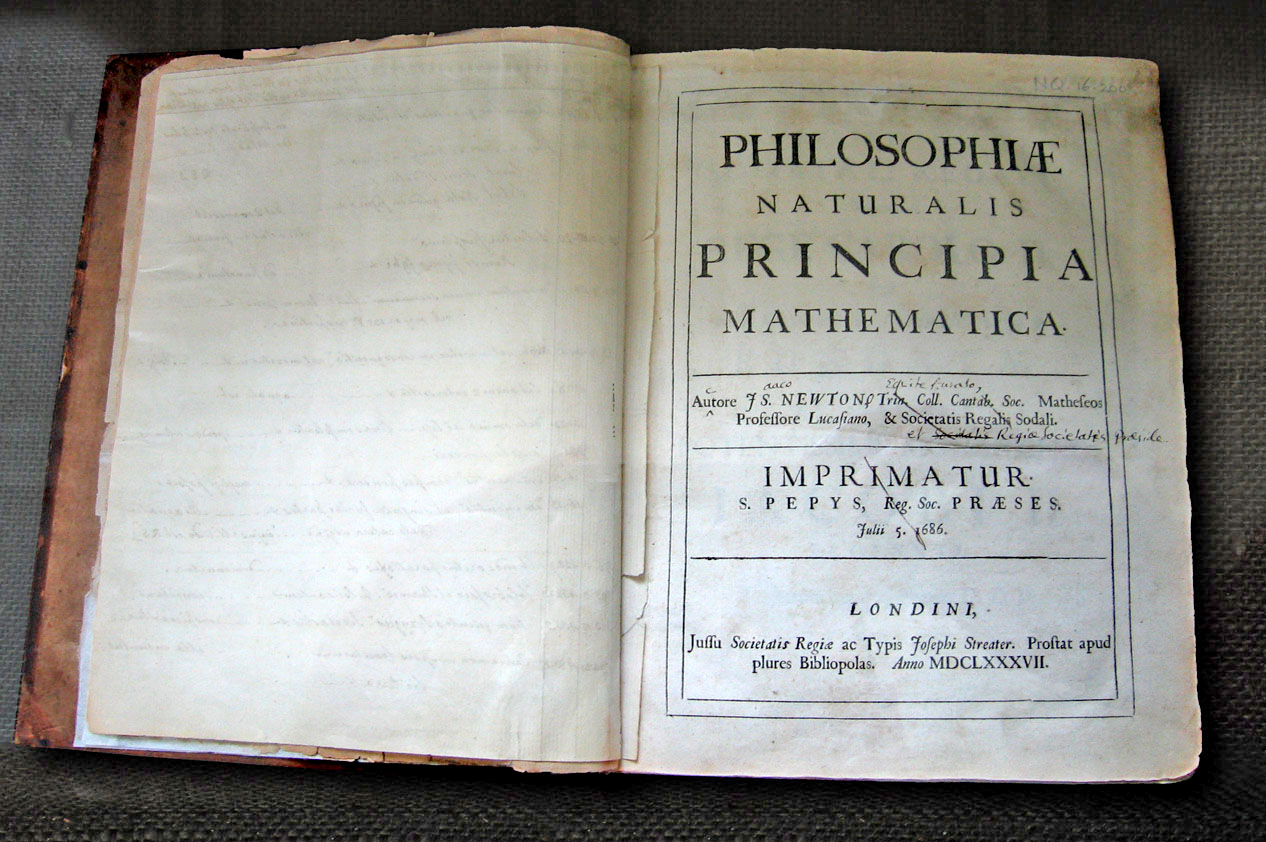
The Philosophiæ Naturalis Principia Mathematica, commonly called the Mathematical Principles of Natural Philosophy, is a three‑part treatise first published in 1687. Written by Isaac Newton, it presents a systematic mathematical account of nature that unifies terrestrial and celestial phenomena. The work became a cornerstone for modern physics and applied mathematics, introducing formulations that remain central to science.
Image gallery
10 Images




Contents and structure
The Principia is organized into three books that build from idealized motion to the description of the solar system. It opens with fundamental definitions and three laws that form the framework for subsequent arguments. These laws are often cited as Newton's laws of motion, and they underpin the derivation of planetary motion and many mechanical results.
- Book I: Mathematical principles of motion in the absence of resistance, geometrical demonstrations and the mechanics of bodies.
- Book II: Motion in resisting media and methods for treating fluid resistance and collisions.
- Book III: The system of the world, application of the inverse‑square force law to explain planetary orbits and the phenomena of gravity.
Methods and mathematics
Although Newton had developed methods of fluxions (an early form of calculus), the arguments in the Principia are presented largely by geometric reasoning and limits, tailored to the standards of rigorous demonstration of the time. This blend of mathematics and physical interpretation set a new model for scientific explanation: laws expressed quantitatively and applied to observation.
History and editions
The original 1687 edition appeared through the patronage and encouragement of Edmund Halley; later editions introduced clarifying material and responses to critics. Subsequent printings altered phrasing, added scholia and refined proofs as the work was debated and absorbed by the scientific community.
Impact, controversies and legacy
The Principia reshaped natural philosophy by showing that a small set of principles could account for a wide range of physical phenomena, from falling bodies to planetary motion. It provoked discussion and dispute—both about priority for mathematical techniques and about the interpretation of space, time and action at a distance—but its success in predicting and explaining observations secured its central place in the scientific revolution. The Principia influenced mechanics, astronomy and engineering and remains a landmark in the history of science.
Notable facts
The book was written in Latin and framed as mathematical principles rather than as experimental reports. Its rigorous approach encouraged later thinkers to adopt quantitative laws and to test theories against observation. For readers seeking introductions or translations, modern annotated editions and translations are widely available to help bridge the original geometric style and contemporary calculus‑based expositions.
For further reading and resources see: overview and editions, biographical material on Newton, foundational topics in physics and mathematics, and discussions of the laws of motion and gravity.
Related articles
Author
AlegsaOnline.com Philosophiæ Naturalis Principia Mathematica Leandro Alegsa
URL: https://en.alegsaonline.com/art/76504