
Phonon — the quantized vibration of a crystal lattice
A phonon is the quantum of vibrational energy in a crystal lattice: a quasiparticle describing collective atomic motion, important for thermal, electrical and optical properties of solids.
Overview
A phonon is the quantum-mechanical description of a normal mode of vibration in a periodic solid. In everyday language it is convenient to call a phonon a "particle" because it behaves like a discrete packet of vibrational energy and momentum, but strictly speaking a phonon is a quasiparticle representing a collective oscillation of many atoms. The concept links microscopic motion of atoms with macroscopic properties such as heat capacity and thermal conductivity, and it belongs to the domain of physics.
Image gallery
5 Images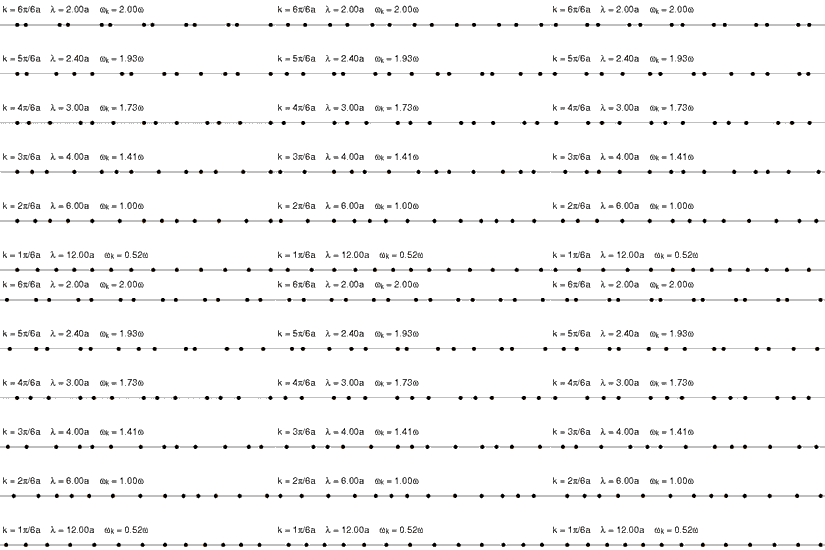


Basic characteristics
Solids built from atoms or molecules arranged on a repeating pattern — a crystal lattice — support waves of displacement that propagate through the structure. These waves are characterized by a wavelength (or wavevector) and a frequency. Quantum theory shows that the energy of each allowed vibrational mode is quantized in units of phonons, so the mode can be thought of as occupied by an integer number of phonons. The allowed frequencies follow a dispersion relation that depends on the lattice geometry and interatomic forces; this relation distinguishes between low-frequency acoustic modes and higher-frequency optical modes.
Types and important distinctions
- Acoustic phonons: long-wavelength modes in which neighboring atoms move in phase; these carry sound and heat.
- Optical phonons: higher-frequency modes in multi-atom unit cells where sublattices move against one another; these often interact with electromagnetic radiation.
- Quanta and classical waves: at large scales vibrations appear continuous, but atomic-scale modes are quantized. The quantum treatment requires ideas from quantum mechanics and leads to discrete allowed oscillation energies.
Historical models and theoretical context
Early attempts to explain specific heat led to two simplified models: the Einstein model, which treated each atom as an independent quantum oscillator, and the Debye model, which treated collective vibrations across the whole solid and successfully described low-temperature heat capacity. These frameworks paved the way for the fuller lattice-dynamics treatment that yields phonon dispersion curves and mode densities. Calculating allowable vibration frequencies involves solving equations of motion for atoms in the repeating lattice and imposing periodic boundary conditions, which produces the quantized spectrum of normal modes.
Practical importance and examples
Phonons play a central role in numerous solid-state phenomena. They transport thermal energy and thus determine thermal conductivity; their scattering limits heat flow in insulators and affects thermoelectric performance. Phonons interact with electrons and can scatter charge carriers, influencing electrical resistance. In conventional superconductors phonon-mediated attraction between electrons is the mechanism behind Cooper pairing. Optical phonons are probed in vibrational spectroscopies and are responsible for features in Raman and infrared spectra.
Experiments and additional considerations
Phonon properties are measured by techniques such as inelastic neutron scattering, inelastic x-ray scattering and Raman spectroscopy, which map dispersion relations and lifetimes. Scattering processes include normal collisions that conserve crystal momentum and Umklapp events that effectively dissipate momentum and contribute to thermal resistance. Phonons also have finite lifetimes due to anharmonic interactions and defects, and these lifetimes control thermalization rates in nanostructures and devices.
For accessible background reading on lattice vibration concepts, see introductory materials on vibrations, the nature of allowed frequencies, basic macroscopic versus microscopic behavior, discrete oscillations, and more advanced treatments in solid-state quantum mechanics.
Questions and answers
Q: What is a phonon?
A: A phonon is a quantized lattice vibration in physics.
Q: What does the word "quantized" mean in physics?
A: In physics, the word quantized means that only certain values of something are allowed.
Q: How can something that is quantized be thought of?
A: Something that is quantized can be thought of as stairs; you can only move from step to step and you can't stand in between steps.
Q: What is a lattice?
A: A lattice is the repeating or periodic structure of a crystal, made up of atoms or molecules in a certain pattern with points on the pattern at which the atoms or molecules are located.
Q: Can solids, liquids, and gases all experience vibrations?
A: Yes, solids, liquids, and gases can all experience vibrations.
Q: Why do phonons exist?
A: To understand why phonons exist, complicated quantum mechanics is needed. Without going into too much detail, the interactions between the constituent atoms or molecules of a crystal are analyzed quantum mechanically. Because of their arrangement in a pattern that repeats, when one arrives at a mathematical expression for the frequency of oscillation, one finds that there are only distinct quantized values allowed.
Related articles
Author
AlegsaOnline.com Phonon — the quantized vibration of a crystal lattice Leandro Alegsa
URL: https://en.alegsaonline.com/art/76563