
Petroleum coke (petcoke)
Carbon-rich solid residue from crude oil refining used as fuel and industrial feedstock; available in fuel and specialty grades and associated with sulfur and metal contamination risks.
Overview
Petroleum coke, commonly called petcoke, is a solid carbonaceous residue left after refining heavy petroleum fractions. It is produced when the heaviest parts of crude oil are thermally processed to remove volatile components. The material is largely carbon with variable amounts of hydrogen, sulfur and trace metals, and it appears as coarse nodules or powder depending on the production route and grade. For basic composition data see composition sources.
Image gallery
2 Images
Production methods and types
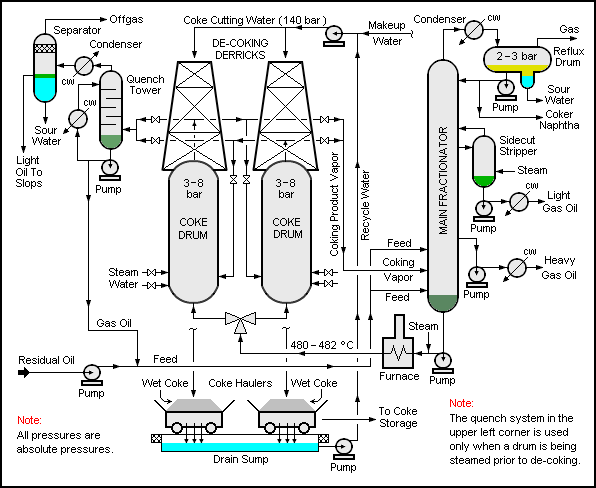
Petcoke is generated in refinery coking units that upgrade residual fuel oils. The main processes are delayed coking and fluid coking; other methods yield different shapes and properties. Major commercial categories include:
- Fuel (green) coke: a cheaper, porous form burned as an industrial fuel after drying.
- Calcined coke: heat-treated to remove volatiles and harden structure for industrial uses.
- Needle coke: a dense, low-impurity grade used to make graphite electrodes and some battery anode materials.
- Shot and sponge coke: morphological variants produced under specific conversion conditions.
These types depend on feedstock and process conditions in the refinery; heavier petroleum residues are typical feedstocks (refinery feed), while coal-derived coke is produced from coal under quite different conditions (comparison with coal coke).
Properties and industrial uses
Petcoke has a high carbon content and substantial calorific value, making it attractive as a fuel in cement kilns, power plants and industrial boilers. Specialty grades are essential for producing carbon anodes in the aluminum industry and for graphite electrodes used in electric-arc steelmaking. It is also used as a recarburizer in steel and iron processing and in certain metallurgical heat treatments (steel uses, iron applications).
Environmental and health considerations
While economical, petcoke can contain sulfur and trace metals such as nickel and vanadium, which become concerns when the material is combusted or handled in large volumes. Combustion can emit sulfur oxides and particulates; storage piles can generate dust and runoff that requires management. The presence of metals influences both emissions and the value of specific grades (nickel issues, vanadium issues).
Storage, handling and regulation
Petcoke is typically stored near refineries or shipped to industrial consumers. Because it can be dusty and weather-sensitive, best practices include covered storage, water suppression or dry handling systems and runoff controls. Local air quality and waste regulations often govern its use and transport; markets for calcined and needle coke are more tightly controlled due to purity requirements.
Distinctions and notable facts
Petroleum coke differs from metallurgical coke (made from coal) in origin, chemistry and common uses. Calcination (a high-temperature treatment) converts green coke into a harder, lower-volatile product required for electrical and metallurgical applications. Needle coke, although a small fraction of total production, is strategically important for aluminum smelting and electrode manufacture because of its low coefficient of thermal expansion and high conductivity.
For further technical references and regulatory guidance, see composition, coal coke comparison, refinery coking, coal coking background, nickel, vanadium, steel heat-treatment uses, and iron industry uses.
Related articles
Author
AlegsaOnline.com Petroleum coke (petcoke) Leandro Alegsa
URL: https://en.alegsaonline.com/art/76227