
Pentacontagon (50-sided polygon)
A pentacontagon is a polygon with fifty sides. This article explains its geometry, formulas for angles and area, symmetry, constructibility, etymology, and notable combinatorial properties.
A pentacontagon, sometimes spelled pentecontagon, is a polygon with fifty sides and fifty vertices. In the context of geometry it is one example in the family of many-sided polygons; more generally it is a type of polygon. The shape can be irregular or regular. For any pentacontagon the sum of the interior angles equals 8640 degrees, obtained from the general formula (n-2)·180° with n = 50.
Image gallery
4 Images

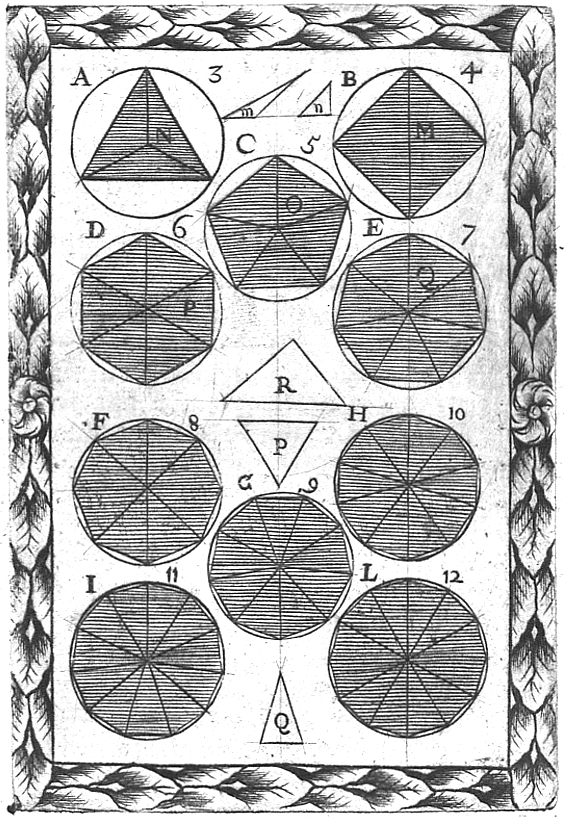
Geometric characteristics
For a regular pentacontagon (all sides and angles equal) simple numerical values follow directly from n = 50. The central angle between consecutive vertices is 360°/50 = 7.2°. Each interior angle measures 180° - 360°/50 = 172.8°, so the polygon's edges deviate only slightly from a straight line. Triangulation of a pentacontagon produces 48 triangles, and the number of diagonals is 50·47/2 = 1175.
Formulas and algebraic description
- Interior angle sum: (50-2)·180° = 8640°.
- Interior angle (regular): 172.8°; central angle: 7.2°.
- Area for regular pentacontagon with side length s: A = (50/4)·s²·cot(π/50) = (25/2)·s²·cot(π/50), or equivalently A = 25·s·a where a is the apothem.
- Apothem a relates to side s by a = s/(2·tan(π/50)).
- Symmetry of the regular form: dihedral group D50 of order 100.
As with any regular n-gon, the coordinates of its vertices on the unit circle are given by the 50th roots of unity, e^{2πim/50} for m = 0,1,…,49, which connects the pentacontagon to complex numbers and cyclotomic theory.
Constructibility and related figures
The regular pentacontagon has Schläfli symbol {50}. A classical result about straightedge-and-compass constructibility states that a regular n-gon is constructible if and only if n = 2^k times a product of distinct Fermat primes. Because 50 = 2·5^2 contains a repeated Fermat prime (5 appears twice), the regular pentacontagon is not constructible with only compass and straightedge. It can, however, be studied algebraically or approximated and can be drawn by other methods.
Related star polygons are denoted {50/k} for integers k with 2 ≤ k ≤ 24; when gcd(50,k) > 1 the figure decomposes into several identical polygons (a compound), otherwise it produces a single star polygon. These variations are commonly explored in the study of polygonal symmetries and star figure classification.
Etymologically, the name derives from Greek roots: penta- (five) combined with konta (tens) to indicate fifty; alternative spellings reflect different transliterations. In practice, pentacontagons are most often of theoretical and pedagogical interest—used to illustrate polygon formulas, symmetry groups, and relationships among roots of unity—rather than appearing frequently in standard architectural patterns, although any many-sided figure can serve decorative or approximation-to-circle purposes.
Related articles
Author
AlegsaOnline.com Pentacontagon (50-sided polygon) Leandro Alegsa
URL: https://en.alegsaonline.com/art/75622
Sources
- books.google.com : The Facts on File Geometry Handbook
- books.google.com : The New Elements of Mathematics: Algebra and geometry
- mathworld.wolfram.com : Constructible Polygon
- math.iastate.edu : "Archived copy"
- mathworld.wolfram.com : Pentacontagon
- mathforum.org : Naming Polygons and Polyhedra
- books.google.com : A Mathematical Solution Book Containing Systematic Solutions to Many of the Most Difficult Problems: Taken from the Leading Authors on Arithmetic and Algebra, Many Problems and Solutions from Geometry, Trigonometry and Calculus, Many Problems and Solutions from the Leading Mathematical Journals of the United States, and Many Original Problems and Solutions