
Pentadecagon (15-sided polygon)
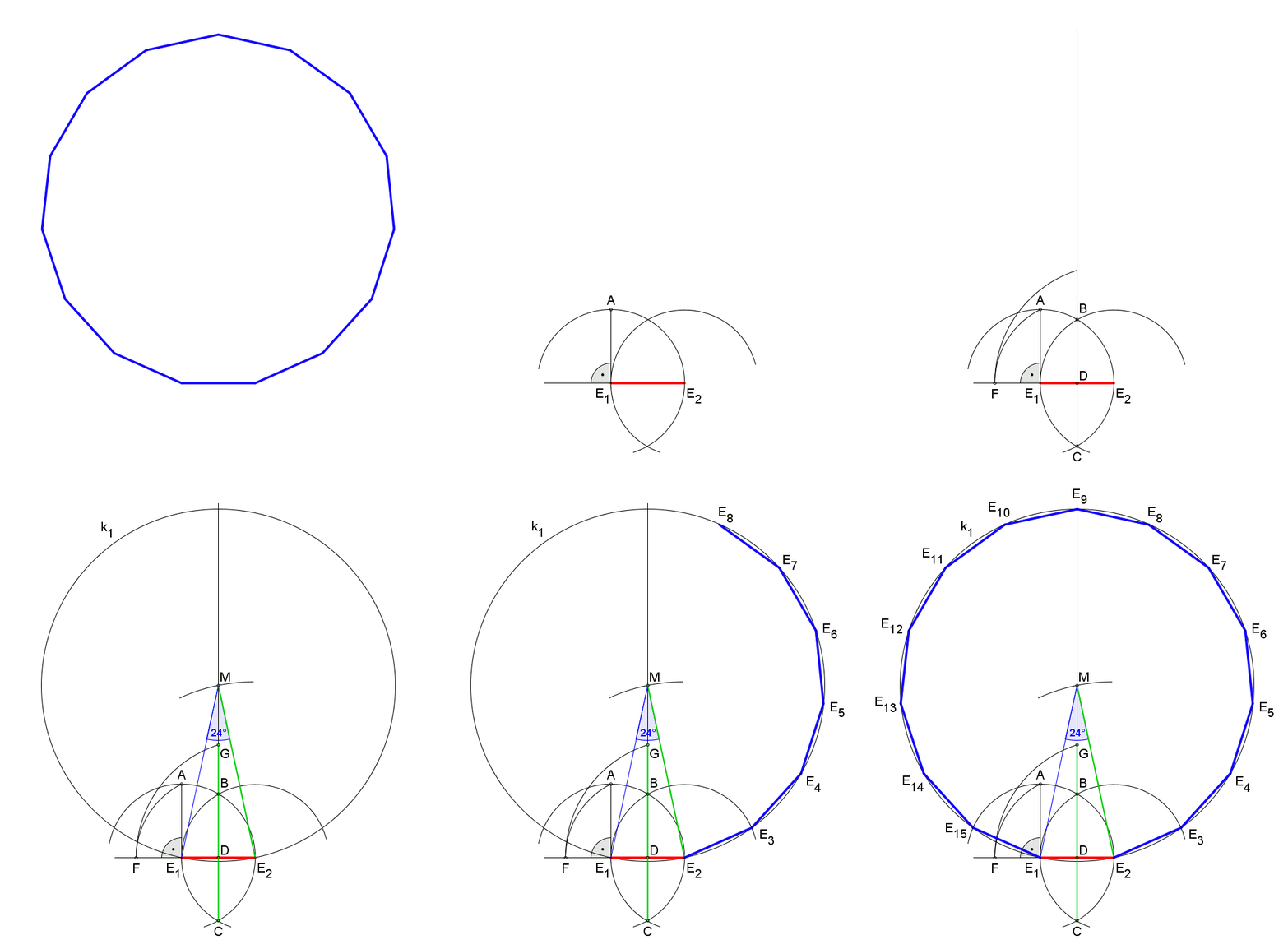
A pentadecagon is a polygon with 15 sides and vertices. The regular pentadecagon has interior angles of 156°, central angle 24°, is constructible by classical methods, and has dihedral symmetry D15.
A pentadecagon, also called a quindecagon or 15-gon, is a planar polygon with fifteen straight edges and fifteen vertices. When all sides and angles are equal it is a regular pentadecagon: a highly symmetric figure whose vertices lie on a common circle and whose study connects elementary geometry, trigonometry and classical compass-and-straightedge construction.
Image gallery
6 Images



Basic properties
The regular pentadecagon has a central angle of 360/15 = 24° between adjacent vertices and each interior angle measures (15-2)·180/15 = 156°. The sum of all interior angles equals 13·180 = 2340°. A 15-gon has n(n-3)/2 = 90 diagonals. Its symmetry group is the dihedral group D15 of order 30, comprising 15 rotations and 15 reflections.
Formulas and coordinates
Area and metric relations for a regular pentadecagon can be written in closed form. For side length a: area = (15/4)·a^2·cot(π/15). In terms of circumradius R: area = (15/2)·R^2·sin(2π/15). Vertex coordinates in the complex plane are proportional to the 15th roots of unity: exp(2πik/15) for k = 0,...,14.
Construction and algebraic facts
Because 15 = 3·5 and both 3 and 5 are Fermat primes, the regular pentadecagon is constructible with straightedge and compass. Trigonometric values like cos(2π/15) can be expressed using nested square roots, allowing explicit classical constructions that combine constructions for an equilateral triangle and a regular pentagon.
Related figures and examples
Besides the regular convex form, one can draw star polygons with the same 15 vertices by connecting every k-th vertex; notable star figures include {15/2}, {15/4} and {15/7}. Pentadecagons appear in problems of tiling approximations, decorative design, and polygonal decomposition exercises in elementary geometry.
For further general reference about fifteen-sided polygons see pentadecagon resources and treatments that discuss construction steps, trigonometric identities, and symmetry classifications.
Related articles
Author
AlegsaOnline.com Pentadecagon (15-sided polygon) Leandro Alegsa
URL: https://en.alegsaonline.com/art/75623