
Penny Black — the world's first adhesive postage stamp
The Penny Black, introduced by the United Kingdom in 1840, was the first adhesive postage stamp. This article explains its design, printing, use, distribution, and significance for postal reform and collecting.
The Penny Black was the world's first adhesive postage stamp, issued in the United Kingdom in 1840 as part of postal reforms that introduced prepayment for ordinary letters. Officially released on 1 May 1840 and valid from 6 May, the stamp bore a profile of Queen Victoria and covered the standard one‑penny domestic letter rate of the time. Its introduction followed proposals for simplifying and reducing postal charges and marked a turning point in the global development of modern postal services. See an overview at first adhesive postage stamp and related postal reform material at postal history resources.
Image gallery
6 Images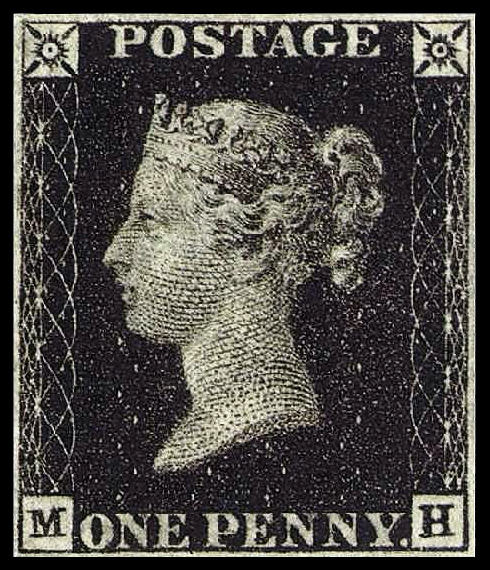


Design and manufacture
The design features a left‑facing head of Queen Victoria derived from a medallion by William Wyon, printed in black ink on white paper. Each stamp included small check letters in opposite corners to deter forgery and to identify position on the printed sheet. Sheets were printed in large runs and issued with a gum adhesive on the back so they could be affixed to letters. Details about the stamp's artwork and typographic features can be found via design studies and archival plates at UK postal archives.
Use and cancellations
When the Penny Black was placed on mail it was normally cancelled with a red Maltese cross mark so the adhesive could not be reused. Although visible on the black-printed stamp, the red cancellation proved imperfect: it was sometimes difficult to spot and could be cleaned away, which encouraged fraud. Because black ink cancellations were easier to see on the later red stamps, the Penny Black was soon superseded by the Penny Red. For practical notes on cancellations and forensics see cancellation references and related collections at postmark studies.
Distribution, print run and survival
Distribution of the Penny Black was not uniform at first. All London post offices received official issues, but many provincial offices did not immediately get supplies; some towns offered stamps unofficially before the general rollout. For instance, a number of offices, including Bath, made early sales and local practices varied. The recorded print run totaled hundreds of thousands of sheets and many millions of individual stamps; while used examples are common today, unused or pristine specimens are much scarcer. General production and distribution information is summarized at postal distribution records and historical summaries at philatelic resources.
Collecting, value and legacy
The Penny Black remains a central object of interest for collectors and historians. Ordinary used examples are widely available in collections, but items in mint condition, with intact gum and no traces of cancellation, are rare and command higher prices; a mint example may fetch significant sums at auction. Beyond market value, the Penny Black's chief legacy is symbolic: it established the principle of prepaid postage by adhesive labels and inspired similar reforms and stamp issues around the world. Contemporary philatelic guides, plate studies and auction catalogues provide more detail for collectors and researchers.
- Issue date: 1 May 1840 (valid from 6 May 1840).
- Main design: Queen Victoria's profile derived from a medal by William Wyon.
- Cancellation: red Maltese cross (later changed to black on the Penny Red).
- Distribution notes: London offices received official issues first; some other offices offered early or unofficial sales.
Related articles
Author
AlegsaOnline.com Penny Black — the world's first adhesive postage stamp Leandro Alegsa
URL: https://en.alegsaonline.com/art/75600
Sources
- firstissues.org : "Great Britain: Wednesday, May 6, 1840"