
Patrick Geddes — Scottish biologist, sociologist and pioneering town planner
Sir Patrick Geddes (1854–1932) was a Scottish biologist, sociologist, geographer and influential town planner known for the civic survey method, 'place–work–folk' approach and master plans for Jerusalem and Tel Aviv.
Overview
Sir Patrick Geddes (2 October 1854 – 17 April 1932) was a Scottish natural scientist turned social thinker whose work bridged biology, sociology, geography and urban planning. Trained in biology, he applied ecological and evolutionary metaphors to human settlements and civic life and promoted interdisciplinary study as a foundation for practical design. He is widely remembered for introducing systematic surveys of places before making plans and for influencing planning practice across Europe, the Middle East and India during the era of British India.
Image gallery
6 Images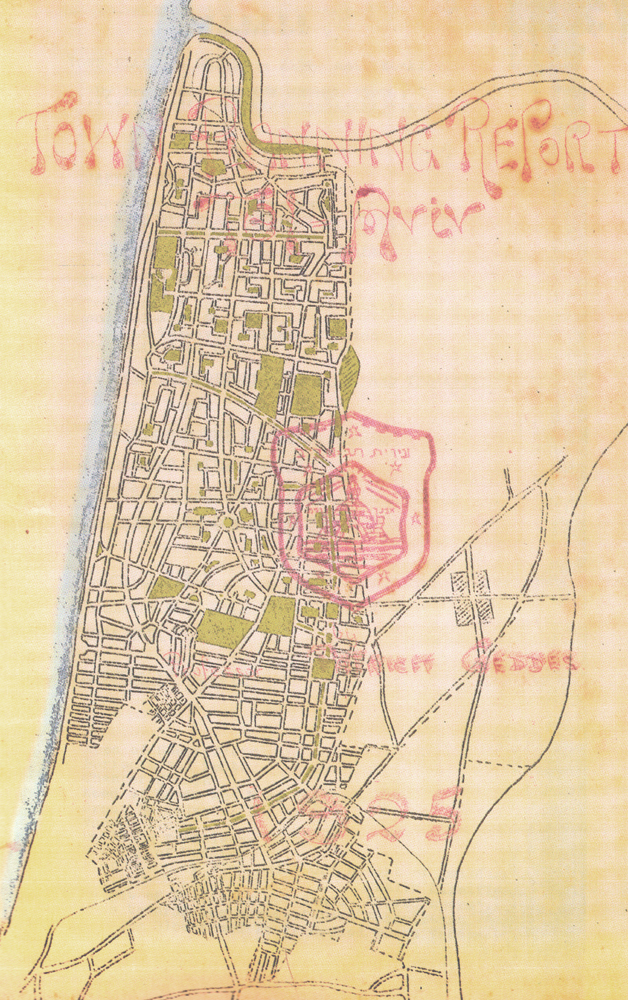


Key ideas and methods
Geddes emphasized the need to understand existing social and environmental conditions before acting. His motto, often summarized as "diagnosis before treatment," encouraged planners to gather civic surveys of population, economy, buildings and green spaces. He framed cities as living entities and used the triad place, work, folk to guide analysis and policy. Another hallmark was "conservative surgery," a preference for selective improvement and preservation rather than wholesale demolition.
Principles and practices
- Civic survey: systematic collection of maps, photographs and social data to inform planning.
- Regional thinking: planning at a scale that links towns, countryside and infrastructure.
- Education and participation: training students and communities to study their own environments.
- Incremental change: guiding development through careful repair and adaptation rather than radical clearance.
Major projects and examples
Geddes prepared master planning work that combined conservation with modern needs. Notable commissions include a postwar plan for Jerusalem prepared in 1919 and an early master plan for Tel Aviv completed in the mid-1920s. His Tel Aviv plan accommodated Mediterranean light, public open space and street patterns that later provided a framework in which modernist movements — such as Bauhaus — could be expressed in what became the city's White City. The Jerusalem work attempted to reconcile historic fabric with new public uses and infrastructure; both plans illustrate his preference for integrating old and new.
Work in other regions and legacy
Geddes taught, advised and promoted planning in many countries. His work in India included education and urban studies projects that sought to adapt ideas to local climates and societies. He founded educational institutions and public exhibitions to spread planning techniques. His influence can be traced in the development of civic survey methods, in the early conservation movement and in later planners who emphasized social and ecological dimensions of cities.
Notable facts
Geddes was knighted for his work and remained a public educator as well as a practitioner. Small memorials and plaques commemorate his influence in places where he worked; for example, a modest board remembers him under a bridge on Heil HaShirion Street in Tel Aviv. For further reading on his life and methods one may consult biographical and planning histories that examine the intersection of his scientific training and civic reform efforts. See also contemporary resources on urban conservation and regional planning for developments tracing back to Geddesian ideas.
biologist | Jerusalem master plan (1919) | Tel Aviv plan (1925)
Related articles
Author
AlegsaOnline.com Patrick Geddes — Scottish biologist, sociologist and pioneering town planner Leandro Alegsa
URL: https://en.alegsaonline.com/art/75051