
Pascal's simplex
A multidimensional generalization of Pascal's triangle producing multinomial coefficients; useful in combinatorics, probability, and discrete geometry.
Overview — Pascal's simplex is the higher-dimensional analogue of Pascal's triangle. It is a systematic arrangement of numbers whose entries are the multinomial coefficients that appear when expanding a sum of several variables. The term sits in the context of a mathematical term describing triangular and simplicial arrays and is closely related to the geometric notion of a simplex.
Image gallery
4 Images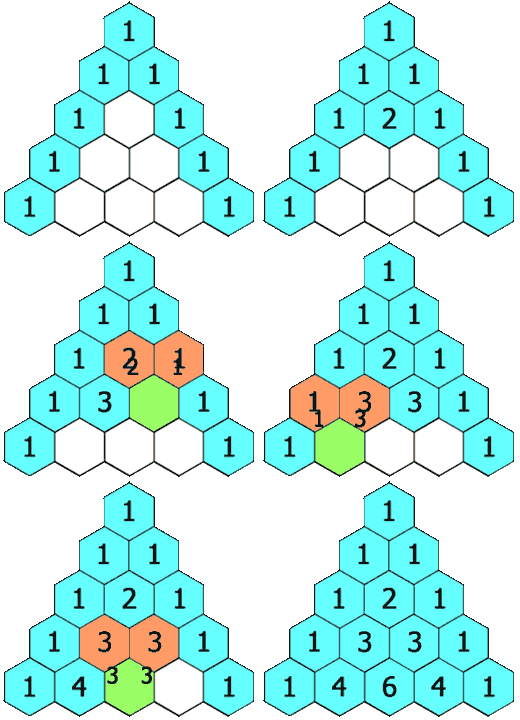
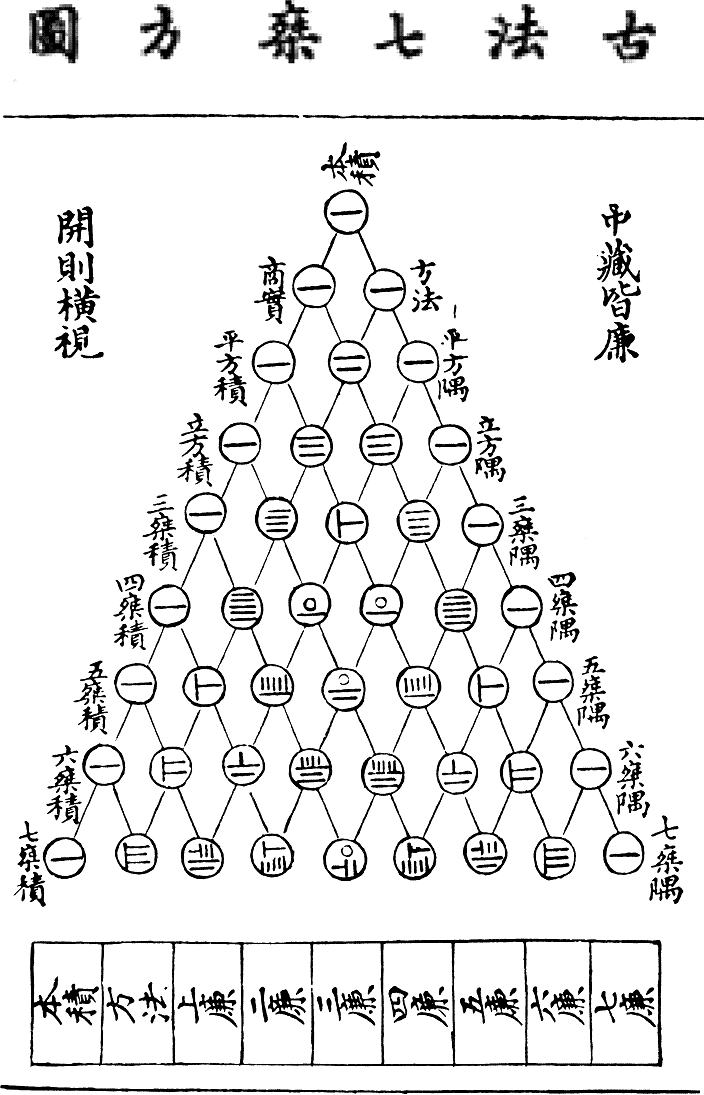

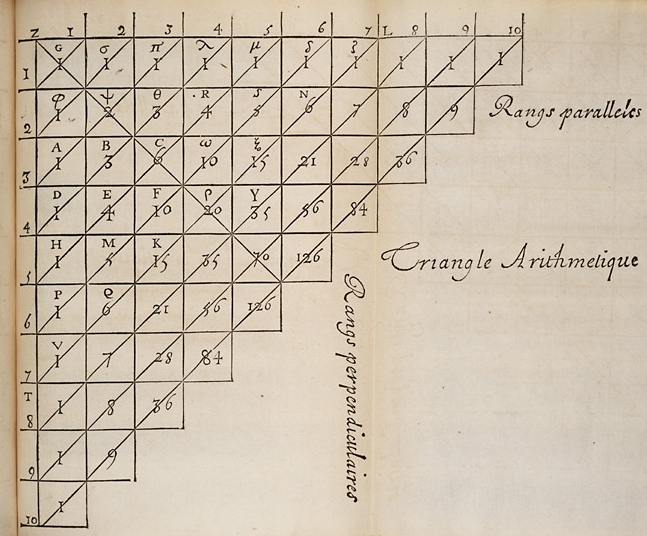
Definition and algebraic interpretation
Each entry of Pascal's simplex can be identified with a multinomial coefficient. For nonnegative integers n and a tuple of nonnegative integers (k1, k2, ..., km) summing to n, the corresponding entry equals n!/(k1! k2! ... km!). These numbers are the coefficients of terms in the expansion of (x1 + x2 + ... + xm)^n and generalize the binomial coefficients that form Pascal's triangle.
Construction rules
The array is built layer by layer by degree (the total n). An entry at multi-index (k1,...,km) equals the sum of m entries from the previous layer whose index is the same except one coordinate reduced by 1. In other words, each entry is the sum of its immediate predecessors along the m coordinate directions, mirroring the local addition rule of Pascal's triangle.
Lower-dimensional examples
When m=2 the simplex reduces to the familiar two-row form of Pascal's triangle (binomial coefficients). For m=3 one obtains a three-dimensional arrangement often called Pascal's pyramid or tetrahedral array, whose layers contain tetrahedral numbers and trinomial coefficients.
Applications and notable facts
- Combinatorics: counts ways to distribute indistinguishable items into distinct boxes or count permutations with repeated types.
- Probability: coefficients give probabilities in the multinomial distribution.
- Discrete geometry and number theory: layers produce figurate numbers and exhibit modular patterns that generalize fractal-like behavior seen in Pascal's triangle.
Historically, Pascal's triangle was popularized by Blaise Pascal, but multidimensional generalizations are natural extensions studied in combinatorics and algebra. For further reading on related arrays and their properties see standard combinatorics texts or online references: definition resources, geometric simplex overview, and Pascal's triangle articles.
Related articles
Author
AlegsaOnline.com Pascal's simplex Leandro Alegsa
URL: https://en.alegsaonline.com/art/74895