
Pas de Quatre: the 1845 Romantic ballet for four celebrated ballerinas
Pas de Quatre (1845) is a short Romantic-era ballet by Jules Perrot to music by Cesare Pugni, created to showcase four leading ballerinas and notable for its rare gathering of rivals on one stage.
Overview
Pas de Quatre is a brief but historically significant work from the Romantic ballet era. The dance was choreographed by Jules Perrot to music by Cesare Pugni and intended as a display piece rather than a narrative ballet. It belongs to the tradition of the romantic ballet in which atmosphere, ethereal style and individual virtuosity were prized. The premiere took place at Her Majesty's Theatre in London on 12 July 1845, and contemporary accounts record enthusiastic critical response.
Image gallery
4 Images
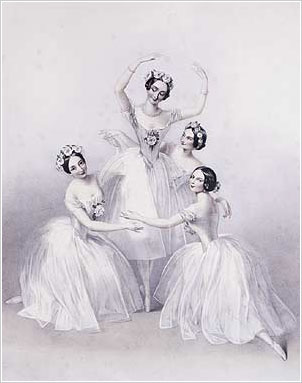


Original cast and premiere
The work was created expressly for four of the most famous ballerinas of the mid-19th century: Marie Taglioni, Carlotta Grisi, Fanny Cerrito and Lucile Grahn. Each dancer was given moments to display her particular style and technical strengths. The short piece was performed only a handful of times during its initial run—four performances in total—and the third performance was attended by Queen Victoria and Prince Albert, an endorsement that underscored the ballet's public prominence.
The arrangement of four leading stars on a single bill was unusual and required careful negotiation. Benjamin Lumley, manager of the theatre, is credited with persuading the dancers to collaborate despite strong professional rivalries. One major contemporary figure, Fanny Elssler, was not included; tensions between Elssler and Taglioni were such that Elssler had threatened to perform Taglioni's signature role from La Sylphide, and she therefore did not participate.
Form and choreography
Pas de Quatre is essentially a divertissement composed of a sequence of solos, pas de deux passages and ensemble phrases that culminate in a final group display. The choreography is designed to contrast the dancers' different qualities — lightness, bravura, expressiveness — rather than to advance a storyline. Pugni's score is concise and supportive, providing rhythmic clarity and melodic material suited to short variations and ensemble textures. Perrot arranged the order and content of the variations so that each ballerina could be presented to best advantage while preserving overall balance.
Features and historical notes
- Title meaning: pas de quatre literally means "step of four" or "dance for four".
- Original conception: a showcase rather than a narrative, common in 19th-century theatrical practice.
- Performance history: only a few original performances, but the piece acquired lasting fame because of its unique cast.
- Social context: the production highlighted both artistic collaboration and competitive star culture in ballet.
Although the original 1845 presentations were brief, Pas de Quatre has proved durable in ballet history. Over time it has been reconstructed and adapted by choreographers and historians interested in Romantic-era style, and it remains an important example of how choreography, music and star personalities combined to shape dance culture in the nineteenth century. The work is frequently cited in discussions of performance practice, costume and the cult of the ballerina, and it continues to be studied and staged in versions that seek to evoke the original spirit of its famous premiere.
Related articles
Author
AlegsaOnline.com Pas de Quatre: the 1845 Romantic ballet for four celebrated ballerinas Leandro Alegsa
URL: https://en.alegsaonline.com/art/74878