
Parable of the Mustard Seed
A New Testament parable of Jesus about small beginnings and great growth, found in Matthew, Mark, Luke, and with a variant in the Gospel of Thomas; often interpreted as a metaphor for the Kingdom of God.
The Parable of the Mustard Seed is a brief teaching of Jesus that appears in three canonical Gospels and in a non‑canonical collection of sayings. It uses the image of a very small seed that becomes a large plant to describe the unexpected or disproportionate growth of the "Kingdom" that Jesus speaks about. The story is recorded in the Synoptic Gospels: the Gospels—specifically Matthew 13:31–32, Mark 4:30–32, and Luke 13:18–19—and a related version appears in the non‑canonical Gospel of Thomas (logion 20). The three canonical accounts are short and closely related, though each writer shapes the detail slightly to fit his narrative context.
Image gallery
2 Images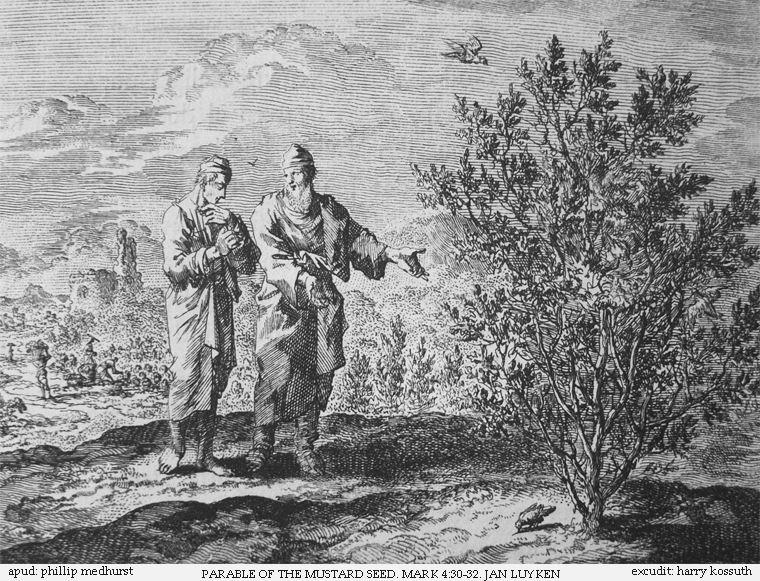

Summary and key imagery
In its typical form the parable compares the "Kingdom of Heaven" or "Kingdom of God" to a mustard seed that a sower plants. The seed is described as the smallest of seeds sown in the field, yet when it grows it becomes larger than other herbs and appears as a tree large enough to provide shelter for the birds of the air. The central images—the tiny seed, rapid growth, and sheltering branches—are meant to evoke a striking contrast between humble origin and expansive result.
Variations and textual notes
- Matthew places the parable in a collection of kingdom parables and follows it with the Parable of the Leaven, reinforcing the theme of growth from small beginnings.
- Mark preserves a similarly concise version within a set of parables told to the crowd; his wording emphasizes the sower and the seed's surprising increase.
- Luke presents the parable in a slightly different setting, often read together with other teachings on the nature of the kingdom and repentance.
- The Gospel of Thomas records a variant saying that reflects the same imagery but appears in a different literary and theological frame, showing the parable's early circulation in diverse Christian circles.
Historical and cultural context
The parable draws on agrarian experience familiar to Jesus' listeners. Mustard seeds are famously small, and mustard plants can grow into sizeable shrubs in Mediterranean climates, though they may not become trees in the strict botanical sense. In Jewish and Mediterranean oral culture, vivid botanical and agricultural similes were commonly used to teach moral and religious lessons. The short, memorable form of this parable made it effective for public instruction and transmission.
Interpretations and significance
Scholars and religious readers have offered several complementary readings of the parable. Common interpretations include:
- Esoteric or theological: The seed symbolizes the kingdom's modest origins (the ministry and small group of followers) that will expand beyond expectations.
- Social and ecclesial: The growth into a place where birds nest is read as an image of inclusion or the gathering of peoples—sometimes understood as protection, sometimes as a neutral symbol of expansion.
- Paradoxical teaching: Like other parables, it plays on irony—what is small and insignificant can become dominant—challenging assumptions about power and success.
Legacy and usage
Because of its brevity and vivid metaphor, the Parable of the Mustard Seed has been widely cited in preaching, hymnody, literature, and common speech (for example, the phrase "mustard seed faith"). It also appears frequently in art and teaching as a concise expression of hope about growth from humble beginnings. Interpretive debates persist about specific details (such as botanical exactness or the meaning of the birds), but the parable's core message—small causes can lead to great effects—remains broadly influential across Christian traditions.
For readers interested in the source texts and comparative study, consult the Gospel passages cited above: Matthew 13:31–32, Mark 4:30–32, Luke 13:18–19, and the parallel in the Gospel of Thomas. The parable's placement alongside the Parable of the Leaven in Matthew and Luke highlights a recurring theme in the Gospels: the kingdom's unobtrusive but pervasive growth.
Related articles
Author
AlegsaOnline.com Parable of the Mustard Seed Leandro Alegsa
URL: https://en.alegsaonline.com/art/74484
Sources
- gnosis.org : Lamb translation
- gnosis.org : Patterson/Meyer translation