
Panzerschreck (RPzB) — German WWII infantry rocket launcher
The Panzerschreck (Raketenpanzerbüchse, RPzB) was a reusable German infantry anti-tank rocket launcher of World War II, firing an 88 mm shaped-charge rocket and used primarily in the later stages of the war.
Overview
The Panzerschreck, formally the Raketenpanzerbüchse and often abbreviated RPzB, was a reusable infantry weapon fielded by Nazi Germany during World War II. Its name literally means "tank fright" and it fired an 88 mm calibre projectile that used a high-explosive anti-tank charge to defeat armor. As a shoulder-fired rocket launcher it occupied a role between infantry anti-armor grenades and crew-served anti-tank guns.
Image gallery
6 Images




Design and characteristics
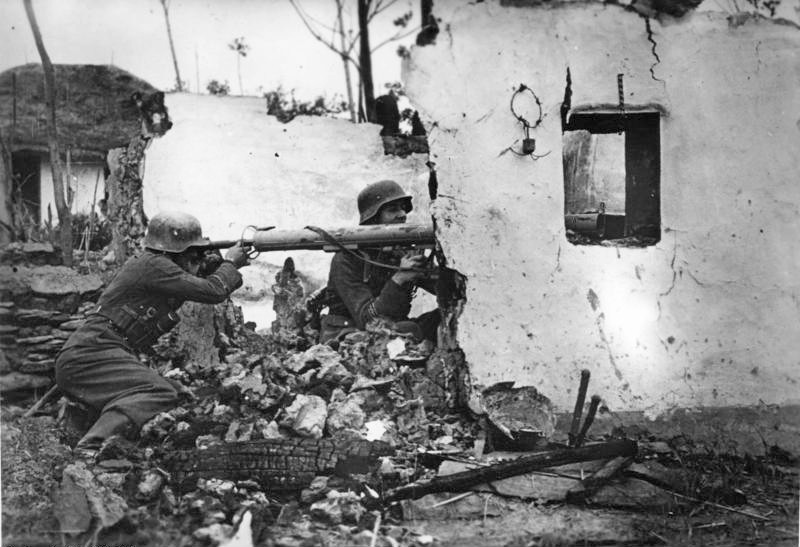
The launcher consisted of a smoothbore tubular launch tube, simple iron sights and a blast shield to protect the crew from backblast. Warheads were shaped-charge (HEAT) rounds capable of penetrating contemporary armor. The system was intended to be reused, with troops carrying replacement rockets rather than disposing of the launcher after a single shot.
- Calibre: commonly described as 88 mm for the warhead diameter (88 mm calibre).
- Propulsion: solid-fuel rocket motor producing a dangerous backblast and a visible plume on firing.
- Protection and aiming: simple sights and a small shield ahead of the tube.
History and development
Introduced in the mid-war period, the Panzerschreck was part of Germany's response to ever-improving Allied armor. It supplemented and contrasted with weapons such as the disposable Panzerfaust, offering reusability at the cost of greater weight and a larger signature when fired. Variants and incremental improvements addressed operator safety and ergonomics as the conflict progressed.
Tactical use and limitations
Infantry units used the launcher in ambushes, urban fighting and close-range anti-armor engagements where mobility and concealment mattered. Operators needed training to manage backblast and the rocket's smoke signature, which could reveal firing positions. The weapon could also be employed against fortifications and soft targets when armor penetration was not required.
Comparison, importance and legacy
Unlike a single-use grenade launcher, the Panzerschreck's reusable design required logistics for rockets but permitted sustained use by trained teams. It served alongside other anti-tank measures to give infantry a portable means to threaten armored vehicles (anti-tank role). The general concept—simple, man-portable rocket launchers with shaped-charge warheads—had a lasting influence on postwar infantry anti-armor weapons and is a subject of study in collections and military history sources (weapon, infantry, 88 mm calibre).
For more on technical details and surviving examples, see specialized references and museum catalogues that document variants and service use (Nazi Germany period sources and postwar analyses often cited in those works).
Related articles
Author
AlegsaOnline.com Panzerschreck (RPzB) — German WWII infantry rocket launcher Leandro Alegsa
URL: https://en.alegsaonline.com/art/74410