
Pangong Tso (Pangong Lake)
High‑altitude saline lake in the Himalayas spanning Ladakh and Tibet; notable for seasonal freezing, striking color changes, fragile ecology and its location along the India–China frontier.
Overview
Pangong Tso (commonly Pangong Lake) is a long, narrow saline lake located in the high Himalayas. The name includes the Ladakhi word tso, meaning "lake." It lies in a trans‑Himalayan valley and sits at high elevation, making it one of the better known high‑altitude lakes in the region. The lake attracts attention for both its dramatic scenery and its geopolitical position, as it stretches across territory administered from the Indian union territory of Ladakh into the Tibetan region administered by China (Tibet).
Image gallery
10 Images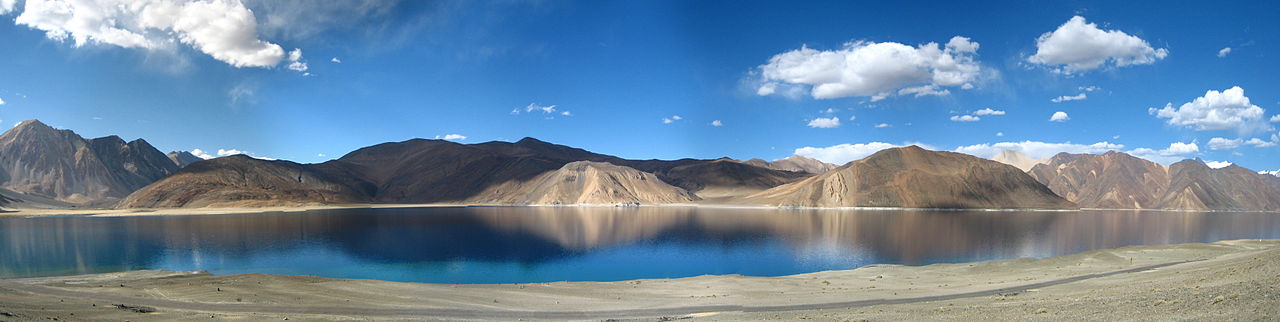


Physical characteristics
Pangong Tso is notable for several physical traits. At roughly 134 km in length and about 5 km at its widest, the lake is unusually long relative to its width. It sits at an altitude of about 4,250 metres (around 13,900 feet). Two thirds of the lake’s length lies across the border in the Tibetan region. Although the water is saline, the lake commonly freezes over during winter months because of the low temperatures at that altitude.
- Length: about 134 km
- Maximum width: around 5 km
- Elevation: approximately 4,250 m
- Hydrology: saline, largely endorheic (limited or no outlet)
Origins and geological context
The basin that contains Pangong Tso was shaped by the same tectonic forces that raised the Himalayas and by glacial and fluvial processes during past cold climates. It occupies a long intermontane trough and its present outline reflects both structural controls and sedimentary infill. Like many high‑altitude lakes, it is a remnant of complex interactions between uplift, erosion and past glaciers.
Ecology and climate
Because the lake is saline and located at high elevation, biological communities are limited and adapted to harsh conditions. Seasonal freezing and large temperature swings constrain aquatic life, but birds and some salt‑tolerant organisms make seasonal use of the lake. The water often appears in different hues at different times of day and year, a result of depth, dissolved salts and suspended sediments that influence light reflection.
Human use and significance
Pangong Tso is a popular destination for visitors, photographers and campers who come to experience its remote scenery and clear air. Access is typically from the Leh region and the area is frequented during the short summer season when roads are passable. The lake also has strategic importance because it straddles areas administered by different governments, and its shoreline has been the focus of border management and patrol activities.
Conservation and notable facts
Growing tourism and seasonal camps have created environmental pressures such as litter, disturbance to wildlife and localized pollution. Efforts to manage visitor impact emphasize waste control, regulated access and education. Pangong Tso remains culturally and visually iconic for the region, widely photographed and often mentioned in travel accounts and popular media for its stark landscape and striking colors. For linguistic or regional context see general references on the Himalayas and local administration in Ladakh and Tibet. Additional background on local names and terms can be found through resources on the Ladakhi language.
Related articles
Author
AlegsaOnline.com Pangong Tso (Pangong Lake) Leandro Alegsa
URL: https://en.alegsaonline.com/art/74362