
Northern Indo-Aryan languages (Pahari or Himalayan Indic languages)
A group of Indo‑Aryan languages spoken across the Himalayan belt — often called Pahari — including Nepali, Kumaoni, Garhwali and Dogri; shaped by geography, history and contact.

Overview
Northern Indo‑Aryan languages, commonly referred to as Pahari (from pahar, "mountain"), form a set of related Indo‑Aryan varieties spoken across the Himalayan and sub‑Himalayan region. They are not a single language but a continuum of languages and dialects found in parts of India, Nepal and Pakistan. The term "Pahari" is used in everyday speech to mean "of the mountains," and it covers multiple linguistic entities that share historical roots in the classical Indo‑Aryan tradition yet display significant local differences.
Image gallery
1 Image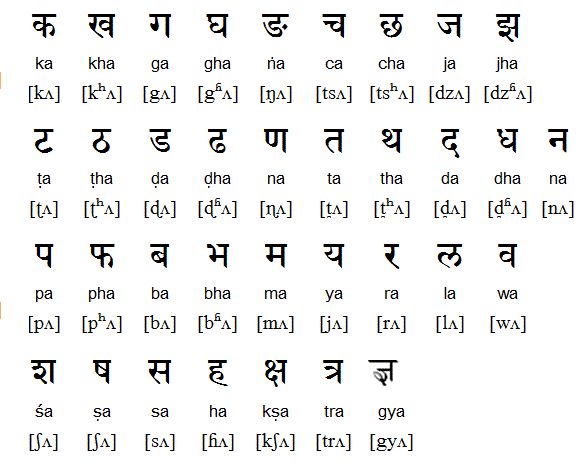
Geography and classification
These languages are distributed along the Himalayan zone from the western reaches in Pakistan and northwestern India to eastern Nepal. Linguists commonly divide the group into subzones such as Western Pahari (for example, varieties in Himachal and Uttarakhand), Central or Mid‑Himalayan varieties, and Eastern Pahari (notably Nepali). Classification is complex: some languages traditionally called "Pahari" are grouped with other Northern Indo‑Aryan branches, and scholars sometimes treat boundary cases differently.
Key characteristics
- Phonology: many of these languages retain typical Indo‑Aryan features such as retroflex consonants and contrastive aspiration, while also showing local changes influenced by terrain and contact with neighboring languages.
- Grammar: they share an Indo‑Aryan grammatical core — postpositional syntax, verb chains, and case marking — and several exhibit split ergativity in past or perfective constructions, a common trait in the family.
- Lexicon: vocabulary derives largely from Sanskrit/Prakrit sources, with layers of borrowing from Persian, Urdu and regional Tibeto‑Burman languages in zones of intense contact.
History and development
These varieties descend from Middle Indo‑Aryan (Prakrit and Apabhramsha) stages and developed under the combined effects of isolation in mountain valleys and interaction along trade and migration routes. The mountainous geography promoted fragmentation, producing a spectrum of mutually intelligible and non‑intelligible varieties. Contact with Tibeto‑Burman languages in higher elevations has left phonetic and lexical traces in many Pahari varieties.
Uses, status and examples
Some Northern Indo‑Aryan languages have high status and institutional support: Nepali is the national language of Nepal and a recognized language in India; Dogri has official recognition in India. Other varieties such as Kumaoni and Garhwali have strong community presence but limited formal support and face pressures from larger regional languages. Because of their patchy distribution, speaker numbers and literacy traditions vary widely; scripts used include Devanagari and, historically in some cases, Perso‑Arabic or local orthographies.
Distinctions and notable facts
"Pahari" is a sociolinguistic label as much as a linguistic one: it groups together mountain varieties that share cultural and geographic identity. Linguistic boundaries do not always match political borders, so closely related speech forms may be classified differently by national censuses. Scholars also distinguish Northern Indo‑Aryan from the neighbouring Dardic and Central Indo‑Aryan groups, though the divisions are subject to ongoing research.
Further reading and resources
- Overview of Himalayan languages
- Pahari language surveys
- Indo‑Aryan language family introductions
- Sociolinguistic studies of mountain communities
- Scripts and orthographies in the Himalayas
- Grammatical features of Northern Indo‑Aryan
- Language policy in South Asia
- Contact influence from Tibeto‑Burman languages
- Ethnolinguistic maps of the Himalayan region
- Comparative phonology of Pahari varieties
Note: Terminology and subgrouping vary among researchers; the label "Pahari" is widely used in everyday contexts but has multiple technical definitions in linguistics.
Related articles
Author
AlegsaOnline.com Northern Indo-Aryan languages (Pahari or Himalayan Indic languages) Leandro Alegsa
URL: https://en.alegsaonline.com/art/74007