
Orthosie (moon of Jupiter)
Orthosie (Jupiter XXXV) is a small retrograde irregular satellite of Jupiter discovered in 2001; it belongs to the Ananke group and orbits at about 20.6 million km with a period of ~603 days.
Orthosie (Jupiter XXXV) is one of Jupiter's many small, irregular moons. Discovered in 2001 by a team led by Scott Sheppard from the University of Hawaii, it is a faint, roughly 2-kilometre-wide body that follows a distant, retrograde orbit around the planet. Orthosie is catalogued as S/2001 J 9 and was given its name in 2003 after a figure from Greek mythology.
Image gallery
2 Images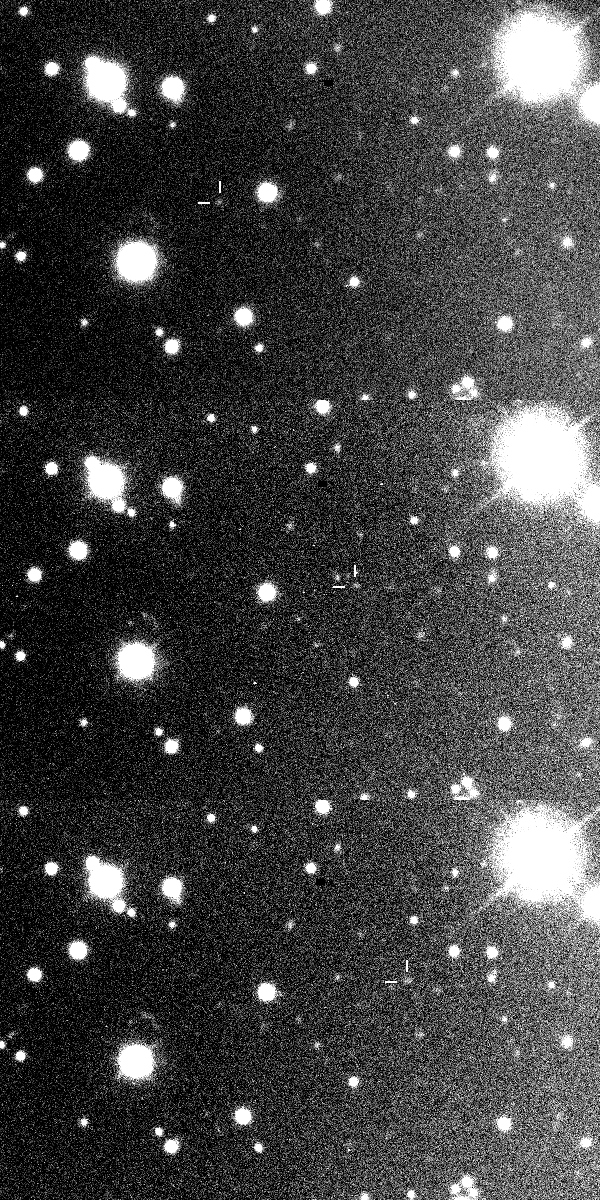

Discovery and naming
The satellite was identified in 2001 during surveys for faint Jovian companions performed by astronomers at the University of Hawaii. The discovery team is associated with several subsequent finds of small outer moons; further information about the group that made the discovery can be found via the discoverers' institutional listing at discovery team. The International Astronomical Union approved the name Orthosie in 2003, drawing from Greek mythology—Orthosie is one of the Horae, daughters of Zeus and Themis. For background on the name’s linguistic and mythological roots see the entries for Greek myth, the Horae, Zeus and Themis.
Orbital characteristics
Orthosie is an irregular, retrograde satellite: it orbits Jupiter in the direction opposite to the planet’s rotation. Key orbital parameters include:
- Average orbital distance (semi-major axis): ~20,568,000 km
- Orbital period: ~602.619 days
- Inclination: ~142° to the ecliptic (about 143° to Jupiter’s equator)
- Eccentricity: ~0.2433
These values show that Orthosie follows an elongated, inclined orbit well outside Jupiter's large regular moons. Explanations of terms such as the ecliptic and orbital eccentricity are available at ecliptic and eccentricity.
Group membership and origin
Orthosie is grouped with the Ananke family, a collection of retrograde, irregular moons that share similar orbital distances and inclinations. The Ananke group occupies orbital radii roughly between 19.3 and 22.7 million kilometres and typically has inclinations near 150°. Members of this family are thought to be fragments of a single captured and subsequently disrupted parent body, an asteroid-like object that broke up after capture by Jupiter's gravity. For an overview of the family see Ananke group.
Physical properties and significance
Orthosie is small and non-spherical, with an estimated diameter of about 2 kilometres; like other tiny outer moons, it is too small to have enough gravity to pull itself into a round shape (non-spherical). Its surface composition is not well constrained from Earth-based observations, but many irregular Jovian satellites are dark and likely composed of rock and possibly ice mixed with dust. Because it is faint and distant, detailed study requires large telescopes or spacecraft observations.
Context and comparison
Orthosie exemplifies the class of irregular satellites that populate the outer regions of giant-planet systems. Unlike the Galilean moons, which are large, regular, and formed by accretion in Jupiter's circumplanetary disk, Orthosie and its fellow Ananke members are smaller, more numerous, and believed to be captured objects. Studying such moons helps astronomers reconstruct capture events, collisional histories, and the dynamical evolution of Jupiter's satellite system.
Further reading
- Discovery details and surveys: discoverers
- Orbital frame references and inclination context: ecliptic
- Astronomical definitions: orbital eccentricity
- Mythological naming sources: Greek, Horae, Zeus, Themis
- Group classification: Ananke group
- Shape and physical notes: non-spherical
Questions and answers
Q: What is Orthosie?
A: Orthosie is a moon of Jupiter.
Q: When was Orthosie discovered?
A: Orthosie was discovered in 2001 by a team of astronomers from the University of Hawaii led by Scott Sheppard.
Q: What is the orbital distance of Orthosie from Jupiter?
A: The average orbital distance of Orthosie from Jupiter is 20,568,000 km.
Q: What is the diameter of Orthosie?
A: The diameter of Orthosie is about 2 kilometers.
Q: Who was Orthosie named after?
A: Orthosie was named after the Greek goddess of prosperity and one of the Horae.
Q: What is the inclination of Orthosie's orbit?
A: The inclination of Orthosie's orbit is 142° to the ecliptic (143° to Jupiter's equator).
Q: What group does Orthosie belong to?
A: Orthosie belongs to the Ananke group, retrograde non-spherical moons which orbit Jupiter between 19,300,000 and 22,700,000 km, at inclinations of about 150°.
Related articles
Author
AlegsaOnline.com Orthosie (moon of Jupiter) Leandro Alegsa
URL: https://en.alegsaonline.com/art/73278
Sources
- cfa-www.harvard.edu : IAUC 7900: Satellites of Jupiter
- cfa-www.harvard.edu : MPEC 2002-J54: Eleven New Satellites of Jupiter
- cfa-www.harvard.edu : IAUC 8177: Satellites of Jupiter, Saturn, Uranus