
Sagittarius (constellation) — the Archer and the Galactic Center
Sagittarius is a southern zodiac constellation representing an archer (often a centaur). It lies toward the densest part of the Milky Way and contains numerous star clusters, nebulae and the radio source Sagittarius A.
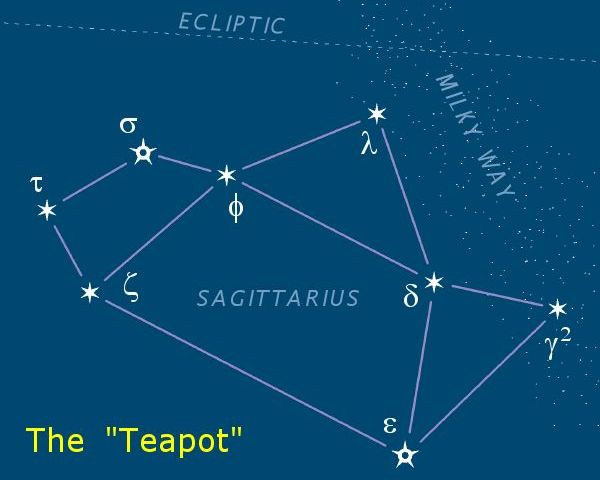
Overview: Sagittarius, Latin for "the Archer," is a prominent southern constellation traditionally depicted as a centaur drawing a bow. It is one of the twelve signs of the Western zodiac and occupies a rich region of the sky through which the plane of the Milky Way passes. Popular asterisms such as the "Teapot" make it relatively easy to recognise to the naked eye when the constellation is well placed.
Appearance and chief stars: The pattern is often described as a mounted archer; on some star charts the human upper body of the centaur is prominent while other depictions emphasise the bow. See the traditional figure of the centaur and the symbolic archer in cultural representations. Bright stars in the constellation include Kaus Australis, Kaus Media, Kaus Borealis, Ascella and Nunki, which form parts of the Teapot and the archer figure. These stars vary in brightness and type, giving the constellation a mix of blue-white and yellowish hues to observers.
Image gallery
10 Images







Notable deep-sky objects
- Dense star clouds and rich star fields: Sagittarius faces toward the galactic center, so the star density and number of faint objects are unusually high compared with many other regions.
- Open clusters and globular clusters: Among the well-known objects is the globular cluster Messier 55; it lies near delta Sagittarii and is visible in modest telescopes.
- Nebulae and bright Messier objects: The constellation hosts spectacular emission nebulae such as the Lagoon Nebula (M8), the Trifid Nebula (M20), the Omega Nebula (M17) and dense star clouds like the Sagittarius Star Cloud (M24).
- Central radio and X-ray sources: The complex radio region called Sagittarius A occupies the heart of this area. Within it, the compact component known as Sagittarius A* is associated with a massive, compact object at the centre of our galaxy that astronomers interpret as a supermassive black hole. Observations indicate a mass of several million times that of the Sun; precise values come from ongoing measurements and modelling (mass estimates).
History and cultural background: The Archer motif has roots in ancient Near Eastern and classical myth. Early star catalogues and star lore from Mesopotamia, Greece and later cultures described figures with bow and arrow near the southern horizon. In many traditions the constellation was linked with hunting, warfare or a heroic figure; medieval and renaissance star maps consolidated the centaur-archer image familiar today.
Observing tips and importance: Sagittarius is best seen from mid-northern latitudes in summer evenings and is more easily observed from the southern hemisphere. Because the region contains bright nebulae and dense star fields, it is a favourite for binoculars and small telescopes. The close proximity of the galactic centre makes Sagittarius a crucial direction for studies of the Milky Way’s structure, stellar populations, star formation regions and the dynamics around the central compact source.
Distinctions and scientific significance: Compared with other constellations, Sagittarius is notable for its combination of cultural visibility and scientific richness. It anchors observational campaigns that probe the interstellar medium, star clusters and the environment around the central compact object. For skywatchers, the Teapot and the bright nebulae provide accessible targets; for astronomers, the region offers a direct line of sight toward the heart of our galaxy and the phenomena found there.
Related articles
Author
AlegsaOnline.com Sagittarius (constellation) — the Archer and the Galactic Center Leandro Alegsa
URL: https://en.alegsaonline.com/art/85254