
Atomic clock — ultra-precise timekeeping using atomic transitions
A clock that uses the natural frequency of atomic energy transitions as its timekeeping reference; the basis of modern time standards, navigation, telecom and precision science.
Overview
An atomic clock is a timekeeper that derives its ticking from the characteristic oscillations of atoms rather than from mechanical motion or a vibrating crystal. Where mechanical devices measure macroscopic motion or quartz clocks count crystal vibrations, an atomic clock measures the frequency of radiation associated with a transition between two energy states of an atom. Because these transitions are determined by well‑defined quantum properties, the resulting time signals are extraordinarily stable and reproducible and serve as the primary references for modern timekeeping.
Image gallery
10 Images


Principle and components
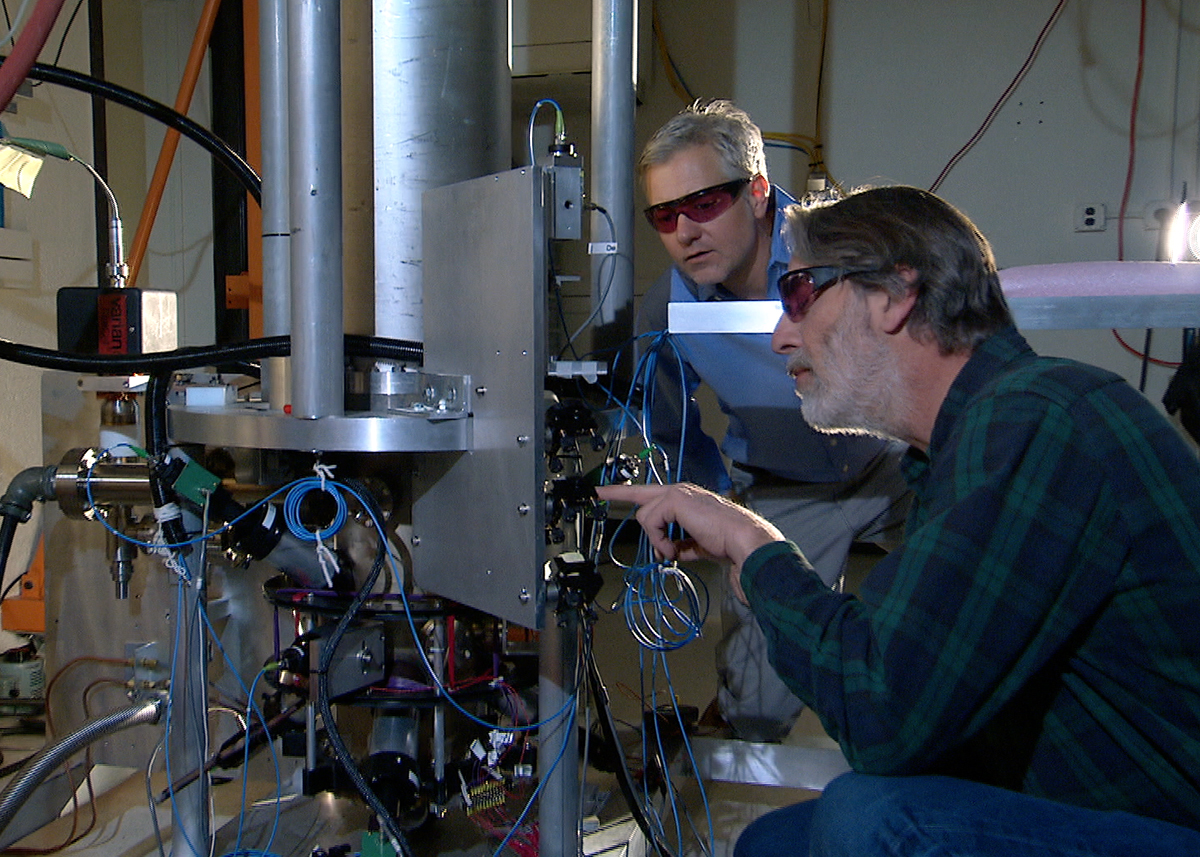
At the heart of an atomic clock is a sample of atoms or a single trapped ion interrogated by electromagnetic radiation at a precise frequency. The apparatus prepares the atoms in a particular quantum state, exposes them to an oscillating field near the transition frequency, and detects how they respond. The clock system adjusts a local oscillator to remain locked to the atomic resonance. This resonance involves changes related to electron energy levels and magnetic interactions, rooted in the quantum behavior of electrons and nuclei rather than macroscopic motion. Practical clocks include sources of atoms, state preparation and detection systems, shielding and control of environmental fields, and a feedback loop that steers the output frequency.
Common types and techniques
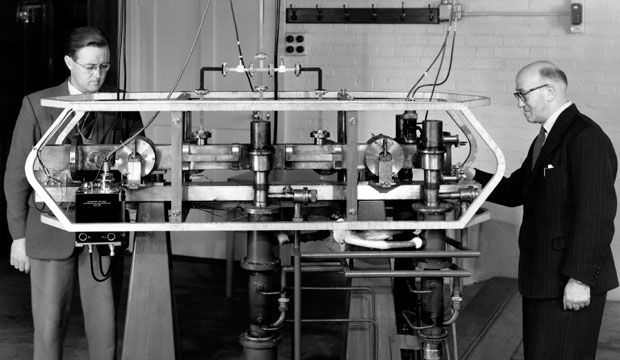
- Cesium beam and fountain clocks use the hyperfine transition of cesium-133; this transition defines the SI second and long served as the world reference.
- Hydrogen masers generate coherent microwave emission and are prized for excellent short-term stability; they are often used in ensembles with cesium standards.
- Rubidium standards are compact and cost-effective, frequently used in telecommunications and industrial systems where extreme laboratory accuracy is not required.
- Optical clocks exploit transitions at optical frequencies in atoms such as strontium, ytterbium or single ions like aluminium; these reach higher precision and stability than microwave clocks and are under active development.
Laboratory methods and improvements
Modern improvements rely on techniques from atomic physics: laser cooling and trapping reduce atomic motion, magneto-optical traps and optical lattices isolate atoms from perturbations, and ultrastable lasers provide narrow interrogation signals. Single-ion traps and neutral-atom lattice clocks differ in how they control interactions and systematic shifts, but both aim to reduce uncertainties arising from motion, electromagnetic fields, and collisional effects. Stability and accuracy are characterized using statistical measures and by comparing independent clocks to reveal and correct systematic biases.
History, standards and institutions
Foundational experimental methods were developed in mid-20th century atomic physics; Isidor Isaac Rabi made important theoretical and experimental contributions while at Columbia, and later researchers built practical cesium clocks. In 1967 the second was redefined in terms of the cesium-133 hyperfine transition (9,192,631,770 cycles of the radiation). National metrology institutes operate ensembles of primary and secondary frequency standards and submit data to the International Bureau of Weights and Measures (BIPM). The BIPM, located in Paris in France, computes International Atomic Time (TAI), an average of many atomic clocks around the world that underpins civil time scales such as Coordinated Universal Time (UTC).
Global network and coordination
There are many dozens of atomic standards maintained across multiple laboratories worldwide; contemporary counts report well over two hundred individual devices at more than sixty institutions participating in coordinated timekeeping. Data from these clocks are combined and compared to produce TAI and UTC. Leap seconds are occasionally applied to UTC to keep it close to mean solar time, and international coordination ensures traceability of distributed time signals.
Applications and significance
- Global navigation satellite systems (GNSS) rely on synchronized atomic clocks aboard satellites and on the ground to provide precise positioning and timing.
- Telecommunications, power grid synchronization, and financial networks require accurate time stamps and distribution supplied by atomic time references.
- Scientific uses include tests of fundamental physics (for example searching for changes in fundamental constants), relativistic geodesy that measures height differences via gravitational frequency shifts, and precision spectroscopy.
Current trends and future prospects
While cesium microwave clocks remain the official realization of the SI second, optical clocks have demonstrated superior performance in stability and accuracy and are strong candidates for a future redefinition of the second. Continued development aims to reduce systematic uncertainties, improve portability for field use, and network distant optical clocks via stabilized optical fibers or satellite links. The field is highly collaborative, involving national laboratories, universities and international bodies working to refine time scales and enable new technologies based on ever more precise time and frequency standards.
Notable figures
Key historical contributors include experimentalists and theorists who advanced atomic resonance techniques and developed practical clocks. The theoretical groundwork and early resonance methods are associated with researchers such as Isidor Isaac Rabi, whose work helped make atomic timekeeping possible and who was recognized with the Nobel Prize in Physics in 1944.
For broader introductions, technical standards, and current developments, authoritative resources and laboratories provide detailed references and updates on timekeeping research and international coordination efforts; see institutional pages and metrology publications linked by national institutes and international organizations.
Tags
Related articles
Author
AlegsaOnline.com Atomic clock — ultra-precise timekeeping using atomic transitions Leandro Alegsa
URL: https://en.alegsaonline.com/art/7045
Sources
- ptb.de : "The primary clocks"
- bipm.org : "BIPM"