
Nitrile (organic functional group and related compounds)
Nitriles are organic compounds containing a carbon–nitrogen triple bond (–C≡N). They occur in solvents and polymers, arise in synthesis, and vary widely in properties and toxicity.
Overview
A nitrile is an organic compound that contains the nitrile functional group, a carbon–nitrogen triple bond commonly written as –C≡N. This structural unit appears in small molecules such as acetonitrile and benzonitrile and in larger synthetic materials. The term "nitrile" may refer to the functional group itself or to any compound that contains it. For a concise reference to the group, see nitrile functional group.
Image gallery
10 Images




Structure and properties
The distinguishing feature of nitriles is the carbon–nitrogen triple bond, which gives the group a linear geometry and a strong dipole moment. The bond is often represented as –C≡N; see carbon–nitrogen triple bond for more on bonding. Physical properties vary with size: low-mass nitriles are often volatile and may have fruity or bitter-almond odors, while heavier nitriles are less volatile and more polar than corresponding hydrocarbons.
Synthesis and reactions
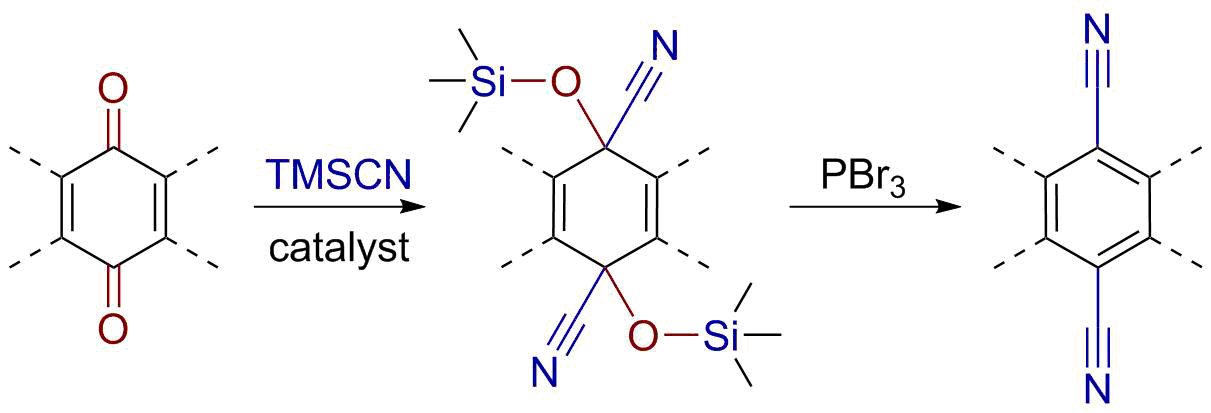
Nitriles are prepared by several common laboratory and industrial methods, including dehydration of amides, nucleophilic cyanation of alkyl halides or aryl diazonium salts, and catalytic processes that introduce the –C≡N group. Typical transformations of nitriles include hydrolysis to carboxylic acids or amides, catalytic hydrogenation to give primary amines, and addition reactions at the carbon of the triple bond.
Uses and examples
Small nitriles such as acetonitrile are valuable solvents in chromatography and organic synthesis. Benzonitrile and related aromatic nitriles are intermediates in the production of pharmaceuticals and agrochemicals. Nitrile functionality is also central to synthetic polymers: nitrile rubber (acrylonitrile butadiene rubber, NBR) is widely used for oil-resistant gloves and hoses. Industry applications and chemical details are discussed in many sources; see industrial applications.
Safety, toxicity and distinctions
Nitriles exhibit a range of toxicities. Some simple or volatile nitriles can be harmful if inhaled or ingested; many undergo metabolic conversion to compounds that can affect biological systems. This is distinct from free cyanide ion or hydrogen cyanide, which are highly toxic species. For practical handling guidance, follow material-specific precautions and consult safety considerations.
Notable facts and related classes
- Isocyanides (isocyanides or isonitriles) are structural isomers of nitriles with very different properties and typically unpleasant odors.
- Nitrile-containing pharmaceuticals and agrochemicals take advantage of the group’s electronic properties to influence bioactivity and metabolic stability.
- Because of their polarity and stability, nitriles are useful intermediates in multi-step chemical syntheses.
Related articles
Author
AlegsaOnline.com Nitrile (organic functional group and related compounds) Leandro Alegsa
URL: https://en.alegsaonline.com/art/70372