
NGC 1672 — barred spiral galaxy in Dorado
NGC 1672 is a prominent barred spiral galaxy in the southern constellation Dorado, about 60 million light‑years away, noted for its strong bar, circumnuclear ring of star formation and central activity.
Overview
NGC 1672 is a barred spiral galaxy in the southern constellation Dorado. It lies at an approximate distance of 60 million light‑years from Earth and shows a prominent stellar bar, multiple spiral arms and a bright, compact central region. Its combination of a strong bar and intense circumnuclear star formation makes it a frequent subject of observational studies across many wavelengths.
Image gallery
4 Images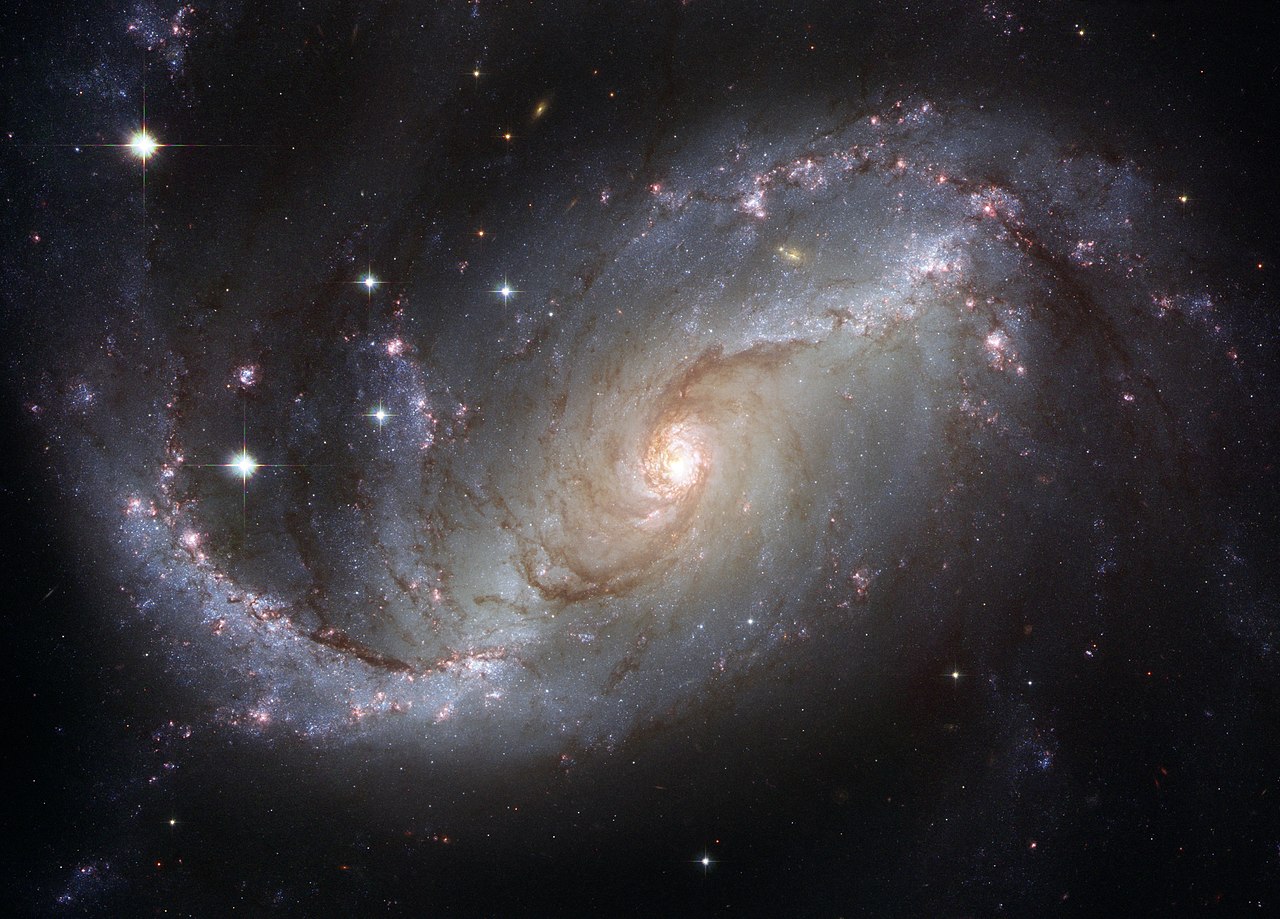


Structure and characteristics
The galaxy exhibits a long bar that connects to inner spiral arms and gives rise to an inner ring or pseudo‑ring where star formation is concentrated. A circumnuclear ring of H II regions encircles the nucleus and produces strong optical and infrared emission. Dust lanes and young star clusters trace the spiral arms, while radio and X‑ray observations highlight enhanced central emission associated with recent star formation and some nuclear activity.
Origins and scientific interest
Galactic bars are important dynamical features that redistribute angular momentum and drive gas inflows. In NGC 1672 the bar appears to channel gas toward the inner regions, feeding the circumnuclear ring and possibly contributing to whatever activity is present in the nucleus. Because the galaxy is relatively nearby, astronomers can resolve individual star‑forming clumps and compare data from optical, infrared, radio and X‑ray facilities to study the interplay between bar dynamics and central evolution.
Observations and resources
NGC 1672 is listed in the New General Catalogue and has been imaged and analysed by many observatories. High‑resolution images reveal the bar, ring and arm structure, while spectroscopy provides information about stellar populations and gas conditions. For general observing information and background material see regional constellation guides and summary pages on distance and discovery: constellation guide and distance and discovery summaries.
Visibility and significance
Best observed from the southern hemisphere, NGC 1672 is popular with both amateur astrophotographers and professional astronomers. It is frequently cited as a clear example of how bars can influence galaxy morphology and trigger central starbursts, making it useful in educational contexts and in comparative studies of barred spiral galaxies.
Related articles
Author
AlegsaOnline.com NGC 1672 — barred spiral galaxy in Dorado Leandro Alegsa
URL: https://en.alegsaonline.com/art/69859