
NGC 3603-B (HD 97950B): a massive WN6h Wolf–Rayet star
NGC 3603-B (HD 97950B) is a very massive, highly luminous WN6h Wolf–Rayet star in the HD 97950 cluster of NGC 3603, roughly 20,000 light‑years away and only a few million years old.
Overview
NGC 3603-B, also catalogued as HD 97950B, is a Wolf–Rayet star near the centre of the compact HD 97950 cluster within the NGC 3603 star‑forming complex. It is one of the most massive and luminous stars identified in the Milky Way, with current estimates indicating a present mass on the order of 132 times that of the Sun and a luminosity of roughly 2.9×10⁶ times solar. The cluster that hosts the star lies at an estimated distance of about 20,000 light‑years — a commonly quoted figure — so the object is a distant but important laboratory for studying extreme stellar physics from Earth.
Image gallery
1 Image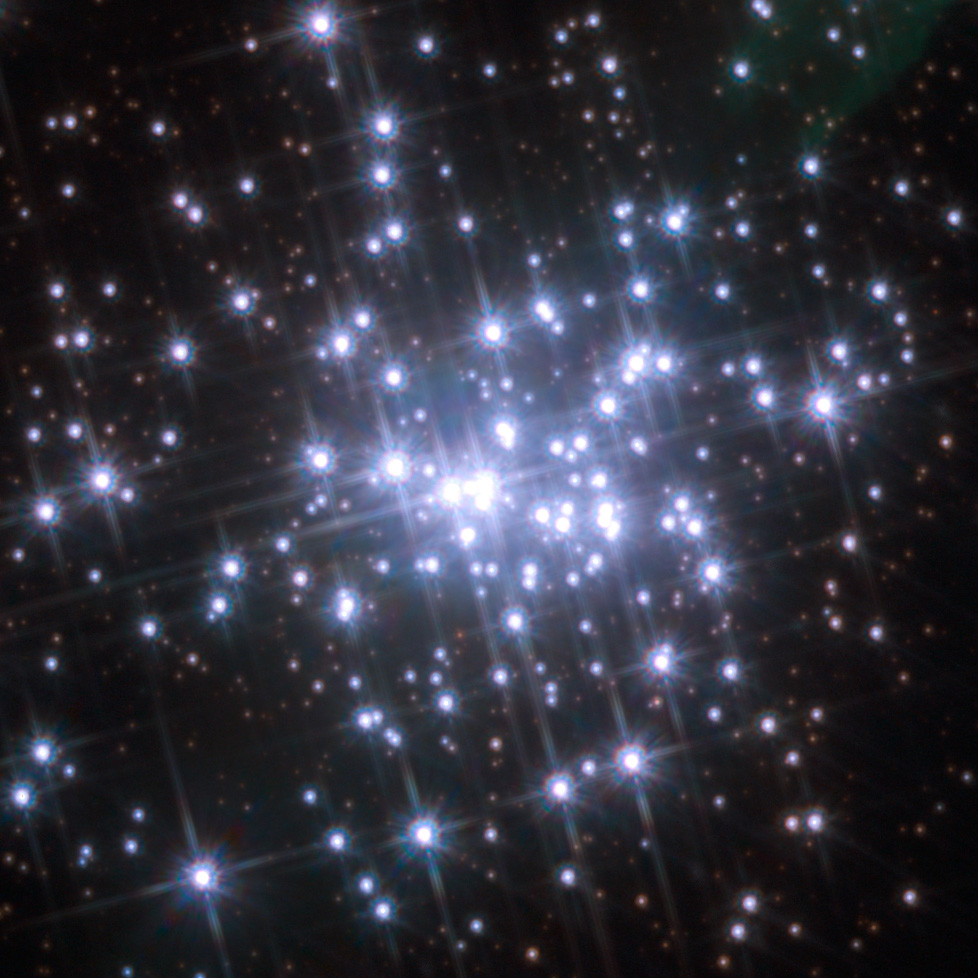
Spectral type and physical characteristics
NDG 3603‑B is classified as WN6h. The 'WN' denotes a nitrogen‑sequence Wolf–Rayet spectrum, where ionised nitrogen emission features are strong relative to ionised carbon. The numeric subtype '6' places it in the mid‑range of WN spectral characteristics, and the appended 'h' shows that hydrogen remains present in the atmosphere. Such stars are extremely hot (tens of thousands of kelvin) and drive powerful, dense stellar winds that shed mass at high rates, so although NGC 3603‑B is very young — on the order of 1–2 million years — it has already lost a significant fraction of its original mass. Its exceptional energy output places it among the most luminous stars known.
Cluster context and origin
NGC 3603‑B resides in the dense HD 97950 cluster, a compact young cluster formed in a massive molecular cloud. The cluster environment is crowded with other massive stars and strong ionising radiation, which sculpts the surrounding H II region. The star's high mass and youth indicate it formed in a recent, intense burst of star formation typical of giant H II complexes; dynamical interactions and the cluster IMF (initial mass function) shape the present population and prevalence of very massive objects.
Evolutionary state and fate
Despite the Wolf–Rayet spectral appearance, many WN6h objects are still burning hydrogen in their cores but show WR signatures because of strong mixing and extreme mass loss. Over the next few million years NGC 3603‑B will continue to lose mass and evolve off the main sequence; its final fate is expected to be a core‑collapse supernova, most likely leaving a black hole remnant. Precise paths depend on binary interactions (if present), rotation, and mass‑loss history.
Scientific importance and notable facts
- As a very massive, luminous WN6h star, NGC 3603‑B provides constraints on the upper end of stellar masses and on models of mass loss and mixing.
- Its extreme radiation helps shape and ionise the surrounding nebula, contributing to feedback processes in massive star formation regions.
- Estimates such as the current mass ≈132 M☉ and luminosity ~2.9×10⁶ L☉ are based on spectral analysis and model atmospheres; these values carry uncertainties typical for distant, heavily reddened objects.
NGC 3603‑B remains a key target for observational programs that probe the physics of the most massive stars, their winds, and their role within young massive clusters. Continued study with spectroscopy, photometry and high‑resolution imaging refines our understanding of how such titans form, evolve, and influence their environments.
Related articles
Author
AlegsaOnline.com NGC 3603-B (HD 97950B): a massive WN6h Wolf–Rayet star Leandro Alegsa
URL: https://en.alegsaonline.com/art/69863