
New Economic Policy (NEP) — Lenin's Mixed-Economy Reform in Soviet Russia
The NEP was Lenin's 1921 policy that replaced War Communism with a mixed economy: limited private trade and small business alongside state control of key industries. It revived the economy until Stalin ended it in 1928.
The New Economic Policy (NEP) was a pragmatic economic program introduced by Vladimir Lenin and the Bolshevik leadership in 1921 to address the crisis that followed the civil war and the strictures of War Communism. It aimed to stabilize the Russian economy and to restore popular support after food shortages, urban dislocation and political unrest. In brief, the NEP substituted compulsory requisitioning and full nationalization for a partial return to market mechanisms. The initiative is often described as a temporary retreat from the revolutionary effort to build immediate state socialism and instead a tactical concession to economic realities.
Image gallery
3 Images

Background and purpose
By 1920–1921 the state faced collapsing agricultural production, severe food shortages and uprisings such as the Kronstadt revolt. Lenin and other leaders judged that the policies of wartime centralization had undermined peasant incentives and ruined trade networks. The NEP was presented as a way to revive agriculture and trade without abandoning the Bolsheviks' long-term socialist aims. Lenin insisted the measure was a transitional step rather than a permanent turn to capitalism.
Key measures and characteristics
- Legalized limited private commerce and small-scale industry, allowing some private enterprise to re-emerge alongside state control.
- State retained control of the "commanding heights"—heavy industry, banking and large-scale transport—preserving a state-directed core while tolerating market activity in other sectors.
- The policy combined elements of market exchange and centralized planning; commentators describe it as a combination of private activity and socialist state control.
- Grain requisitioning was replaced by a tax-in-kind and later by monetary taxation, giving peasants an incentive to produce surplus for sale.
- The return of money and markets helped eliminate the worst of the mass starvation and famine conditions that had afflicted the country under war policies.
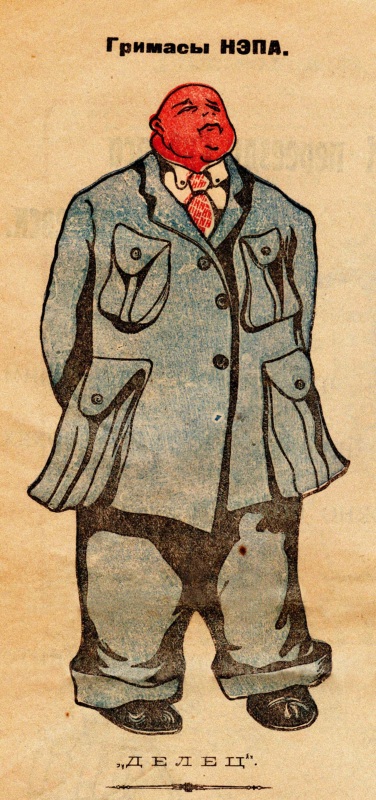
In practice the NEP produced a mixed economy often described as a partly capitalist arrangement within a state-guided framework. Small traders, nicknamed "NEPmen" by contemporaries, played a visible role in towns and markets. The policy also revived domestic trade, stabilized prices and encouraged some foreign commercial contacts, helping to revive the broader economy.
Political debate, limits and end
Within the Bolshevik party the NEP provoked controversy. Some viewed it as a necessary short-term measure; others feared it would reinvigorate capitalist social relations and undermine socialist transformation. Lenin defended the approach as tactical. After Lenin's death, political competition intensified and by 1928 Joseph Stalin and his allies moved to abolish the NEP, launching forced collectivization and the first Five-Year Plans that reasserted state control and rapid industrialization.
Historians regard the NEP as a pragmatic, if temporary, compromise that helped prevent state collapse, restored markets and eased social tensions in the 1920s. Its legacy is debated: it demonstrated both the limits of market mechanisms under a revolutionary government and the tensions between short-term recovery and long-term ideological objectives.
Further reading and archival sources can shed more light on specific measures, the experience of peasants and urban workers, and the NEP's regional variations. For overviews and primary documents see resources linked here: War Communism overview, Russian economic context, NEP policy summaries, debates about mixed economies, private enterprise under NEP, state control, socialist theory, partly capitalist economy, famine history, food crisis analyses, economic recovery studies, Stalin and the end of NEP.
Related articles
Author
AlegsaOnline.com New Economic Policy (NEP) — Lenin's Mixed-Economy Reform in Soviet Russia Leandro Alegsa
URL: https://en.alegsaonline.com/art/69501