
Chevrotain (mouse deer) — small forest ungulates of Tragulidae
Chevrotains, commonly called mouse deer, are the tiniest even-toed ungulates. Found mainly in Asian forests and by a single African species, they are secretive browsers with distinctive tusks and timid behavior.
Overview
Chevrotains, often called mouse deer, are a group of very small, hoofed mammals in the family Tragulidae. They are among the smallest of the even-toed ungulates and are notable for their discreet, solitary habits and rapid, zig-zag flight when startled. Though commonly associated with Asian forests, the family includes species with different ranges and ecological preferences.
Image gallery
10 Images


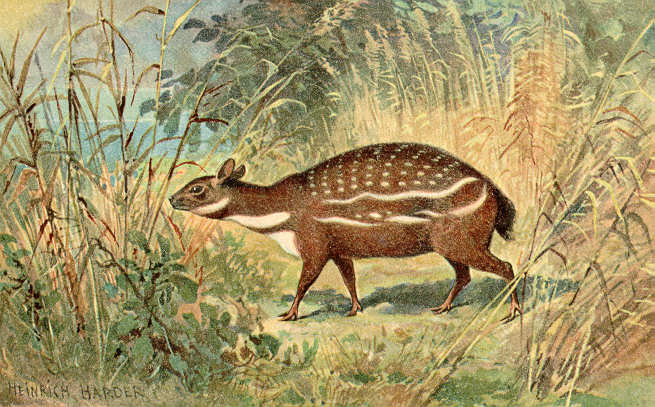

Anatomy, appearance and behaviour
Chevrotains have compact bodies, slender legs and a pointed snout. Unlike many larger deer, they do not grow antlers; instead, many males possess elongated canine teeth that resemble small tusks and are used in displays or fights. Their feet are cloven like other artiodactyls, and when alarmed they often stamp or tap the ground as a warning signal before running. They are characteristically shy and tend to freeze when surprised, then flee through dense undergrowth in an erratic pattern.
Key characteristics
- Very small size; often compared to a hare or rabbit — see a size comparison here.
- Males frequently have elongated upper canines instead of antlers.
- Solitary or paired; primarily crepuscular or nocturnal in many species.
- Diet consists mainly of leaves, fruits and other forest understory plant material.
Taxonomy and distribution
The family Tragulidae includes several genera such as Tragulus, Moschiola and Hyemoschus. Most species occur in South and Southeast Asia, with one distinct water-oriented species native to parts of West and Central Africa. For general range information see distribution maps. Because they are small and secretive, chevrotains are often overlooked in surveys and their true distributions can be under-recorded.
Ecology, conservation and importance
Chevrotains play a role as seed dispersers and as prey for medium-sized forest predators. Several species face pressure from habitat loss, hunting and fragmentation; consequently, some are considered vulnerable or threatened. Their quiet presence in forest ecosystems is an indicator of intact understory habitat, and they are a subject of interest for mammalogists studying the evolution of ruminant-like ungulates.
Cultural notes and notable facts
In parts of Southeast Asia, the mouse deer appears in folklore and fable as a clever or trickster figure. Naturalists also draw attention to chevrotains as primitive or basal among the ruminant lineage, retaining anatomical features that differ from larger, more familiar deer and antelope. For behavioral descriptions and field observations, consult sources on their signaling and escape responses here.
Related articles
Author
AlegsaOnline.com Chevrotain (mouse deer) — small forest ungulates of Tragulidae Leandro Alegsa
URL: https://en.alegsaonline.com/art/67165