
Millennium Island (Caroline Atoll)
Millennium Island, formerly Caroline Island, is an uninhabited atoll in the Southern Line Islands of Kiribati, noted for its intact tropical ecosystems, seabird colonies, and protected status.
Overview
Millennium Island is the informal name for Caroline Atoll, a low-lying atoll in the central Pacific Ocean. It belongs to the Republic of Kiribati and lies among the Southern Line Islands. The atoll is remote and uninhabited today; its modern name commemorates the role the atoll played in celebrations around the year 2000 when Kiribati adjusted the international date line so some of its islands would be among the first land to enter the new millennium.
Image gallery
10 Images





Geography and physical characteristics
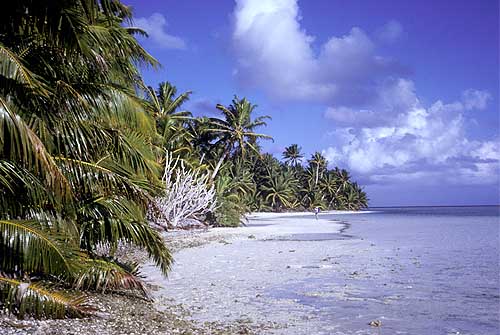
Caroline Atoll comprises about 39 separate islets or motu that fringe a shallow central lagoon. The combined land area of the islets is roughly 400 hectares while the atoll encloses an area of about 24 square kilometres. The rim of coral reef and sandy cay formation is typical of tropical atolls: narrow vegetated strips of land, interspersed with openings to the lagoon, and a reef matrix that supports marine life and buffers the lagoon from the open ocean.
Ecology and wildlife
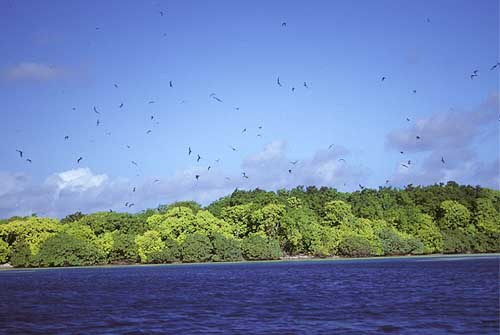
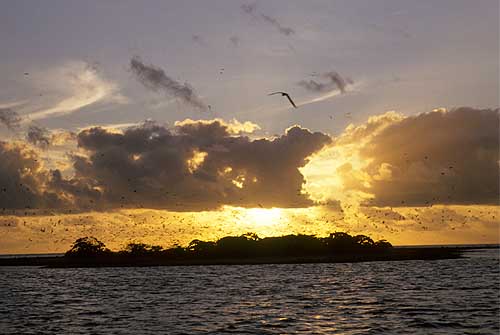
The atoll is one of the more intact tropical island ecosystems in the Pacific. It provides nesting and roosting habitat for large numbers of seabirds, making it an internationally important breeding site; species commonly reported include huge colonies of sooty terns and other pelagic birds. The motus also support one of the world’s denser populations of the terrestrial coconut crab. Because few invasive predators are established across much of the atoll, its bird colonies and native vegetation remain comparatively healthy and extensive.
History and human use
European navigators first recorded the atoll in the early 17th century, with a known sighting in 1606. In the 19th century it attracted transient activities such as guano collection and later limited copra harvesting; governments and private interests laid informal claims over Pacific islands during that era, and Caroline was formally claimed by the United Kingdom in the 19th century. The atoll became part of independent Kiribati when that nation was established in 1979. Historical disturbance was intermittent and on a small scale, so much of the island's native ecology was preserved despite occasional human presence and guano or coconut exploitation.
Conservation, protection and significance
The Kiribati government and international partners have recognized Caroline’s conservation value. The atoll is designated as a wildlife sanctuary and is managed to limit disturbance to seabird colonies and vulnerable species. In 2014 Kiribati established a 12-nautical-mile fishing exclusion zone around the southern Line Islands, including Millennium (Caroline), Flint, Vostok, Malden and Starbuck, to protect marine resources and adjacent ecosystems. Some nearby islands such as Flint and Vostok lie a few hundred kilometres to the west of Caroline; a more distant regional reference point is Papeete, Tahiti, which lies to the south by several hundred kilometres.
Notable facts and current concerns
- Renaming: the atoll is commonly called Millennium Island following Kiribati’s decision around the turn of the 21st century to highlight these islands’ position relative to the date line.
- Wildlife importance: major breeding colonies of seabirds and abundant coconut crabs make it an ecological hotspot in the central Pacific.
- Protected status: designated as a wildlife sanctuary and included in a regional fishing exclusion to reduce human pressure.
- Ongoing threats: like all low atolls, it is vulnerable to sea-level rise, changes in storm patterns, invasive species and the broader impacts of climate change on coral reefs and fisheries.
Access to Millennium Island is tightly controlled and usually limited to scientific teams and conservation missions. Continued monitoring and protection are essential to maintain the atoll’s unusually intact flora and fauna and to conserve its role as a refuge for seabirds and other Pacific species.
For more general background on atolls and Pacific island ecology, see resources on coral atoll formation and island conservation efforts: atoll information, Pacific region overview, and governance or treaty context at national portals: Kiribati and the Southern Line Islands. Additional reading on species and human history can be found through references focused on island wildlife: seabird conservation and island crustaceans such as the coconut crab.
Related articles
Author
AlegsaOnline.com Millennium Island (Caroline Atoll) Leandro Alegsa
URL: https://en.alegsaonline.com/art/65024