
Millook: Folded Cliffs and Geological Significance on Cornwall's North Coast
Millook is a coastal locality in north Cornwall known for dramatic chevron folds in Devonian–Carboniferous rocks, formed during the Variscan orogeny and valued for teaching, research and coastal geology appreciation.
Millook is a coastal locality on the north coast of Cornwall celebrated for its spectacular exposed cliffs and vivid record of deformation. The site is widely cited in geological accounts and was included by the Geological Society among Britain’s most notable sites for structural geology (listing). Millook provides a compact, accessible example of processes that normally operate on much larger tectonic scales.
Image gallery
3 Images

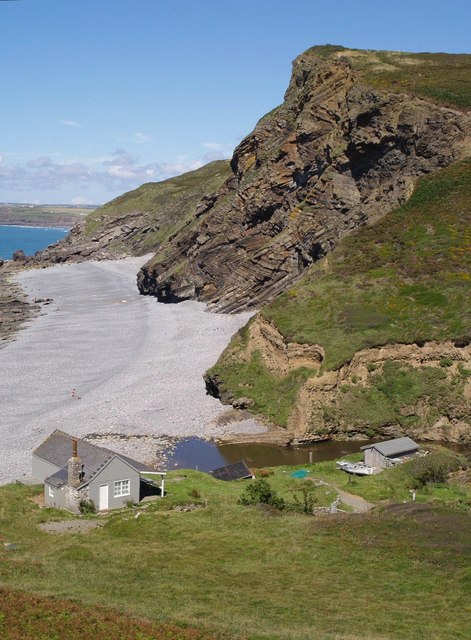
Visible structures and rocks
The cliffs at Millook display a striking sequence of tight chevron folds and associated minor faults and cleavage. These V‑shaped fold sets are readily visible in the cliff faces where repeated layers of sedimentary rock stand out as alternating bands. Field evidence indicates the original beds were deposited in deep water during the later Paleozoic and are identified as sediments of the Devonian and Carboniferous periods. In places the folded sandstones and siltstones contain marine fossils such as brachiopods, which help constrain the age and depositional environment and are referenced in specialist work (fossil reports).
Metamorphism, intrusion and mountain building
Millook’s present character reflects both deformation and thermal alteration. During late Paleozoic mountain building the region experienced the effects of the Variscan orogeny, which compressed and shortened the crust. At roughly the same time hotter magmas emplaced granitic bodies beneath the surface; these intrusions are commonly referred to in geological writing as granite intrusions and are part of the larger batholithic complexes that affected nearby counties such as Devon and Cornwall. Heat from those intrusions caused local contact metamorphism and recrystallisation of some beds, producing the altered lithologies seen today (contact zones).
Tectonic context and wider significance
Although Millook is a local coastal outcrop, it records the effects of a major continental collision between northern landmasses often grouped as Laurussia (also called Euramerica) and southern masses such as Gondwana. This long‑running convergence contributed to the assembly of the late Paleozoic supercontinent commonly named Pangaea. In that larger context Millook represents a small but well preserved portion of the crust that experienced folding, faulting and intrusion during the Variscan episode.
Scientific and educational value
Millook is important for teaching and field mapping because its structures are clear and accessible in a relatively small area. Students and researchers use Millook to illustrate fold geometry, strain patterns and relationships between igneous intrusion and metamorphism. Descriptions of the site and its fossils appear in geological guides and summaries (site notes), helping to make the locality a standard example in structural geology and sedimentary basin studies.
Visiting, safety and conservation
The cliffs attract geologists, photographers and walkers interested in coastal geology, but safety is essential. Coastal exposures are subject to rockfalls and rapid tidal changes; visitors are advised to remain well back from the cliff base, to check tide times and to follow local advice and access guidance (visitor information). Because geological features are non‑renewable, conservation guidance discourages careless collecting and encourages recording rather than large‑scale removal of specimens. Local conservation organisations and landowners work to balance access with protection (local stewardship).
Practical notes and further reading
Millook is often visited as part of broader field trips that include other Variscan localities in south‑west Britain. Field guides and regional summaries provide maps, parking and approach details and explain how the outcrop fits within the regional stratigraphy (guide). Researchers wishing to study the site in detail usually consult published papers, geological survey maps and fossil records (records), and sometimes contact local earth science groups or university departments for advice (academic contacts). Additional resources on fold mechanics, contact metamorphism and Variscan geology are available in standard texts and online summaries (technical summaries).
- Representative chevron folds and tight bedding at Millook provide clear examples for structural analysis (examples).
- The sequence links sedimentation, fossil evidence and subsequent igneous and tectonic processes within a short coastal exposure (regional links).
- It remains a useful location for field teaching, photographic study and public education about mountain‑building and coastal geology (education).
Questions and answers
Q: Where is Millook located?
A: Millook is located on the north coast of Cornwall.
Q: What made the cliffs at Millook famous?
A: The cliffs at Millook were famous because they were voted by the Geological Society as one of Britain's top 10 geological sites, coming top of the "folding and faulting" category.
Q: What type of folds do the cliffs at Millook have?
A: The cliffs at Millook have a series of horizontal chevron folds.
Q: What type of rocks were the cliffs at Millook made of originally?
A: The rocks were originally sedimentary rocks that were laid down in deep water during the Devonian and Carboniferous periods.
Q: What caused the alteration of the rocks at Millook?
A: The rocks at Millook were altered by heat from granite during mountain building in the English counties of Devon and Cornwall.
Q: What caused the intense pressure on the sediments that resulted in the folding and faulting of the rocks at Millook?
A: The Variscan orogeny caused the intrusion of the hot granite, which subsequently put intense pressure on the sediments causing them to be folded and faulted.
Q: What was the cause of the mountain system that the cliffs at Millook are a part of?
A: The mountain system that the cliffs at Millook are a part of was caused by a continental collision between Euramerica (Laurussia) and Gondwana, which formed the supercontinent of Pangaea.
Related articles
Author
AlegsaOnline.com Millook: Folded Cliffs and Geological Significance on Cornwall's North Coast Leandro Alegsa
URL: https://en.alegsaonline.com/art/65058
Sources
- bbc.co.uk : "Chart-topping rocks: UK's 'Greatest Geosites' announced"
- doi.org : 10.1016/j.jsg.2007.03.010