
Mikoyan MiG-27
Soviet-era ground-attack aircraft derived from the MiG-23, introduced in the mid-1970s and used for low-level strike missions by several air forces until late 2010s.
Overview
The Mikoyan MiG-27 is a single-seat, variable-geometry wing combat aircraft developed in the Soviet Union as a dedicated ground-attack derivative of the MiG-23 family. Conceived to perform close air support and interdiction tasks, the MiG-27 traded some air-to-air capability for improved targeting, armor and weapons-carrying arrangements optimized for low-altitude strikes. Its service life began in the mid-1970s and it served with a number of Soviet and export air forces for several decades.
Image gallery
10 Images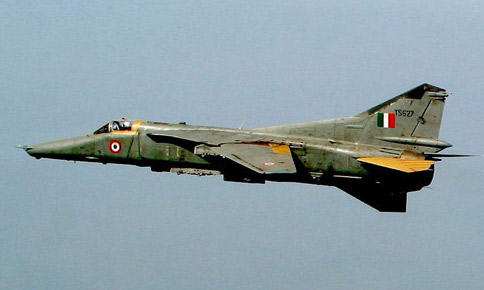


Design and characteristics
The MiG-27 retained the swing-wing layout and basic fuselage of the MiG-23 but incorporated a substantially redesigned nose, avionics suite and weapons bay tailored for strike missions. The nose contained electro-optical and laser-ranging equipment for target acquisition rather than the larger long-range radar found on air-superiority fighters. The airframe was strengthened for higher loading during low-level flight and equipped with multiple external hardpoints to carry bombs, rockets, guided munitions and fuel tanks. An internal automatic cannon provided a built-in port for strafing and ground-attack runs.
Development and variants
MiG-27 production produced several versions with incremental improvements to avionics, navigation, targeting systems and structural features for different export customers. Some variants emphasized improved forward-looking sensors and optical targeting, while export models sometimes received downgraded systems for export control reasons. The type is commonly identified in Western sources by the NATO reporting name "Flogger," used for the broader family derived from Mikoyan designs. The Mikoyan design bureau continued to offer upgrades over the aircraft’s operational life to extend its utility.
Operational history
The MiG-27 was widely used in the Soviet inventory for battlefield strike and saw notable employment in the Soviet–Afghan War, where its low-level delivery capability and heavy ordnance load made it suited to interdiction and close support. Export customers included several Warsaw Pact and non-aligned states; one of the last major operators, the Indian Air Force, used the MiG-27 for decades before retiring the type from frontline service in 2019. Across its operational career, the aircraft flew attack sorties in a variety of regional conflicts, where its role was primarily to suppress ground targets rather than seek air-to-air engagements.
Operators and legacy
- Primary operator: Soviet Air Force (and later successor services during the early post-Soviet period).
- Export customers: multiple countries acquired variants for strike duties; over time most operators phased the type out in favor of newer multirole platforms.
- Legacy: the MiG-27 demonstrated the Soviet approach to specialized strike aircraft—prioritizing survivability, ordnance payload and sensors for battlefield attack. Several air forces replaced it with multirole fighters and dedicated strike aircraft offering modern precision-guided weapons.
Notable facts and distinctions
The MiG-27 is distinguished from the MiG-23 primarily by its forward fuselage and mission fit; whereas the MiG-23 was designed with a stronger air-to-air focus, the MiG-27 sacrificed some radar and interception capability to incorporate targeting optics, a reinforced structure and larger weapons load for low-altitude operations. For further technical and historical reference, see material from the Mikoyan design bureau and contemporary aerospace analyses.
Related articles
Author
AlegsaOnline.com Mikoyan MiG-27 Leandro Alegsa
URL: https://en.alegsaonline.com/art/64900